A desert full of whales
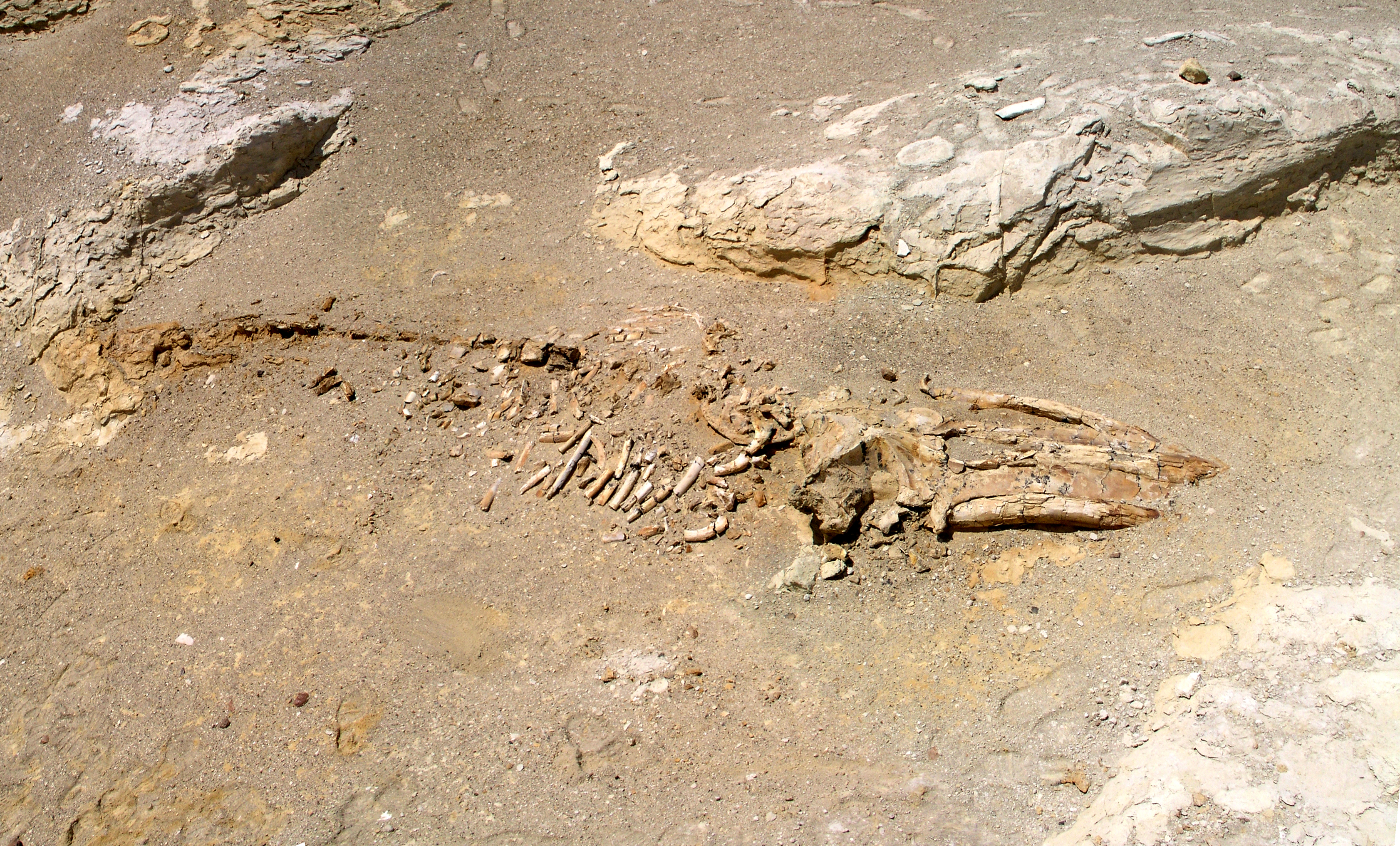
In the coastal desert of southern Peru, the Pisco Formation holds one of the world's most remarkable fossil assemblages. It is a Cenozoic marine Fossil-Lagerstätte, a site known for exceptional preservation and a high concentration of fossils. Hundreds of fossilized whale skeletons are scattered throughout an 80-meter-thick layer of diatomaceous sediment. These are not the remains of individual beachings over millennia; they are evidence of repeated, catastrophic mass death events that occurred between 6 and 9 million years ago.
The whales did not die on a beach. Taphonomic analysis shows the skeletons are randomly oriented, consistent with carcasses sinking to the bottom of a protected bay rather than being stranded ashore. Most skeletons are found articulated or with their bones closely associated, indicating they were buried quickly, before currents or scavengers could scatter the remains. The fine-grained sediment, composed of the silica skeletons of microscopic algae called diatoms, entombed the animals rapidly. This rapid burial is the reason for their preservation. It prevented colonization by invertebrates that typically break down carcasses on the seafloor; the surrounding sediments show no evidence of bioturbation, or churning by organisms.
The likely cause of these mass deaths is the very algae that preserved the skeletons. Scientists propose that periodic, toxic algal blooms poisoned the whales and other marine life. Modern-day harmful algal blooms can kill marine mammals that consume contaminated fish. Orange blotches found on some of the fossil bones are thought to be the mineralized remnants of the algal mats that grew on the carcasses. Evidence suggests this was not a single event, but a series of at least four distinct mass mortality episodes that occurred over thousands of years.
An ancient ecosystem entombed
The Pisco Formation provides a detailed snapshot of a complete marine ecosystem. Baleen whales are the most abundant large fossils, and they are not the only ones. The site contains many Miocene marine vertebrates. Paleontologists have identified extinct species of sperm whales, pinnipeds (seals), and various dolphins. One unusual find is an extinct "walrus-whale," a dolphin that had a tusked, walrus-like face.
In addition to marine mammals, researchers have found fossils of sharks, billfish, and sea turtles. Teeth from the gigantic shark Carcharocles megalodon are found here, sometimes embedded in whale bones, indicating scavenging or predation. The fossils also include seabirds and an unexpected discoveries: an aquatic sloth. This species, Thalassocnus, was a giant sloth that had adapted to a marine lifestyle.
The preservation is unusual that it extends to rarely fossilized materials. In at least five whale specimens, portions of their baleen were preserved. Baleen is made of keratin, the same protein in human fingernails, and typically decays long before fossilization can occur. Its presence shows the incredibly rapid and gentle burial process within the diatomaceous ooze, which protected even delicate organic structures from decomposition. This level of preservation has made the Pisco Formation one of the most important sites for studying the evolution of marine life.