The collection in the desert
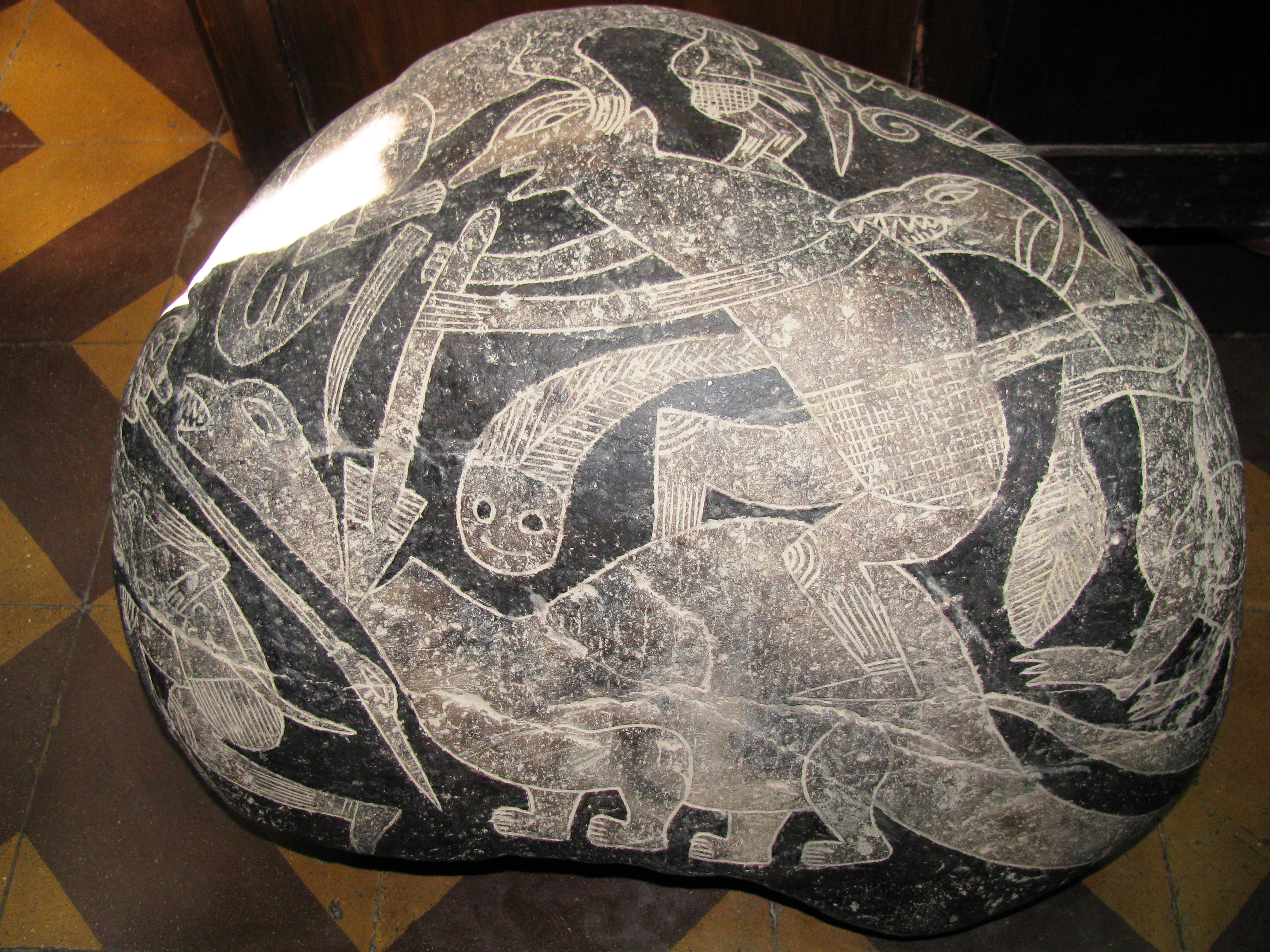
In the 1960s, Peruvian physician Javier Cabrera Darquea began collecting thousands of unusual artifacts from the Ica region of Peru. He received his first stone as a birthday gift in 1966. His collection eventually grew to over 11,000 stones, which he housed in a private museum he opened in 1996. The stones are andesite river rocks, smoothed by erosion and covered in a dark patina of natural oxidation.
The carvings etched into this dark layer depict astonishing scenes. Many show humans interacting with dinosaurs—hunting them, or even riding them. Species like Triceratops, Stegosaurus, and various sauropods appear alongside people. Other stones show what appears to be advanced medical knowledge, including complex surgeries like heart transplants and brain surgery. Still others show technological devices like telescopes. Cabrera believed these stones were a library left by an ancient, highly advanced civilization that coexisted with dinosaurs. His collection consists of stones ranging from small pebbles weighing 15-20 grams to large boulders of 500 kilograms.
A farmer's confession
The primary source for most of Cabrera's collection was a local farmer named Basilio Uschuya. As the stones gained notoriety, they attracted the attention of the Peruvian government, because the sale of national antiquities is illegal. After being arrested, Uschuya confessed that he and his wife had carved the stones themselves. In a 1977 BBC documentary, he demonstrated his method, using a dentist's drill to etch designs he copied from comic books, textbooks, and magazines. To create a fake patina and give the stones an aged appearance, he baked them in cow dung.
Scientific analysis supports the forgery claims. While the andesite stones themselves are ancient, microscopic examination of the carved grooves reveals they are fresh and lack the weathering one would expect from genuine ancient artifacts. Many of the dinosaur depictions are based on outdated paleontological reconstructions popular in the mid-20th century. For instance, some dinosaurs are shown with anatomies, such as sprawling legs or dragging tails, that modern science knows to be incorrect. Some of the creatures depicted, like ceratopsians, are not known to have lived in South America.
A kernel of authenticity?
While the fantastic scenes of dinosaurs and surgery are confirmed forgeries, the story is not entirely simple. The practice of engraving stones is known in pre-Columbian Peruvian cultures. Engraved stones were first reported in the region by Spanish chroniclers in the 16th century. Some archaeologists believe that a small fraction of the Ica stones, particularly those with simpler geometric or animal designs consistent with known pre-Columbian art, may be authentic.
These potentially genuine artifacts are separate from the thousands of fakes produced by Uschuya and others for the tourist trade. The problem for archaeologists is that the massive influx of forgeries has made it nearly impossible to identify and study any potentially real artifacts in a reliable context. The tens of thousands of fakes have contaminated the archaeological record, creating a mystery that is part modern hoax and part obscured local history.