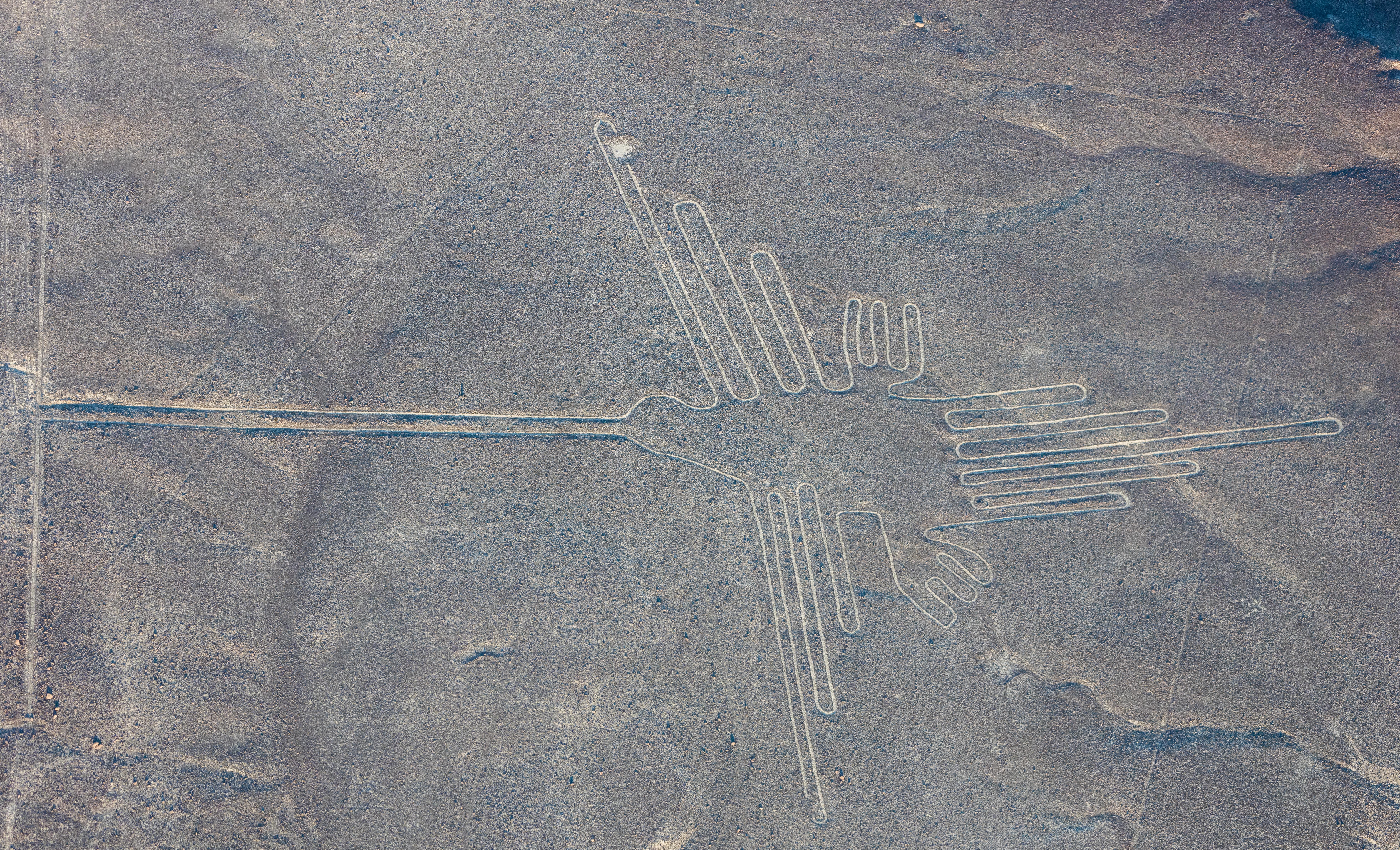
A 93-meter hummingbird etched into desert pavement 2,000 years ago by removing dark stones to expose lighter ground beneath. The Nazca people created over 70 animal figures visible only from above. Long before flight existed.
Diego Delso, CC BY-SA 4.0
A Negative Impression
The Nazca Lines Hummingbird is a negative geoglyph, a design formed by taking something away. The Nazca people created this 93-meter-long figure between 500 BCE and 500 CE by removing the dark, reddish-brown pebbles that cover the desert floor. These stones are coated in iron oxide from millennia of exposure. Removing this thin, dark layer—only 10 to 15 centimeters deep—exposed the lighter, yellow-grey subsoil of sand and clay beneath. The result is a continuous outline that appears drawn onto the earth.
The extremely stable and arid climate of the Nazca Desert is the reason this shallow etching has survived for two millennia. With minimal rain and wind, the delicate contrast between the dark desert pavement and the exposed lighter ground remains almost perfectly preserved. The entire figure, which spans 66 meters from wingtip to wingtip, was executed as a single, unbroken line, showing a sophisticated understanding of large-scale design.
An Avian Out-of-Towner
Scientific analysis of the hummingbird figure has produced a discovery: the bird depicted is not native to the Nazca desert region. Ornithological studies compared the geoglyph's features—its long beak and distinctively long, pointed tail—with bird species found in Peru. The analysis concluded that the figure does not represent a local hummingbird. Instead, it strongly resembles a hermit (Phaethornis genus), a type of hummingbird found in the humid forests of the Andean foothills and the Amazon basin, hundreds of kilometers away.
This identification of an exotic species shows the Nazca people's world. It suggests contact, trade, or knowledge of distant ecological zones. The choice of a forest bird also supports theories about the lines' purpose. In Andean cultures, hummingbirds are frequently associated with water, rain, and fertility. For a society dependent on agriculture in one of the driest places on Earth, invoking a symbol connected to water would have been a constant concern.
Celestial Map or Ritual Path?
The purpose of the Nazca Lines has been the subject of scientific debate for decades. German mathematician Maria Reiche, who dedicated her life to studying the lines, proposed that they formed a massive astronomical calendar. She suggested that the hummingbird's long beak, along with an adjacent set of straight lines, aligns with the sunrise on the winter solstice.
Another prominent theory, advanced by anthropologist Johan Reinhard, connects the lines to water rituals. This hypothesis posits that the geoglyphs were not meant to be seen from above by humans, but were created as sacred paths for ceremonial processions. These rituals were likely directed at mountain deities who were believed to control the weather and water supply. The animal figures, like the exotic, water-associated hummingbird, would have been powerful symbols in these pleas for agricultural fertility. The two theories are not mutually exclusive; the lines may have served multiple ceremonial and astronomical functions for the Nazca people.
💡Fun Facts
The hummingbird geoglyph is drawn in a single, continuous line that never crosses itself.
The species depicted is likely a hermit hummingbird, which lives in the tropical forests on the other side of the Andes mountains.
Maria Reiche, the lines' most famous researcher, spent decades cleaning the sand and stones from the geoglyphs using a simple household broom to protect them.
The dry and windless climate of the Nazca desert has preserved the shallow 15-centimeter-deep etchings for nearly two millennia.
Scenic flights over the lines typically run daily from 8:00 AM to 4:00 PM, with morning flights recommended for less turbulence.
Admission
Viewing the Hummingbird requires chartering a scenic flight, with prices varying by operator. A nearby observation tower provides a limited view of the Tree and Hands figures for a small fee, but not the Hummingbird.
Accessibility
The geoglyphs are a protected UNESCO World Heritage Site and cannot be walked on. Viewing is done from small aircraft, which may have accessibility limitations. The observation tower is a multi-story metal structure with stairs.