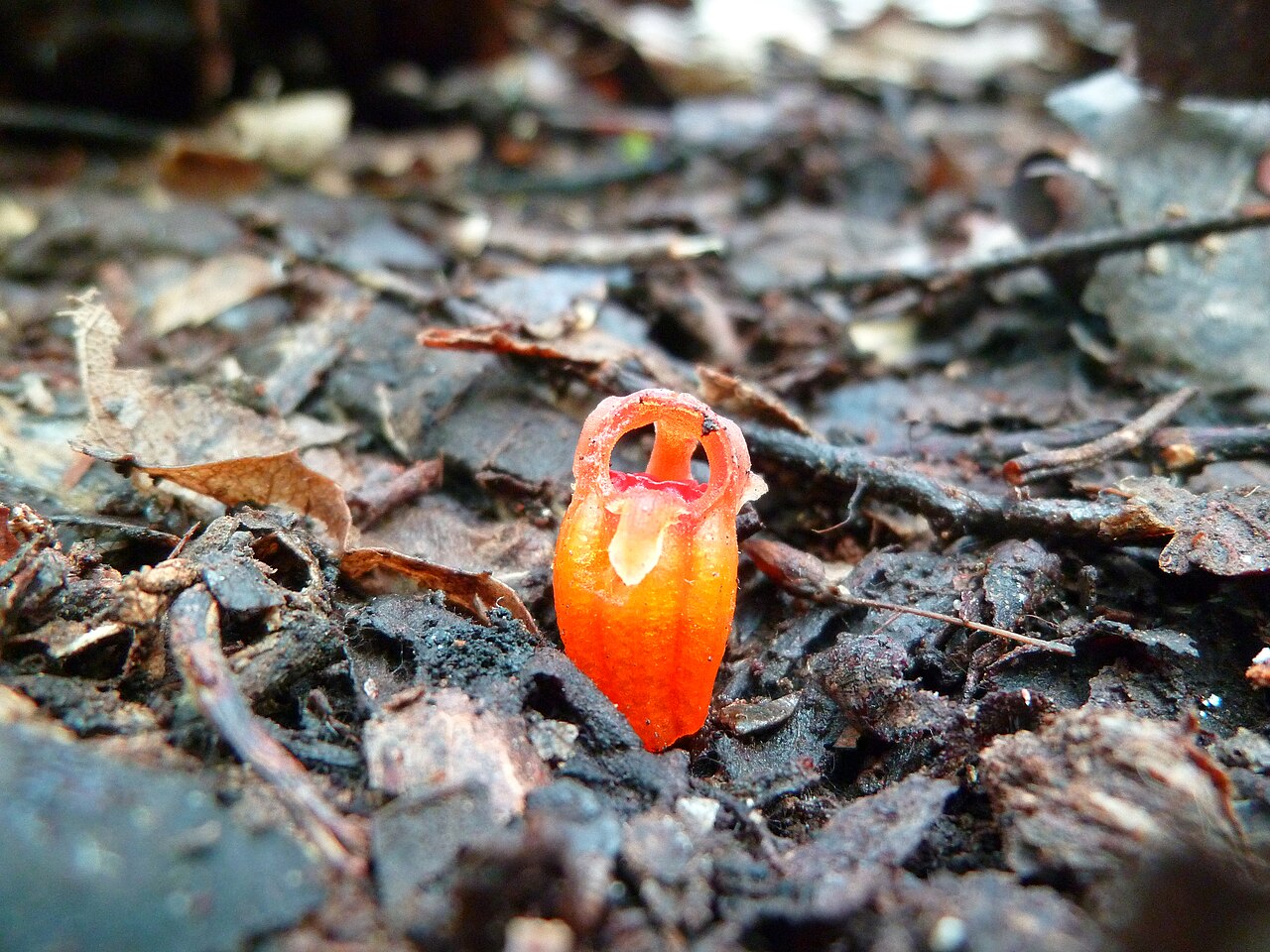
A plant that eats fungi
Thismia neptunis is a plant that does not grow like one. It has no chlorophyll, produces no leaves, and does not perform photosynthesis. Instead, it lives almost its entire life underground as a network of roots, surviving through a strategy called mycoheterotrophy. This means it steals all of its nutrients by parasitizing soil fungi. These fungi are themselves connected to the roots of nearby photosynthesizing trees, creating a complex underground network.
When it flowers, the plant sends up a single, pale stem about 9 cm tall. The flower itself is only about 12 mm long and 7 mm wide, with a partially transparent, urn-shaped body marked by 12 orange vertical stripes. From the top of this structure emerge three long, thin appendages that resemble antennae, each about 4.5 cm long. The entire organism is small and appears only briefly for a few weeks, sometimes not emerging at all in a given year. This elusive nature, and its strange appearance, makes it incredibly difficult to find.
Lost and found
The Italian naturalist Odoardo Beccari first discovered Thismia neptunis in the Gunung Matang massif of western Sarawak in April 1866. He made detailed drawings of the unusual specimen, but for the next 151 years, the plant was never officially recorded again. It was not recorded again, known only from Beccari's original illustrations.
In January 2017, a team of Czech researchers rediscovered the species in the same area. This was only the second confirmed sighting in its history. The rediscovery provided the first-ever photographs of the plant and allowed for a more complete scientific description than Beccari's original notes. The habitat is primary lowland rainforest, a ecosystem threatened from deforestation in Sarawak. Because so few individuals have ever been found—fewer than 50 are estimated to exist—researchers suggest it qualifies for a Critically Endangered conservation status.