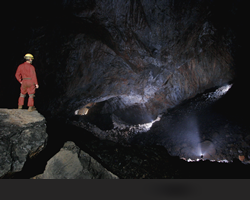
Deep inside a Borneo mountain lies a single, unbroken cave chamber so vast it could hold 40 Boeing 747s.
Dave Clucas, CC BY 2.5
An Accidental Discovery of Scale
In January 1981, three British cavers, Andy Eavis, Dave Checkley, and Tony White, were navigating a river passage inside a mountain in Borneo's Gunung Mulu National Park. As they moved deeper into the cave, known as Gua Nasib Bagus or Good Luck Cave, they entered a space where their powerful headlamps could not find any walls. The beams simply vanished into the darkness. After hours of exploration, they emerged not entirely sure of what they had found. Subsequent surveys confirmed their discovery: the largest known cave chamber in the world by area, the Sarawak Chamber.
Initial measurements were staggering, estimating the chamber to be three times larger than the previous record-holder, the Big Room in Carlsbad Caverns, New Mexico. A 2011 survey using modern laser scanning technology provided precise dimensions. The chamber is approximately 600 meters long, 435 meters wide, and reaches a maximum height of 115 meters. Its total surface area is 164,459 square meters, and its volume is over 9.5 million cubic meters. The unsupported roof alone has a span of 300 meters.
A Million-Year Hydrology Project
The Sarawak Chamber is a karst formation, created by the power of water acting on rock over immense timescales. The chamber is carved out of the Melinau Limestone, a thick layer of rock formed from a reef complex during the Upper Eocene to Early Miocene ages. For millions of years, rainfall from the surrounding tropical rainforest seeped through the ground and into the limestone.
This water, made slightly acidic by dissolved carbon dioxide from the soil, slowly dissolved the soluble limestone, enlarging cracks and fissures into massive conduits. A river flowing from the nearby Hidden Valley found its way into the rock, its persistent flow eroding and carrying away the dissolved rock, ultimately carving out the enormous void. The chamber's exceptional size and stability are partly attributed to the geological structure of the surrounding rock, where dipping strata form a supportive anticline flank. The river that created the chamber still flows through its boulder-strewn floor today.
An Ecosystem in Total Darkness
Life persists even in the complete absence of sunlight. The chamber supports a unique ecosystem entirely dependent on resources from the outside world, primarily brought in by millions of cave swiftlets and bats that roost on its high ceilings. These creatures exit the cave nightly to forage, returning to deposit vast quantities of guano on the chamber floor.
This guano forms the base of the food web for a host of troglobites—animals adapted to permanent life in a cave environment. The nutrient-rich deposits feed large populations of insects, which in turn are prey for other specialized creatures. Ghostly white crabs and various species of cave crickets and spiders can be found navigating the guano piles and the dark and damp terrain. The chamber allows for studying how life adapts to one of the most extreme and isolated environments on the planet.
💡Fun Facts
When the discoverers' headlamp beams failed to hit a far wall, they first thought their equipment was malfunctioning.
The chamber is located within Gua Nasib Bagus, which translates to "Good Luck Cave".
By area, it is the largest known uninterrupted enclosed space, natural or man-made, on Earth.
The sound inside is often described as deafeningly silent, broken only by dripping water or the flutter of bats.
Access is by guided expedition only, which must be arranged in advance with the Gunung Mulu National Park authorities.
Admission
Varies by tour package; requires a multi-day commitment and staying overnight at a designated camp.
Accessibility
Extremely challenging. Reaching the chamber involves a multi-hour trek through dense rainforest, followed by navigating a river inside the cave which may require swimming and traversing ledges with fixed ropes. This tour is restricted to experienced cavers with a high level of physical fitness.