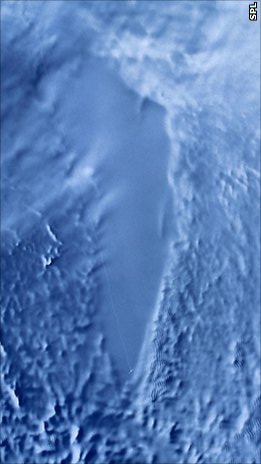
A signal beneath the ice
Deep below the East Antarctic Ice Sheet lies Lake Vostok, the largest of the continent's hundreds of subglacial lakes. It is a vast body of freshwater, approximately 250 kilometers long and 50 kilometers wide, comparable in surface area to North America's Lake Ontario. The water has been sealed off from the surface for at least 15 million years, buried under 3,700 to 4,200 meters of glacial ice. The immense pressure from the overlying ice keeps the water liquid at an average temperature of -3°C (27°F).
In this isolated environment, airborne surveys detected a significant geophysical curiosity. On the lake's eastern side, researchers mapped a large magnetic anomaly measuring 105 by 75 kilometers. This feature is a localized disturbance in the Earth's magnetic field with a strength of over 1,000 nanoteslas. Its existence points to a major geological feature in the bedrock, but the exact nature of this feature is a subject of scientific debate. The ice sheet, which is over four kilometers thick in some areas, makes direct investigation exceptionally difficult.
Competing geological theories
Several hypotheses attempt to explain the source of such a strong magnetic signature. One prominent theory suggests the anomaly is caused by a significant thinning of the Earth's crust. Lake Vostok is situated in a tectonic basin, possibly a continental rift valley similar to East Africa's Great Rift Valley. If the crust here is substantially thinner than in surrounding areas, the warmer mantle would be closer to the surface. This could create the observed magnetic variation and would also explain the geothermal heat required to keep the lake from freezing solid at its base.
Another possibility relates to the composition of the rock itself. The anomaly could indicate a large body of iron-rich rock or an unusual concentration of magnetic minerals. This area of Antarctica is part of the ancient East Antarctic Shield, a craton of Precambrian rock. The anomaly marks a boundary between different geologic terranes or crustal blocks that collided and joined hundreds of millions of years ago during the formation of supercontinents. Without drilling through kilometers of ice to collect rock samples, the precise cause of the magnetic anomaly under Lake Vostok is one of Antarctica's most compelling unsolved questions.