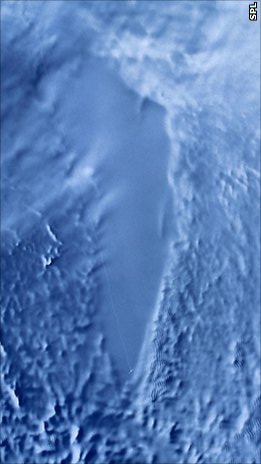
A lake the size of Lake Ontario lies buried under 4 kilometers of Antarctic ice, sealed off from the outside world for at least 15 million years. Whatever life exists down there has been evolving in total darkness and extreme pressure, completely isolated from the rest of Earth's biosphere.
Goddard Space Flight Center, Public domain, via Wikimedia Commons
A world beneath the ice
Deep below the East Antarctic Ice Sheet lies Lake Vostok, one of the largest and most mysterious lakes on Earth. Its existence was first suggested by Russian geographer Andrey Kapitsa in the 1960s based on seismic soundings, but it was not confirmed until 1996 through airborne radar and satellite data. The lake is immense, measuring 250 kilometers long by 50 kilometers wide, with an estimated water volume of 5,400 cubic kilometers. Its surface sits approximately 4,000 meters below the ice, placing it about 500 meters below sea level.
The water remains liquid due to a combination of factors. The immense pressure from the overlying ice—more than 350 times that of the atmosphere at sea level—lowers the freezing point. Geothermal heat radiating from the Earth's interior warms the lake from below. The average water temperature is a frigid -3°C. Directly above the lake is Russia's Vostok Station, the site of the coldest temperature ever recorded on Earth's surface: -89.2°C, observed on July 21, 1983. The ice core drilled at this station provides one of the longest continuous paleoclimatic records available, stretching back over 420,000 years and covering four distinct glacial cycles.
The search for life
The lake's extreme isolation for an estimated 15 million years makes it a target in the search for unique life forms. The water chemistry is unlike almost any other lake on Earth. It is an oligotrophic, or nutrient-poor, environment expected to be supersaturated with oxygen and nitrogen at levels 50 times higher than typical freshwater lakes. This high gas concentration, trapped as clathrate structures within the water, would be toxic to most known organisms, suggesting any life must possess unique adaptations.
A multi-decade drilling project, led by Russian scientists, finally breached the ice shield and reached the lake's surface on February 5, 2012. To prevent contamination of the pristine ecosystem with drilling fluids like freon and kerosene, the final penetration was carefully managed. The pressure difference caused lake water to surge up into the borehole, where it froze, creating a plug of clean ice for sampling.
Analysis of this frozen water and accretion ice—lake water that has frozen to the bottom of the glacier—has yielded tantalizing results. Researchers have identified the DNA sequences of thousands of organisms. The majority belong to bacteria and fungi, but some sequences match organisms that live near deep-sea hydrothermal vents, hinting that such features may exist on the lake floor. While scientific debate continues over potential contamination, some bacterial DNA found does not match any known species in global databases, suggesting a truly unique ecosystem may exist in the dark depths.
💡Fun Facts
The ice core drilled above Lake Vostok provides a continuous climate record stretching back 420,000 years.
The immense pressure and geothermal heat keep the lake's water at a liquid -3°C.
The water contains about 50 times more dissolved oxygen than ordinary freshwater lakes, which would be toxic for most known organisms.
Lake Vostok is considered a scientific analog for icy moons like Jupiter's Europa and Saturn's Enceladus, which may harbor liquid water oceans beneath their frozen surfaces.