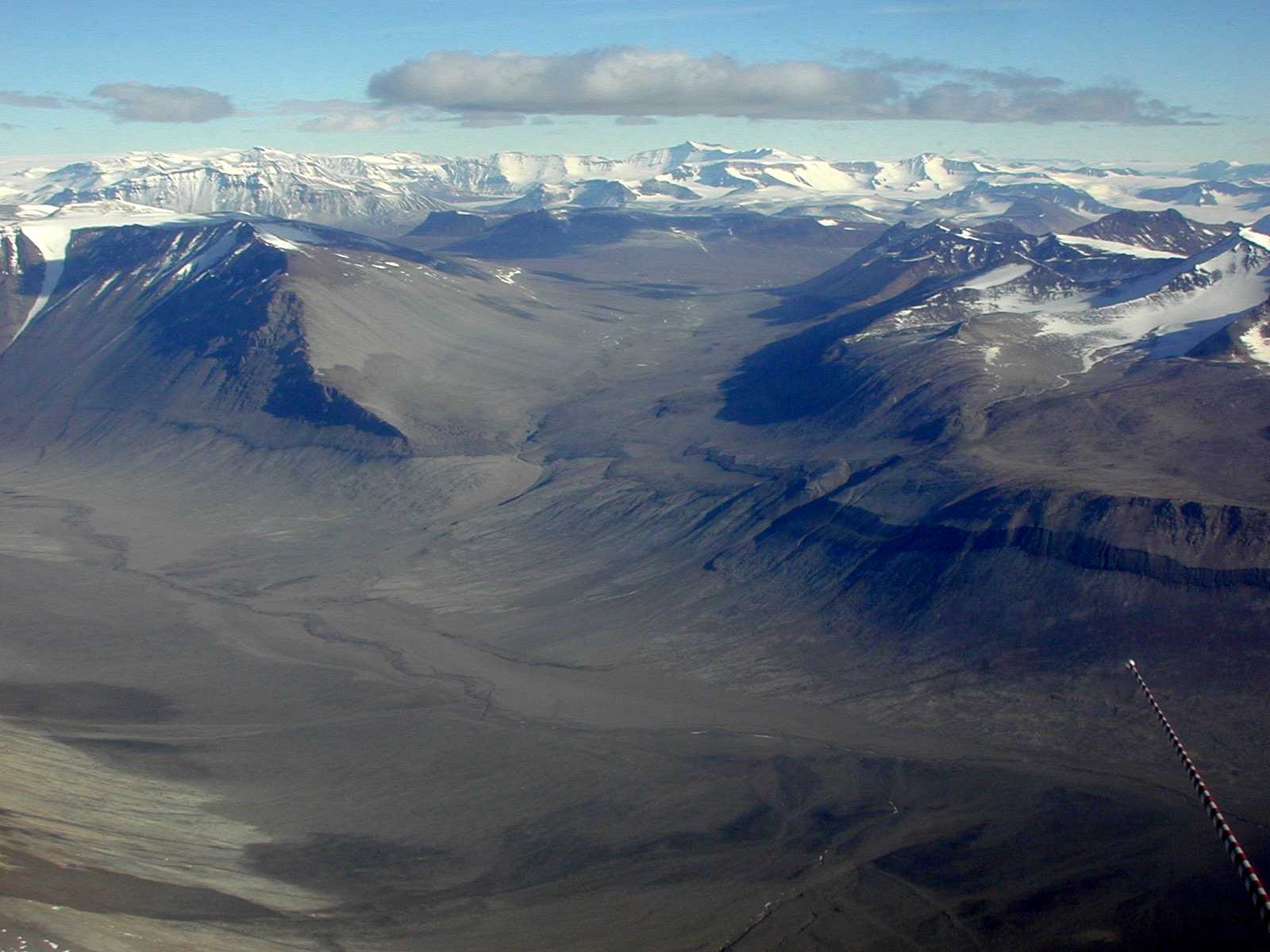
Bacteria and algae living inside translucent rocks in the driest place on Earth, surviving on occasional snowmelt and photosynthesizing through sandstone. It's Earth's best Mars analog ecosystem.
NSF/Josh Landis, employee 1999-2001, Public domain
The hidden ecosystem
The McMurdo Dry Valleys are the largest ice-free area in Antarctica, a polar desert where conditions are so extreme that early explorers like Robert Falcon Scott considered them devoid of life. With mean annual temperatures around -19°C and precipitation less than 100 mm water equivalent per year, life here approaches its environmental limits. Yet within the porous Beacon sandstone that dots the landscape, a complete ecosystem exists, hidden from the desiccating winds and intense ultraviolet radiation. This is the cryptoendolithic community, a Greek term meaning "hidden within rock."
These communities colonize the pore spaces a few millimeters below the rock's surface. The translucent sandstone allows just enough sunlight to penetrate for photosynthesis—typically 0.1% to 1%—while blocking harmful UV rays. Inside, microorganisms form distinct, stratified layers. Lichen-dominated communities are the most widespread. These often feature a black, melanin-rich fungal layer just beneath the surface crust, followed by a white zone of lichen mycobionts, a green layer of photosynthetic algae (like Trebouxia), and sometimes a lower cyanobacterial zone (Chroococcidiopsis sp.). This layered structure creates a self-contained world of primary producers (algae, cyanobacteria), consumers (fungi), and decomposers (bacteria). The rock itself provides physical stability, thermal buffering against extreme temperature swings, and access to mineral nutrients.
Survival at the limit
Life inside an Antarctic rock operates on a geological timescale. Water, the main limiting factor, comes only from melting snow that briefly wicks into the porous stone. Metabolic activity is possible only when rock temperatures rise above 0°C for a few weeks during the Antarctic summer. The organisms are psychrophiles, adapted to the cold, but photosynthesis rates are still incredibly low. For lichen-dominated communities, the maximal rate of carbon fixation is around 4.5 nanograms of carbon per hour per square meter, occurring at 10°C.
This slow metabolism results in some of the longest turnover times for life on Earth. Estimates suggest that community lipid carbon takes approximately 20,000 years to turn over. The communities themselves are ancient, and some of the bacterial lineages within them may have diverged from related taxa as far back as 1.2 billion years ago, long before the glaciation of Antarctica.
The extreme cold, dryness, and high radiation of the Dry Valleys make them the best terrestrial analog for the environment on Mars. Scientists study these cryptoendolithic communities to study how life might survive in similar niches on other planets. Fungi collected from these rocks, such as Cryomyces antarcticus, have been sent to the International Space Station and exposed to simulated Martian conditions for 18 months. After exposure, over 60% of their cells remained intact with stable DNA, demonstrating remarkable resilience. This suggests that if life ever arose on Mars, it might have retreated into similar protected, rock-based habitats as the planet's climate deteriorated.
💡Fun Facts
Microbiologists E. Imre Friedmann and Roseli Ocampo-Friedmann first documented these endolithic communities in the 1970s, overturning the belief that the Dry Valleys were lifeless.
Some bacteria from these communities belong to lineages that may date back to the Precambrian era.
The fungi *Cryomyces antarcticus* and *Cryomyces minteri* survived 18 months of exposure to a simulated Mars atmosphere and UV radiation outside the International Space Station.
The term "cryptoendolithic" was coined to describe these organisms, which live inside the pore spaces of rocks, distinguishing them from chasmoendoliths (living in fissures) and euendoliths (which bore into rock).