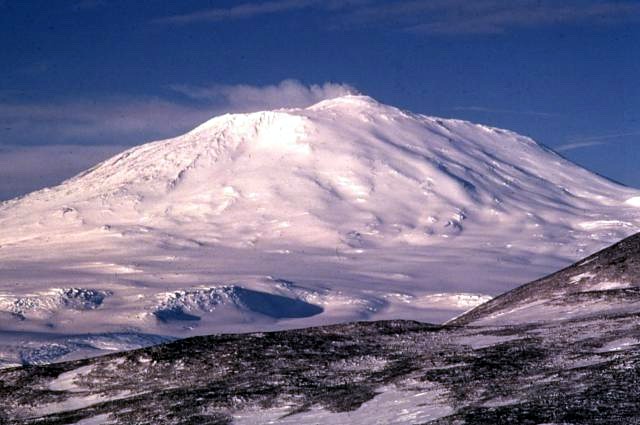
Volcanic heat on a frozen continent
Mount Erebus is the southernmost active volcano on Earth, rising 3,794 meters (12,448 feet) above Ross Island. For over 1.3 million years, it has been an anomalous spot of intense heat on the frozen continent. The volcano's summit holds one of the world's few persistent lava lakes, a churning pool of molten phonolitic lava that has been continuously active since at least 1972.
This constant geothermal activity creates a phenomenon on the volcano's ice-covered flanks: fumarolic ice towers. Volcanic gases, primarily steam superheated from the magma below, rise through cracks in the rock. As this hot, moist air vents into the frigid Antarctic atmosphere—where summer air temperatures average -20°C (-4°F)—the water vapor freezes instantly, building hollow towers of ice around the openings. These structures can be massive, with some reaching heights of 18 meters (60 feet).
The same volcanic heat that builds the towers also melts vast caverns and tunnels beneath the ice. Inside these ice caves, a completely different environment exists. Geothermal heat keeps the caves relatively warm, with some maintaining temperatures as high as 25°C (77°F). This creates a stark temperature gradient between the cave's interior and the perpetually frozen world just meters away.
An unexpected ecosystem
The warm and dark interiors of the Erebus ice caves host unique biological communities isolated from the outside world. These ecosystems are important for studying oligotrophs—organisms that can survive on minimal resources. With no sunlight for photosynthesis, life here depends on chemosynthesis. Microbes derive energy from chemical reactions with the volcanic gases, such as carbon monoxide and hydrogen, that seep into the caves.
Researchers have discovered a surprising diversity of bacteria and fungi within the caves and surrounding heated soils. DNA analysis has revealed many unique sequences not found anywhere else on Earth, suggesting these microbial communities have evolved in isolation. The dominant bacteria belong to phyla like Chloroflexi and Acidobacteria. Curiously, Archaea, a domain of single-celled organisms common in other extreme environments like deep-sea vents, appear to be absent.
The soil on geothermal patches like Tramway Ridge, where ground temperatures can reach 65°C (149°F), supports extensive moss beds and cyanobacterial mats. These small islands of warmth also provide habitats for microscopic animals, including tardigrades and bdelloid rotifers, which have evolved incredible strategies to survive freezing and dehydration. This complex, hidden biosphere, powered by volcanic energy, changes our understanding of the limits of life on Earth.