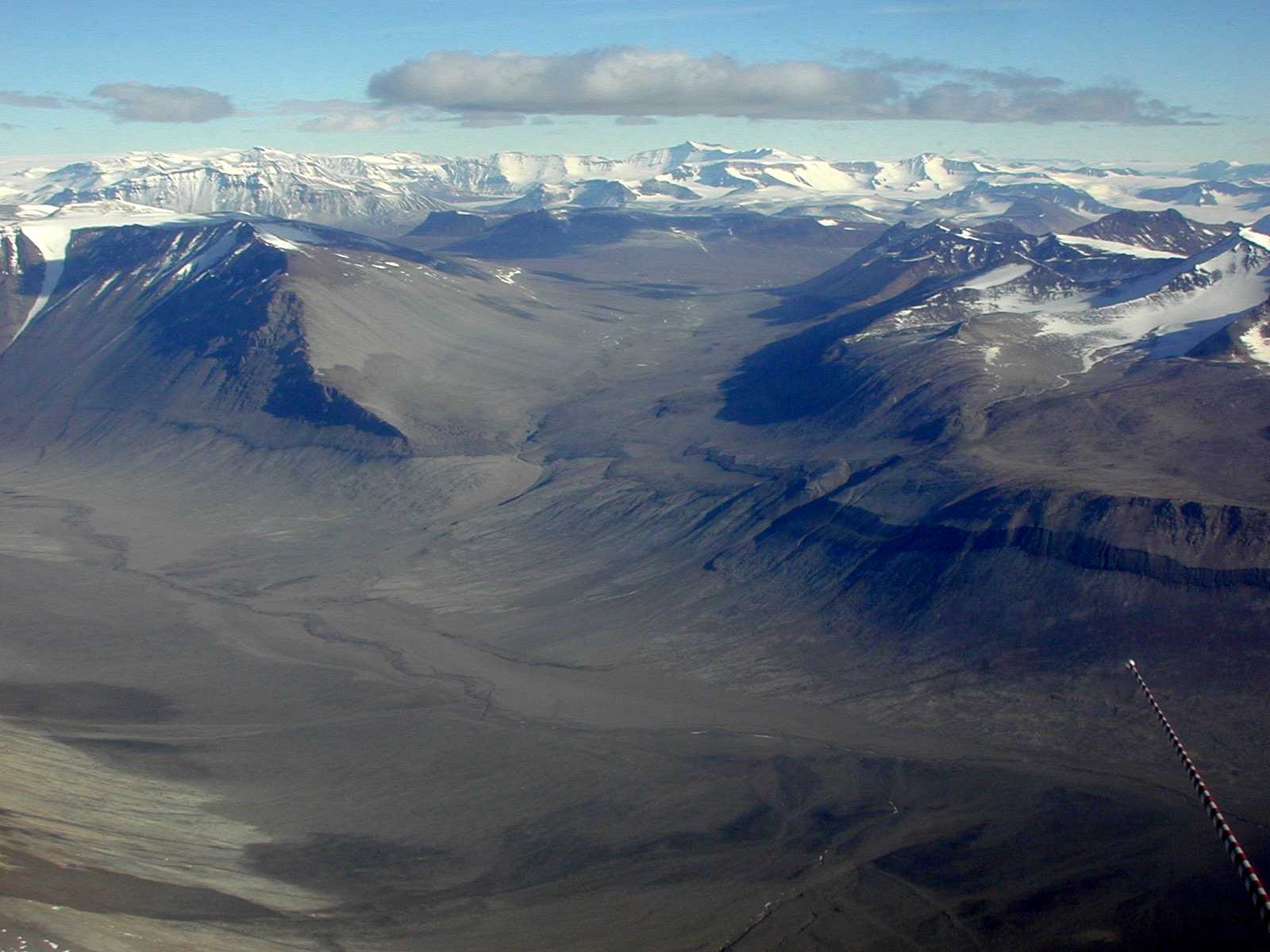
A Martian landscape on Earth
The McMurdo Dry Valleys are the largest ice-free region in Antarctica, covering about 4,800 square kilometers. They are also one of the most extreme deserts on the planet. The Transantarctic Mountains block ice from flowing into the valleys, and powerful katabatic winds, which can reach speeds of over 300 km/h, scour away any snow that falls. The result is a landscape that has not seen rain in an estimated two million years. With a mean annual air temperature around -20°C and extremely low humidity, the Dry Valleys are one of the closest terrestrial analogs to the surface of Mars.
The soil chemistry, permafrost, and cycles of freezing and thawing are so similar to Mars that scientists have used the valleys as a testing ground for planetary exploration since the Viking missions of the 1970s. The hyper-arid, cold conditions here represent one end of the environmental spectrum where life can persist, is a laboratory for studying the absolute limits of biology. The ecosystems are simple, dominated by microorganisms, lichens, and mosses, with a near-total absence of plants or animals.
Hidden life inside rocks
In this barren landscape, life finds refuge in an unusual place: inside the rocks themselves. These organisms are called cryptoendoliths, meaning "hidden within rock." Communities of cyanobacteria, algae, fungi, and lichens colonize the microscopic pore spaces within Beacon Sandstone formations. The rock itself provides a shield. Just a few millimeters beneath the surface, the organisms are protected from harsh ultraviolet radiation, temperature fluctuations, and wind-driven erosion.
The sandstone's translucent quartz grains act as a natural filter, allowing just enough sunlight to penetrate for photosynthesis while blocking the most damaging UV rays. Inside this protected niche, different organisms form distinct, colored bands. Cyanobacteria and green algae, the primary producers, occupy the layers where light is sufficient but UV stress is low. Fungi and other heterotrophic bacteria live in layers above or alongside them, forming a complete, self-contained ecosystem.
These microbial communities have an extraordinarily slow metabolism. Photosynthesis only occurs for a few weeks during the Antarctic summer when rock temperatures briefly rise above 0°C, allowing trace amounts of moisture to become liquid. Because of this, their growth rates are among the slowest on Earth, with carbon turnover times estimated to be in the thousands of years. One of the most resilient inhabitants, the cyanobacterium Chroococcidiopsis, is found in extreme deserts worldwide and is a candidate for studying how life might survive on other planets.