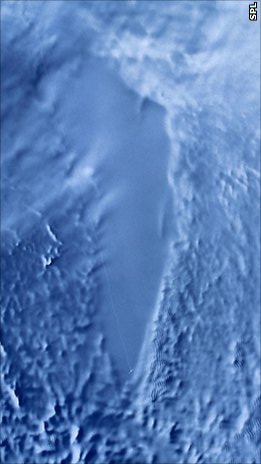
Life sealed under 4,000 meters of ice
Deep beneath Vostok Station, the coldest recorded place on Earth, lies a body of freshwater the size of North America's Lake Ontario. This is Lake Vostok, and it has been sealed off from the atmosphere for at least 14 million years. The lake exists under an ice sheet nearly 4,000 meters (13,100 feet) thick. The immense weight of this ice creates pressures over 350 times greater than at sea level and keeps the water liquid at an average temperature of -3°C (27°F). It is total darkness, extreme pressure, and cold. The first evidence of microbes in this isolated environment came from analyzing "accretion ice"—lake water that has frozen onto the bottom of the overlying glacier. In 1999, scientists studying ice cores drilled to a depth of 3,623 meters found frozen microorganisms. This discovery showed that Lake Vostok, despite its hostile conditions, might have a unique ecosystem. Later DNA sequencing studies of this ice revealed thousands of distinct species, mostly bacteria but also fungi and archaea. This genetic material suggests a surprisingly diverse community of organisms has adapted to this extreme environment over millions of years.
The drilling operations themselves are a major challenge. Russian science teams began drilling deep ice cores in the 1970s and finally pierced the ice shield to reach the lake's liquid surface on February 5, 2012. Great care was taken to avoid contaminating the pristine lake with drilling fluids like kerosene and Freon, which were used to keep the 3,768-meter borehole from freezing shut.
Psychrophiles and the pace of evolution
The organisms that live in Lake Vostok are called psychrophiles, or "cold-loving" microbes. They have developed remarkable adaptations to survive. To prevent freezing solid, they produce special antifreeze proteins that bind to ice crystals and inhibit their growth. Life in the near-freezing, nutrient-poor water requires an exceptionally slow metabolism. The energy available is so scarce that some bacteria might get their energy from minerals in the rocks, essentially "eating rocks" to survive.
This slow metabolism means life proceeds at a geological pace. Cell division, a process that takes minutes for some bacteria, could take centuries for the microbes in Lake Vostok. This extremely slow rate of reproduction has deep implications for evolution. The DNA of these organisms is remarkably similar to known species, suggesting that evolution in this environment has been almost static for millions of years.
Analysis of the accretion ice has identified a wide range of bacteria. Some are psychrotolerant (able to endure cold) rather than truly psychrophilic (thriving in cold). Researchers have found DNA from bacteria, like Hydrogenophilus thermoluteolus, which is typically found near deep-sea thermal vents, suggesting geothermal activity might warm the lake floor. The water is also supersaturated with oxygen, at levels 50 times higher than in ordinary freshwater lakes, creating another unique challenge for any life within. Studying this isolated ecosystem shows life might persist in other extreme, ice-covered environments in the solar system, such as on Jupiter's moon Europa or Saturn's moon Enceladus.