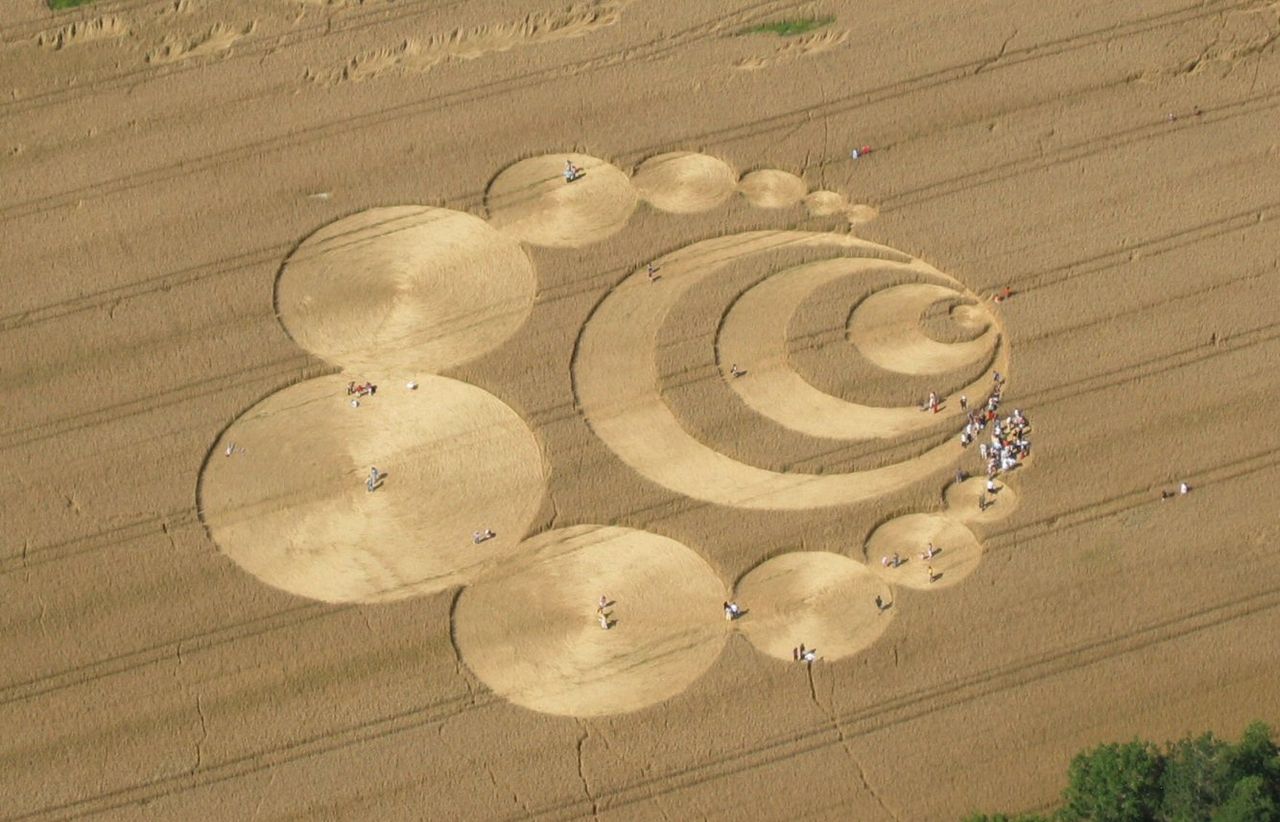
A region of anomalies
Wiltshire, England, is the global epicenter for crop circles, with roughly 80% of the UK's formations appearing in its fields. Since the late 1970s, this area, with many ancient sites like Stonehenge and Avebury, has hosted thousands of these geometric patterns. The phenomenon gained widespread public attention in the 1980s, evolving from simple circles to elaborate pictograms. In 1991, Doug Bower and Dave Chorley claimed responsibility for creating over 200 circles since 1978 using simple tools like wooden planks and ropes. They were inspired by a 1966 account of a "flying saucer nest" in Tully, Australia.
Following their confession, the number and complexity of crop circles worldwide increased dramatically. Designs began to incorporate complex mathematical principles. In 1996, a formation depicting a Julia set fractal, composed of 151 circles and measuring 915 feet long, appeared opposite Stonehenge. Other designs have encoded representations of the Mandelbrot set, the golden ratio, and even a graphical representation of the first ten digits of pi that appeared near Wroughton. The concentration in Wiltshire is sometimes linked to the area's numerous prehistoric landmarks and a high concentration of underground aquifers.
Investigating the patterns
Scientific analysis of plants and soil from crop formations has yielded unusual findings. The BLT Research Team, a US-based group, has published papers describing physical abnormalities in plant samples. These include elongated plant nodes (the "knuckles" on the stem) and the presence of microscopic iron-magnetite spheres distributed in specific patterns within the formations. Researchers report that the stems within the patterns are typically bent at a 90-degree angle, not broken, allowing the plants to continue to grow.
The creation of the patterns is a subject of debate. The scientific consensus is that crop circles are constructed by humans. Artists have demonstrated the ability to create complex designs using basic equipment like ropes, planks, and GPS devices. However, some researchers argue that the observed biophysical changes in the plants and the geometric precision of many formations are difficult to replicate with simple mechanical means. Other proposed explanations have included unusual meteorological phenomena like plasma vortices or microwave energy emissions. Regardless of their origin, the formations appear most frequently in canola, barley, and wheat during the UK growing season, from April to early September.