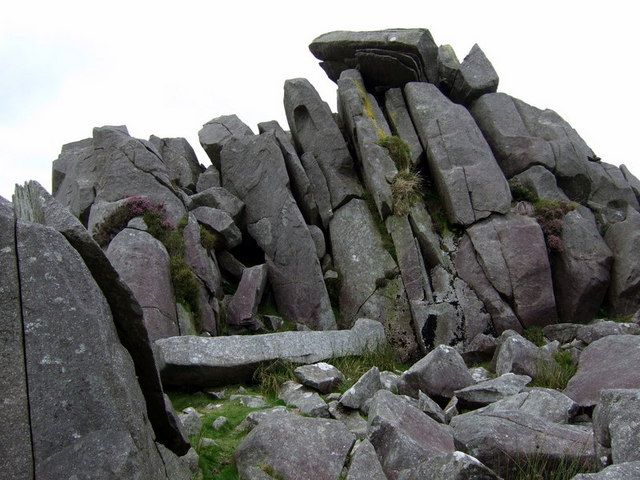
80 stones transported 240 kilometers from Wales to Stonehenge, each weighing 4 tons. Neolithic people moved them 5,000 years ago without wheels, possibly by raft, sled or human muscle alone. Why they chose these specific Welsh stones over abundant local rock remains unexplained.
ceridwen, CC BY-SA 2.0
The Preseli Hills Quarries
The smaller stones of Stonehenge, the so-called "bluestones," were quarried from the Preseli Hills in Pembrokeshire, Wales, almost 240 kilometers (150 miles) away from their final placement on Salisbury Plain. Geochemical analysis has pinpointed the exact origin of many of these stones to two specific Neolithic quarries: Carn Goedog and Craig Rhos-y-felin. Carn Goedog was the primary source for the spotted dolerite, an igneous rock with white spots, while Craig Rhos-y-felin provided rhyolite, another type of igneous rock.
Archaeological work at these sites reveals evidence of quarrying activity dating to around 3000 BCE. The rock at both outcrops naturally forms vertical pillars, which Neolithic workers could exploit. Instead of carving blocks from solid rock, they likely inserted wooden wedges into the natural joints. When soaked with water, the wedges would expand and split the pillars from the rock face. Excavations have uncovered stone tools and artificial platforms at the base of the outcrops, which probably were loading bays to ease the massive stones onto wooden sledges for transport.
A Monumental Neolithic Undertaking
Transporting roughly 80 bluestones, each weighing between 2 and 4 tons, was an immense challenge. The precise route is still debated, but the location of the quarries on the north side of the Preseli Hills suggests a predominantly overland journey. This route, possibly following a path similar to the modern A40 road, would have involved dragging the stones on sledges over rough terrain, across rivers, and through forests. The human effort required would have been enormous, involving hundreds of people over long periods.
The question of why these specific stones were chosen is a central mystery. Every other Neolithic monument in Europe was built with megaliths sourced within about 16 kilometers. One theory suggests the stones were first part of a local Welsh monument that was later dismantled and moved to Stonehenge, perhaps as a symbol of tribal unification or ancestral connection. Other ideas point to the unique acoustic properties of the stones or a belief in their healing powers. The Preseli Hills themselves were a significant prehistoric area with burial chambers, stone circles, and other ceremonial sites, showing the area held special importance for Neolithic people.
💡Fun Facts
The term "bluestone" is a catch-all for about 20 different rock types at Stonehenge, so named because they take on a bluish hue when wet or freshly broken.
Radiocarbon dating at the quarries suggests the stones were extracted between 3400 and 3200 BCE, potentially 500 years before they were erected at Stonehenge around 2900 BCE.
Geologists and archaeologists have refuted the long-standing theory that glaciers carried the stones to Salisbury Plain, confirming they were transported by humans.
The Preseli Hills are crossed by an ancient 13-kilometer trackway known as the "Golden Road," which was a route for trade and travel during the Neolithic and Bronze Ages.
The Preseli Hills are part of the Pembrokeshire Coast National Park and are open 24/7, though hiking is best and safest during daylight hours.
Admission
Free
Accessibility
The terrain is rugged moorland with uneven, unpaved hiking trails. It can be boggy in places and is not suitable for wheelchairs or strollers. Sturdy footwear is essential.