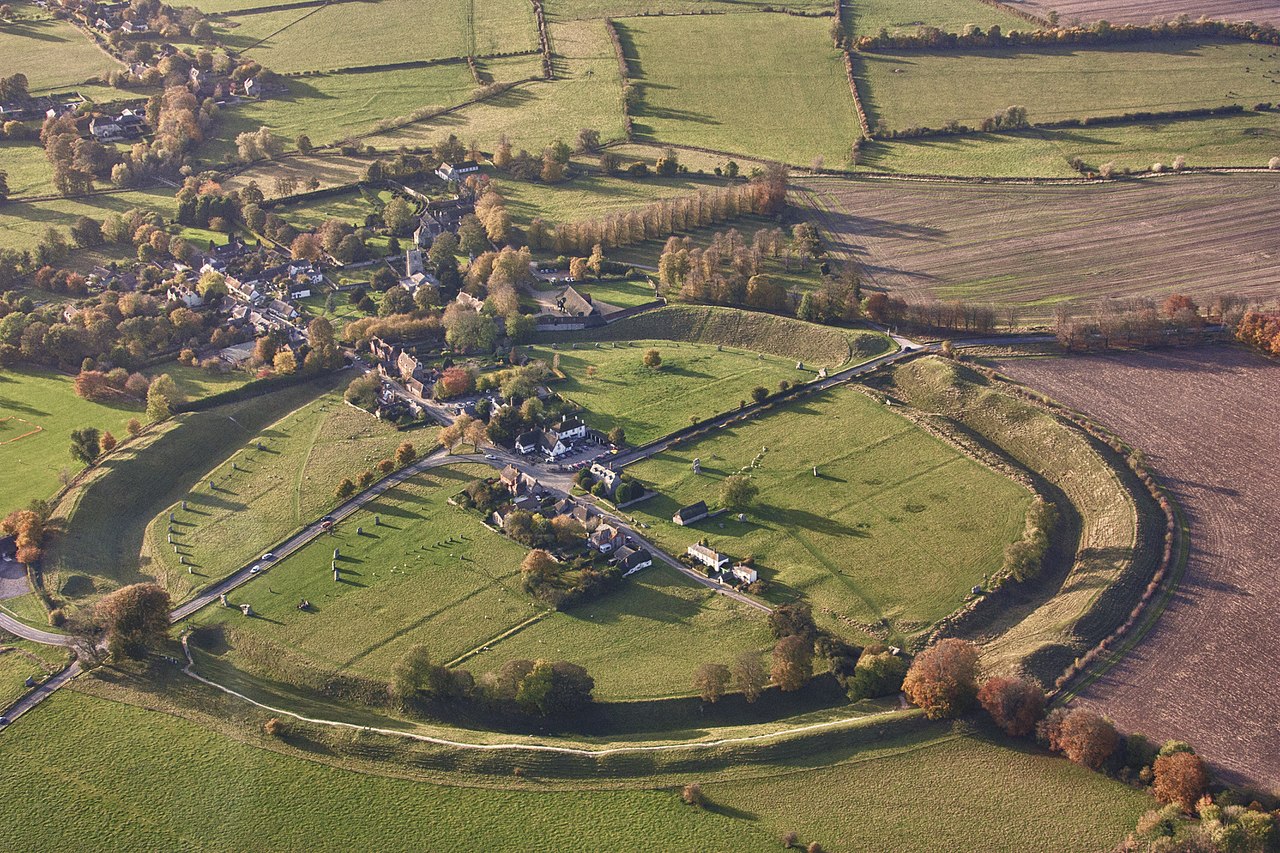
Europe's largest stone circle is so massive that an entire village sits inside it. The surrounding ditch alone required moving 200,000 tons of chalk with antler picks.
MikPeach, CC BY-SA 4.0, via Wikimedia Commons
A Monument of Measurement
The defining feature of Avebury is its scale. The outer stone circle has a diameter of 331.6 meters (1,088 feet), making it the largest in the world. This circle originally contained around 100 massive sarsen stones. The entire complex sits within a huge circular earthwork, or henge, that measures over 1,000 meters in circumference. To create this henge, Neolithic workers excavated a ditch that was originally up to 9 meters deep and 21 meters wide. Excavations led by archaeologist Harold St George Gray revealed that the primary digging tool was the antler of the red deer; over 40 antler picks were found at the bottom of the ditch. The chalk rubble removed from the ditch was used to build the outer bank, which originally stood up to 7 meters high.
The stones themselves are a type of silicified sandstone called sarsen, which formed around 40 million years ago in the Palaeogene period. These stones were not quarried in the modern sense but were found scattered across the local Marlborough Downs. The builders selected stones weighing up to 40 tons, and in one case, an estimated 100 tons, and transported them to the site. Inside the vast outer circle are two smaller stone circles, each approximately 100 meters in diameter. The northern circle originally had 27 stones and the southern circle had 29. These numbers correspond to the sidereal and synodic lunar months, suggesting the site may have functioned as a complex astronomical calendar.
An Evolving Scientific Picture
Construction at Avebury was not a single event but a series of projects undertaken between roughly 2850 BC and 2200 BC. Radiocarbon dating of the henge suggests it was built in the middle of the third millennium BC. The entire monument is part of a much larger prehistoric area that includes Silbury Hill—the largest prehistoric mound in Europe—and the West Kennet Long Barrow, a chambered tomb dating to around 3650 BC.
For decades, archaeologists debated the construction sequence. The prevailing theory was that the monument was built from the outside in, starting with the large henge. Recent geophysical surveys have challenged this view. In 2017, ground-penetrating radar revealed a previously unknown square megalithic monument hidden within the southern inner circle. This square, measuring about 30 meters on each side, appears to surround the location of an even earlier Neolithic timber building, dated to around 3500 BC. This discovery suggests the entire complex may have grown outwards from a much older, central structure. This process of monumentalizing a former domestic space shows the social and historical values of the people who built it.
The purpose of the two inner circles is a subject of scientific investigation. The distinct numbers of stones—27 and 29—point toward a lunar purpose. One theory is that they were used to track lunar cycles and perhaps to calibrate solar and lunar calendars over long periods. The stones themselves also show variation. They are often categorized as either tall and slender or short and squat, which has led some researchers to theorize about gender symbolism.
💡Fun Facts
The largest remaining stone weighs an estimated 100 tonnes, making it one of the heaviest megaliths in Britain.
In the 14th century, many stones were deliberately buried, possibly as an attempt to erase pagan symbolism.
A skeleton found under a toppled stone in 1938 was dubbed the "Barber-Surgeon". He carried scissors and a medical probe and had coins dating to around 1320 AD. His remains, thought lost in WWII, were rediscovered in 1998.
Ground-penetrating radar revealed a unique square monument hidden inside one of the circles, potentially one of the site's earliest structures.
The stone circle is accessible from dawn until dusk. National Trust facilities, including the car park and toilets, are typically open from morning until late afternoon.
Admission
Access to the stone circle and henge is free. There are admission fees for the Alexander Keiller Museum and Avebury Manor.
Accessibility
The terrain around the stone circle is uneven and can be muddy. Some sectors are accessible to wheelchairs and mobility scooters, preferably when the ground is dry. An all-terrain mobility scooter may be available to borrow.