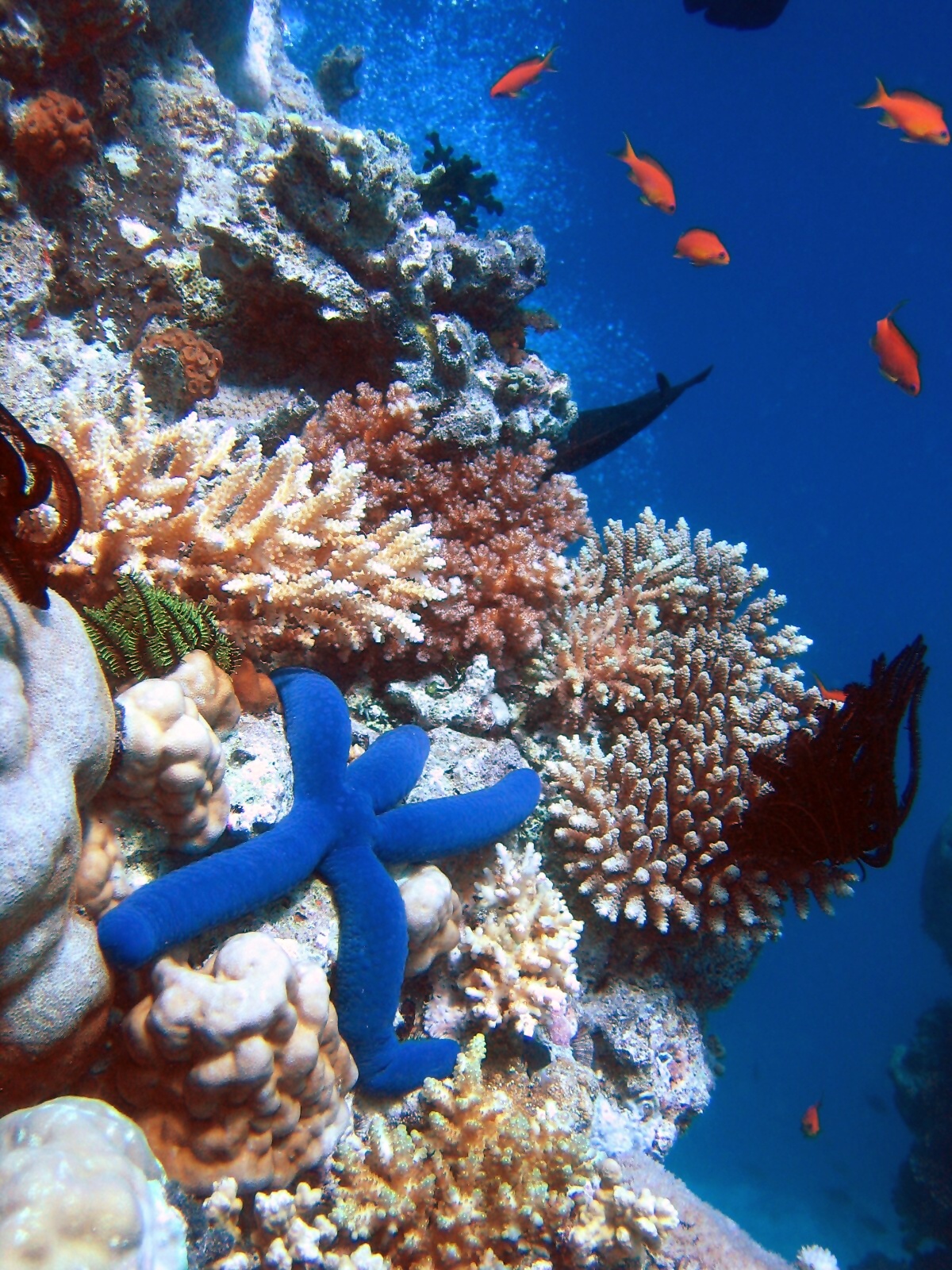
A crucible of coral evolution in the Coral Triangle, the Wakatobi archipelago has extraordinary marine biodiversity.%%CITE_1%%%%CITE_2%%%%CITE_3%% The name "Wakatobi" is an acronym of the four main islands: Wangi-Wangi, Kaledupa, Tomia, and Binongko.%%CITE_4%%%%CITE_5%%%%CITE_6%% These islands are part of the Wakatobi National Park, a protected area of over 1.39 million hectares, where the land makes up only 3% of the total area.%%CITE_5%%%%CITE_7%% The park contains a high concentration of marine life, with researchers having identified 750 of the world's 850 coral reef species and more than 942 species of fish.%%CITE_4%%%%CITE_5%%%%CITE_7%% This diversity exists across various reef types, including fringing reefs, barrier reefs, and atolls, which total approximately 600 kilometers in circumference.%%CITE_4%%
Wakatobi's reefs have demonstrated remarkable resilience to the effects of climate change, particularly coral bleaching. While rising sea temperatures have devastated reefs globally, Wakatobi has remained comparatively unscathed. This resilience is partly due to local oceanographic conditions. The area experiences significant seasonal temperature fluctuations, with water temperatures ranging from 25°C to 31°C. This regular exposure to warmer water, driven by local weather systems rather than global El Niño oscillations, has likely allowed the corals here to evolve a higher tolerance for heat over centuries. Cool water upwellings and currents help to moderate temperatures, preventing the prolonged heat stress that typically causes widespread bleaching.
A living laboratory for future reefs
The unique characteristics of Wakatobi's corals make the region an important area for scientific research. Scientists are studying the genetic makeup of these heat-tolerant corals to understand the specific mechanisms behind their resilience. Research indicates that thermal tolerance has a strong genetic basis. Some corals harbor specific strains of symbiotic algae, known as zooxanthellae (from the genus Symbiodinium), which are themselves more heat-tolerant. The presence of the Symbiodinium subclade D1a, for instance, is known to be associated with higher heat tolerance in corals.
The study of coral genetics in this region extends to understanding population connectivity. Researchers use genetic markers to trace how coral larvae disperse between reefs, which helps in designing effective marine protected areas. For example, studies on the branching coral Acropora millepora and the brooding coral Seriatopora hystrix have revealed different patterns of genetic diversity and population structure, influenced by their reproductive strategies and local ocean currents. This research is supported by organizations like Operation Wallacea, which brings student volunteers to the Hoga Island Marine Station to contribute to long-term monitoring and conservation efforts, including reef restoration projects using "reef stars" to stabilize rubble and promote new coral growth. The insights gained from Wakatobi's resilient reefs provide a model for conservation and restoration strategies worldwide, offering hope for the future of coral ecosystems in a warming world.