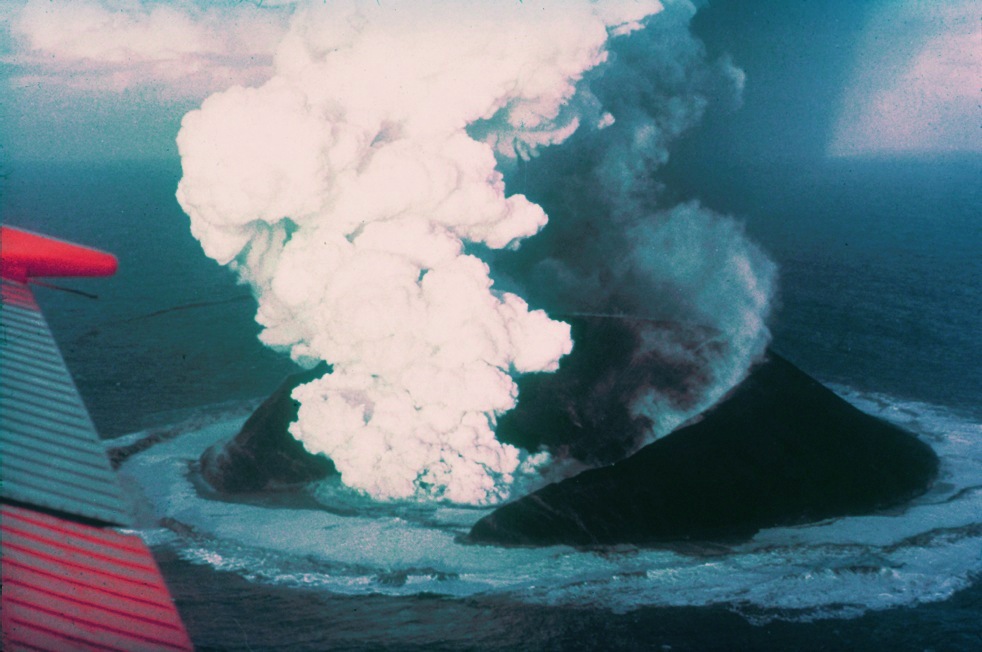
Within 3 years of this island emerging from the sea in 1963; bacteria had colonized it. Carried by seabirds in their droppings. Turning sterile rock into living soil.
Howell Williams, NOAA, Public domain, via Wikimedia Commons
Birth of a natural laboratory
On November 14, 1963, fishermen off the southern coast of Iceland witnessed a column of smoke and ash rising from the sea. An underwater volcano, 130 meters below sea level, had erupted with enough force to breach the surface. For the next three and a half years, the eruption continued, spewing lava and tephra until it formed a new island. Named after Surtr, the fire giant of Norse mythology, Surtsey reached a maximum size of 2.7 square kilometers by the time the eruption ceased on June 5, 1967.
From its birth, Surtsey was recognized as an opportunity to observe the colonization of a sterile landmass. In 1965, while the volcano was still active, the island was declared a nature reserve, protecting it from human interference. This protection allows for the study of primary succession—the process by which life establishes itself in an environment devoid of soil and organic matter. The island is a pristine natural laboratory where scientists can document the arrival and development of life from its earliest stages.
The first colonists
The first visible lifeforms were not what scientists initially expected. While it was thought that lichens would be the first pioneers, they did not appear until 1970. Instead, the colonization began at a microbial level with the arrival of bacteria, moulds, and fungi carried by ocean currents and wind. The first vascular plant, a sea rocket (Cakile arctica), was found on the shore in the spring of 1965, its seeds likely delivered by the waves.
Mosses were first observed in 1967, and by 1970, 18 different species had been recorded. These early plants, along with lichens, began the slow process of breaking down the volcanic rock and creating the first pockets of organic material. This initial phase was slow; during the island's first 20 years, only 10 plant species became permanently established in the nutrient-poor tephra.
The arrival of birds began a new phase in the island's development. Gulls were seen on the island within weeks of its formation. In 1970, fulmars and black guillemots became the first bird species to nest on Surtsey. The establishment of a large gull colony in the 1980s significantly accelerated soil formation. The birds' guano deposited large amounts of nitrogen and other nutrients into the volcanic ash, transforming it into a more fertile substrate. This enrichment allowed for more complex plants to take root. By 2008, 69 species of plants had been found on the island, including the first bush—a tea-leaved willow (Salix phylicifolia)—discovered in 1998.
💡Fun Facts
The island is named after Surtr, a fire giant from Norse mythology who is foretold to set the world on fire at the end of time.
In 2009, scientists discovered a tomato plant growing on the island. As it grew from human sewage, it was promptly removed to maintain the island's natural succession.
Due to constant wind and wave erosion, Surtsey has lost over half of its original surface area and is expected to continue shrinking.
Scientists visiting the island must undergo a strict decontamination protocol, including checking their clothing for any stray seeds to prevent accidental introductions.