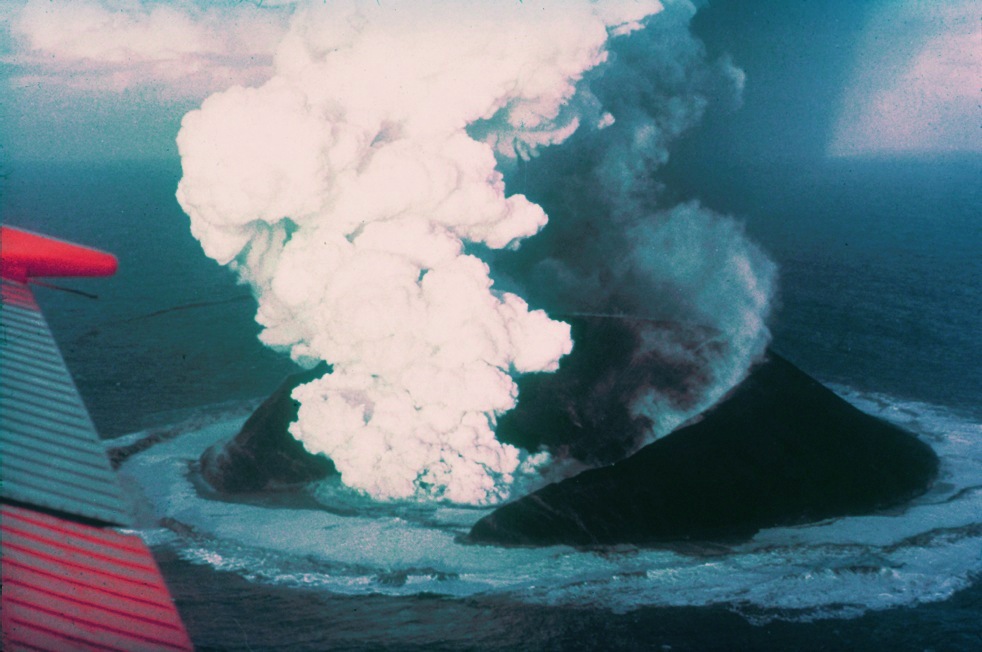
An island born from volcanic eruption in 1963, completely sterile initially. Scientists have documented every single species arrival, creating an unparalleled record of ecosystem assembly from zero.
Howell Williams, NOAA, Public domain, via Wikimedia Commons
A Laboratory From the Deep
On November 14, 1963, fishermen off the southern coast of Iceland witnessed a column of dark smoke rising from the sea. An undersea volcanic eruption, beginning 130 meters below sea level, had breached the surface. For the next three and a half years, until the eruption ceased on June 5, 1967, the volcano built a new island from lava and tephra. Named Surtsey, after the fire giant Surtr from Norse mythology, the island reached a maximum size of 2.7 square kilometers.
From its birth, Surtsey was recognized as a unique natural laboratory. In 1965, while still erupting, it was declared a nature reserve. This designation ensures that the colonization of life on its initially sterile surface could proceed with minimal human interference. The island is a pristine environment to observe primary succession—the process of life taking hold on barren land. Its protection allows for a long-term record of how plants and animals arrive and establish an ecosystem from nothing. In 2008, UNESCO designated Surtsey a World Heritage Site, acknowledging its immense scientific value.
The First Arrivals
Life began to arrive on Surtsey almost immediately, carried by wind, water, and wings. The first microorganisms, bacteria, and fungi were detected as early as 1964. The following year, in 1965, the first vascular plant was found on its northern shore: a sea rocket (Cakile arctica). In the first decade, only about 10 plant species became established in the nutrient-poor volcanic soil. Mosses and lichens were also early pioneers, with the first moss species appearing in 1967 and lichens in 1970.
A significant change occurred with the establishment of a gull colony around 1985. Birds had visited the island from its early days, with fulmars and black guillemots being the first to nest in 1970. The gulls, however, had a much larger impact. Their guano fertilized the soil, allowing more complex and numerous plant species to thrive. By 2008, 69 species of plants had been found on the island. Birds proved to be the primary vectors for seed dispersal, carrying seeds in their digestive systems or attached to their feathers, a discovery that has reshaped understanding of plant colonization on remote islands. The arrival of insects, spiders, seals, and even the first earthworm followed, each new species adding complexity to the developing ecosystem.
💡Fun Facts
The island is named after Surtr, a fire giant from Norse mythology who is foretold to engulf the world in flames during Ragnarök.
Access is so restricted that only a handful of scientists are permitted to land on the island, and they must follow strict protocols to avoid introducing any non-native seeds or organisms.
In the 1970s, a tomato plant sprouted on the island. Scientists discovered it was the result of human waste and quickly removed it to preserve the integrity of the natural experiment.
The island is steadily shrinking due to intense wave erosion. Since 1967, it has lost about half its surface area and may be reduced to just a small, hard tuff core within a century.
Surtsey is a strict nature reserve and is not open to the public. Access is limited to a small number of permitted researchers.
Admission
Not applicable. Tourists are forbidden to land on the island.
Accessibility
The only ways to see the island are by boat tours that circle it or from sightseeing flights. The terrain itself is rough, unconsolidated volcanic rock and is not accessible.