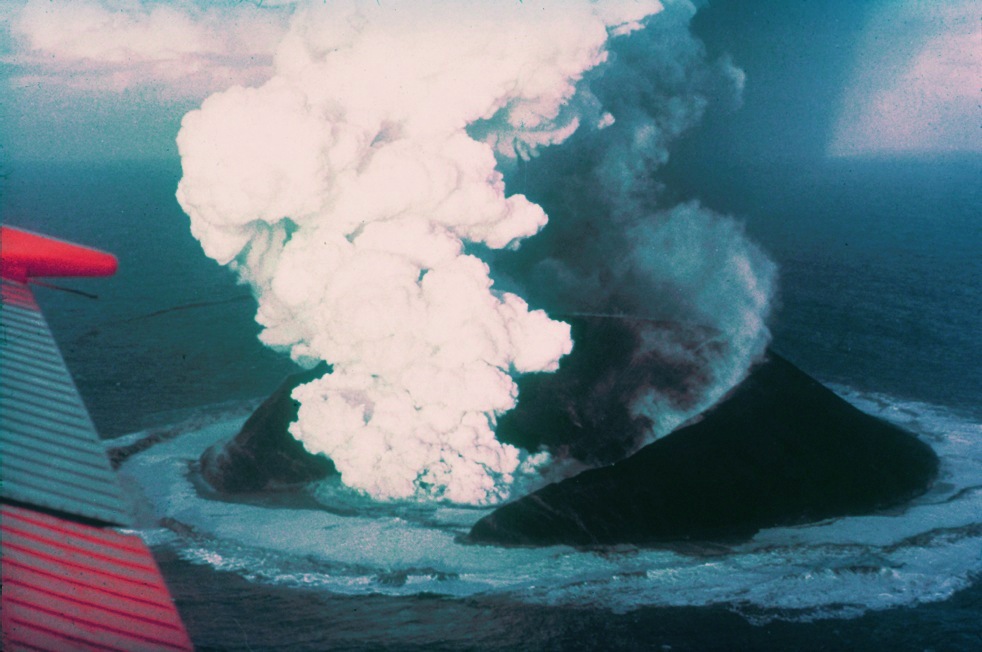
A volcanic birth
On November 14, 1963, fishermen off the southern coast of Iceland witnessed smoke and ash rising from the sea. An undersea volcanic eruption, beginning 130 meters below sea level, had breached the surface. Over the next three and a half years, until the eruption ceased on June 5, 1967, lava and ash built a completely new island. Named Surtsey, after the fire giant Surtr from Norse mythology, the island reached a maximum size of 2.7 square kilometers.
From its birth, scientists recognized the island as an important natural laboratory. It was a sterile environment where the colonization of life could be observed from the very beginning. To preserve this experiment, Iceland declared Surtsey a nature reserve in 1965, strictly prohibiting public access. Only a small number of permitted researchers may set foot on the island, following rigorous protocols to prevent introducing non-native seeds or organisms. This protection has allowed Surtsey to become a world-class site for studying primary succession, the process of life taking hold in a place where none existed before.
The arrival of life
Life arrived on Surtsey faster than many expected. The first colonists were not plants, but microbes, molds, and fungi. In 1965, botanists recorded the first vascular plant, a sea rocket (Cakile arctica), which likely grew from a seed washed ashore by ocean currents. Mosses were first observed in 1967, followed by lichens in 1970. These early pioneers helped with soil development, breaking down the volcanic rock and trapping windblown particles.
Insects were detected as early as 1964, carried by wind from the mainland or even as far as continental Europe. Birds soon followed. The first species to nest on the island were the northern fulmar and black guillemot. The establishment of a large gull colony in the 1980s marked a turning point for the island's ecosystem. The birds' guano enriched the nutrient-poor volcanic soil, accelerating plant growth and allowing more species to establish themselves. By 2008, 69 species of plants had been found on the island. The first earthworm, an important soil engineer, was discovered in 1993, likely transported by a bird from a nearby island.