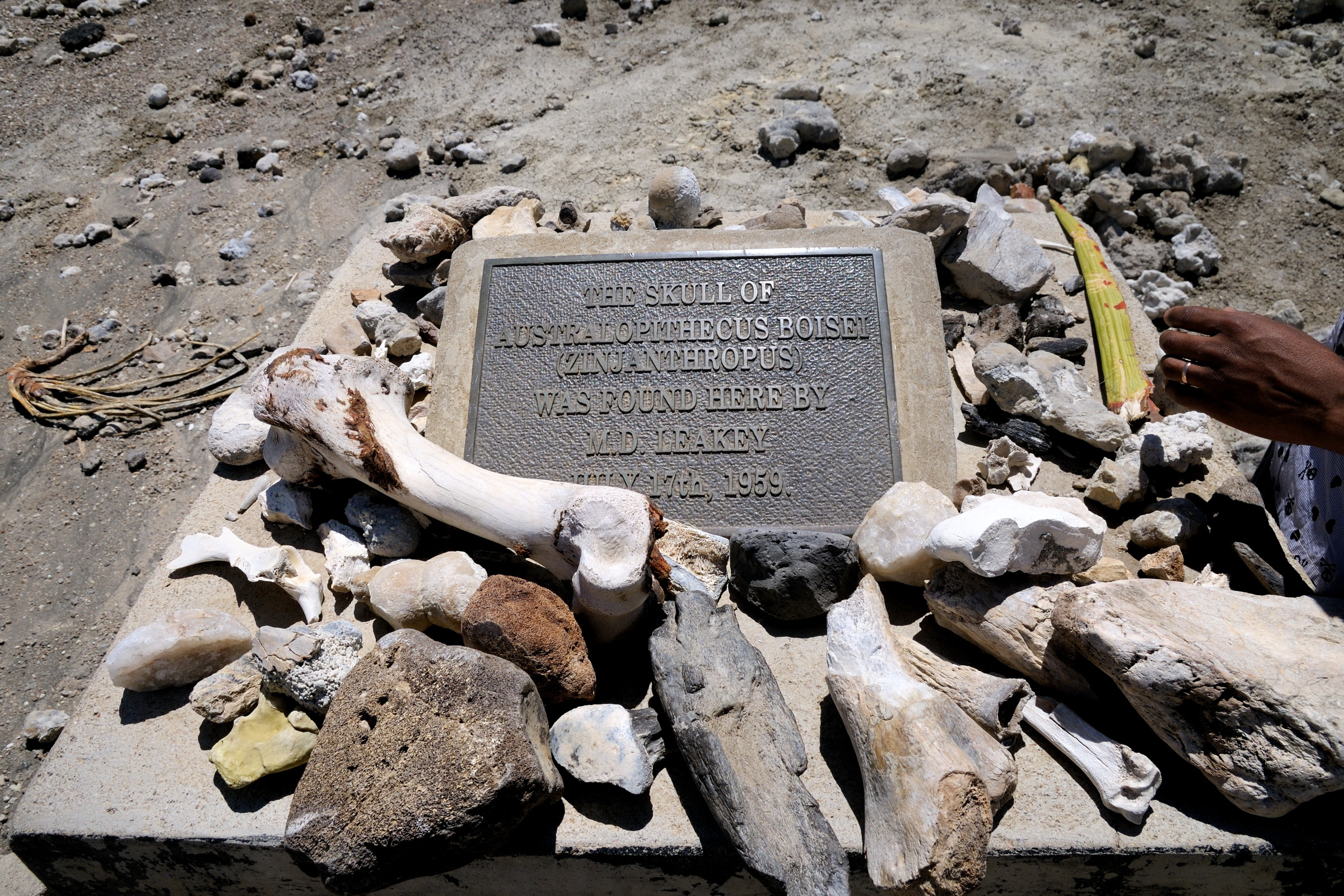
The discovery at FLK Zinj
On July 17, 1959, paleoanthropologist Mary Leakey was searching the sediment layers of Olduvai Gorge with her two Dalmatians when she noticed two large teeth protruding from the hillside. Her husband and collaborator, Louis Leakey, was back at camp with a fever. The teeth were part of an upper jaw, and after 19 days of careful excavation, the Leakeys and their team recovered over 400 fragments of a nearly complete hominin cranium.
The skull, officially designated Olduvai Hominid 5 (OH 5), was found in the geological layer known as Bed I. Radiometric dating of the volcanic rock layer estimated its age at a remarkable 1.75 million years. Lying alongside the skull were stone tools of the Oldowan industry—simple choppers and flakes. This was the first time a hominin of this great age had been found in direct association with tools, establishing a deep timeline for tool manufacturing among human relatives. The discovery attracted immense public interest and secured funding for the Leakeys' continued research in East Africa. Louis Leakey initially named the new species Zinjanthropus boisei. The name derives from "Zinj," an old Arabic word for East Africa, and "Boise," the surname of the Leakeys' financial supporter.
Meet Paranthropus boisei
The skull OH 5 belonged to a species now known as Paranthropus boisei, a distant relative on a side branch of the human evolutionary tree. The species lived in Eastern Africa from about 2.3 to 1.2 million years ago. Its distinctive features are related to powerful chewing. The skull has a prominent ridge of bone along the midline, called a sagittal crest, which anchored massive temporalis muscles. These muscles connected to a thick, deep jaw, generating immense force for the back teeth.
The cheek teeth—the molars and premolars—are enormous, some up to four times the size of a modern human's, with the thickest dental enamel of any known early human. These features earned OH 5 the nickname "Nutcracker Man." Flaring cheekbones created a wide, dish-shaped face. Despite this robust chewing apparatus, the brain size was only about 530 cubic centimeters, less than half the average of a modern human. Isotope and dental microwear studies suggest that rather than cracking nuts, P. boisei primarily ate large quantities of tough, abrasive C4 plants like grasses and sedges. The powerful skull may have been an adaptation for processing large volumes of low-quality vegetation, perhaps falling back on harder foods when preferred resources were scarce.