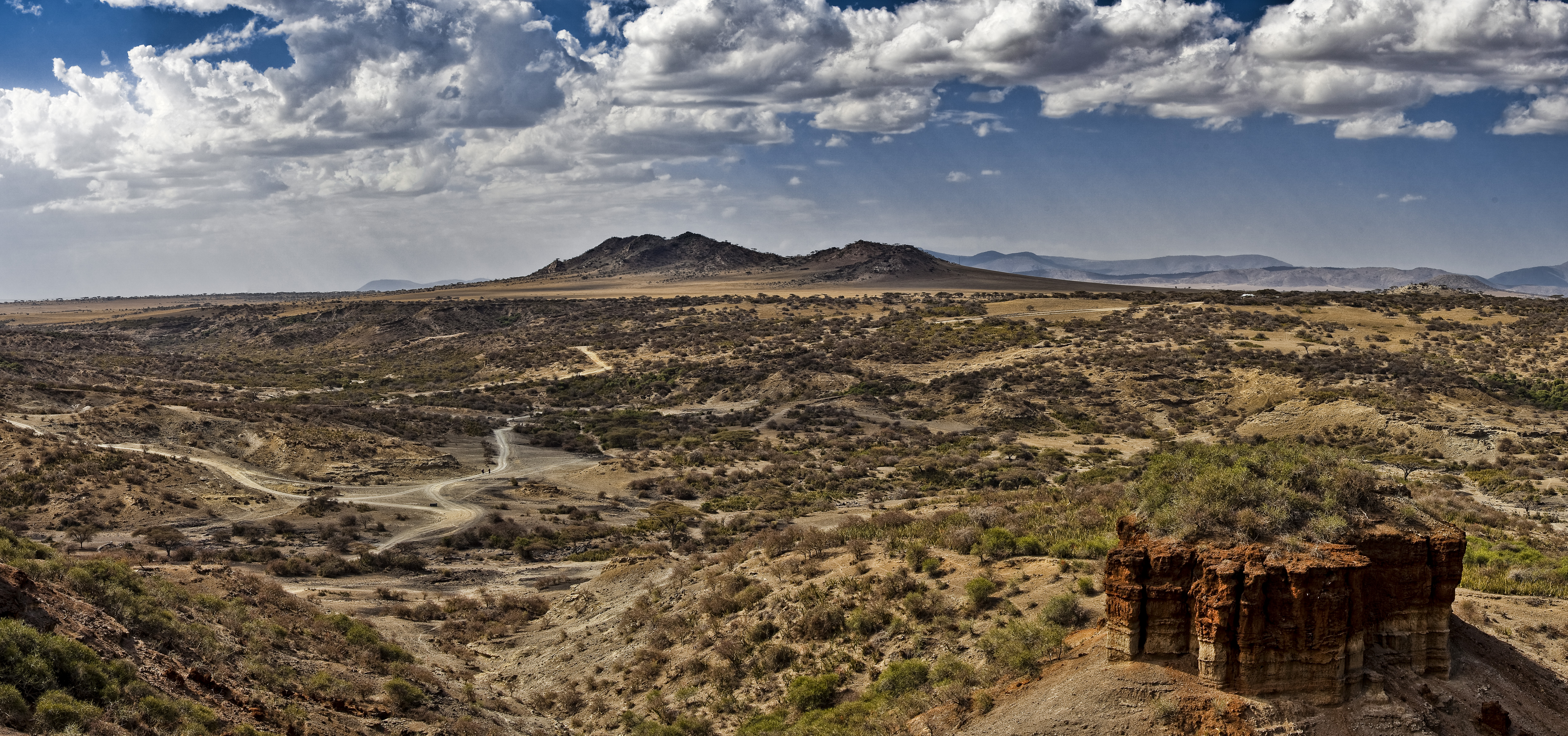
The Cradle of Mankind, where the Leakeys discovered 1.8-million-year-old Homo habilis fossils alongside the oldest known stone tools. The gorge preserves 2 million years of human evolution in a single location, making it an important paleoanthropological site on Earth.
Noel Feans, CC BY 2.0
A Canyon Through Time
Olduvai Gorge is a 48-kilometer-long ravine carved into the sedimentary plains of the Serengeti. Its steep sides reach depths of 90 meters, exposing a cross-section of Earth's history created by millions of years of geological activity. For much of its past, this area was a lake basin that collected layers of sediment and volcanic ash from nearby eruptions. This process created a neatly stratified record, a geological record documenting two million years of life and environmental change.
Geologists have divided the gorge's layers into seven major formations. The oldest, Bed I, rests on a base of volcanic rock and contains fossils dating back to about 2.1 million years ago. Above it, Beds II, III, and IV continue the timeline, followed by the Masek, Ndutu, and Naisiusiu Beds. The periodic layers of volcanic tuff are especially useful, as they contain potassium isotopes that allow for precise radiometric dating of the fossils and artifacts trapped within them. This clean, datable sequence of layers provides an uninterrupted record of the hominins, animals, and changing climates of the Pleistocene epoch.
Hominin Inhabitants
The history of Olduvai involves from the paleoanthropologists Mary and Louis Leakey. In July 1959, Mary Leakey discovered a fragmented hominin skull in Bed I. The specimen, OH 5, was a robust australopithecine with a wide, dish-shaped face and enormous molar teeth, earning it the nickname "Nutcracker Man". Originally named Zinjanthropus boisei, it is now classified as Paranthropus boisei and dated to 1.8 million years ago. This discovery indicated that early hominins evolved in Africa.
A year later, the Leakeys' son Jonathan found a different type of hominin at the same site. These fossils, including a lower jaw and cranial fragments (OH 7), had smaller teeth and a larger brain capacity, estimated at around 680 cubic centimeters. The Leakeys classified this new species as Homo habilis, or "handy man," proposing it as the maker of the stone tools found in the same 1.8-million-year-old layers. The gorge's upper layers also contain fossils of the later species Homo erectus and even early Homo sapiens, recording continuous hominin occupation of the area for nearly two million years.
The Oldowan Toolkit
The lowest layers of Olduvai Gorge contain the earliest standardized stone tool industry, known as the Oldowan. Dating back as far as 2.6 million years ago in other parts of Africa, the Oldowan tools at this site appear around 2 million years ago. The technology is defined by its simplicity and efficiency. Hominins selected suitable river cobbles and, using a hammerstone, struck sharp-edged flakes from a central core.
The results were twofold: the angular core became a "chopper," a heavy-duty tool for breaking bones to get marrow or for rough woodworking. The flakes, though small, were the real innovation. Their razor-sharp edges were effective for butchering animal carcasses, slicing through hides, and cutting plant material. Microscopic analysis of these simple flakes confirms their use in a wide variety of tasks. While it is not certain which species first invented these tools, their appearance alongside Homo habilis at Olduvai suggests this species was a proficient toolmaker, using technology to gain access to new food sources.
💡Fun Facts
The name "Olduvai" is a misspelling of the Maasai word "oldupai," which is the name for the tough wild sisal plant (*Sansevieria ehrenbergii*) that grows in the gorge.
Mary and Louis Leakey's team nicknamed the famous *Paranthropus boisei* skull (OH 5) "Dear Boy".
The first hominin fossil found at the gorge was discovered not by the Leakeys but by German geologist Hans Reck in 1913.
Layers of volcanic ash from eruptions of nearby volcanoes like Olmoti and Kerimasi are what allowed for the precise potassium-argon dating of the hominin fossils.
The Olduvai Gorge Museum is typically open daily from 8:00 AM to 5:00 PM.
Admission
Admission is included as part of the entry fee for the Ngorongoro Conservation Area.
Accessibility
The site involves walking on uneven, unpaved terrain. The museum itself is accessible, but reaching excavation viewpoints requires navigating dirt paths.