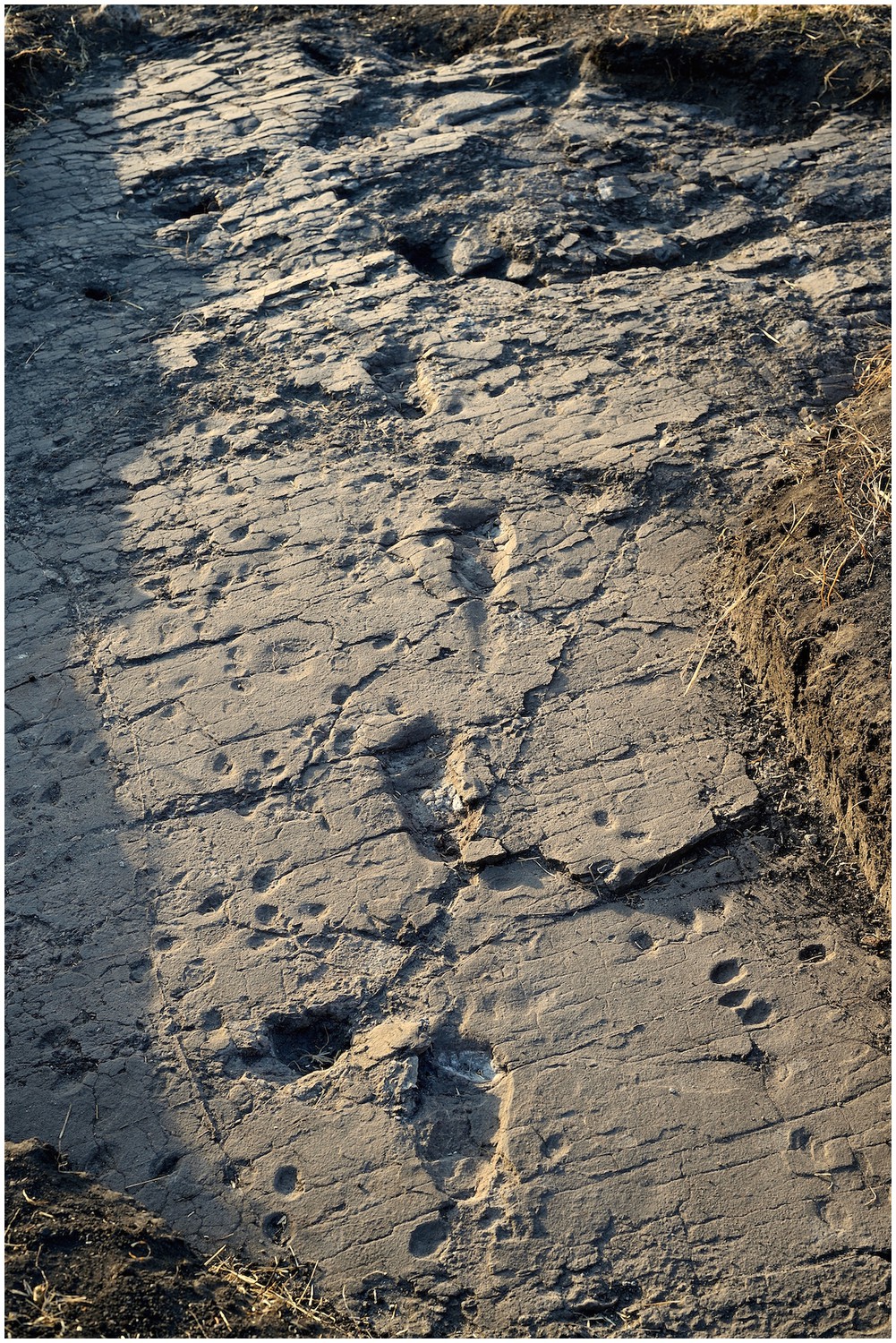
A moment preserved in ash
In the Laetoli area of northern Tanzania, a layer of volcanic tuff contains one of the most direct records of early human evolution. Dated to 3.66 million years ago, these are the fossilized footprints of bipedal hominins. The tracks were preserved by a fortunate sequence of events. First, a nearby volcano erupted, blanketing the landscape with a fine layer of ash. A light rain then turned this ash into a muddy surface, ideal for capturing impressions. Animals, including early humans, walked across this surface, and before the prints could erode, another volcanic eruption sealed them under a new layer of ash. Over millions of years, this ash turned to stone, preserving a moment in time.
A team led by paleoanthropologist Mary Leakey discovered the tracks between 1976 and 1978. The most famous section, known as Site G, is a trackway 27 meters (88 feet) long containing about 70 individual footprints from three individuals walking in the same direction. The species that made the prints is identified as Australopithecus afarensis, the same species as the famous "Lucy" skeleton. This identification is based on fossil remains of the species found in the same sediment layers. The footprints show a pronounced heel-strike, a longitudinal arch, and a big toe in line with the other toes—all signs of a modern, upright walking gait. This settled a long-standing debate, showing that hominins walked bipedally long before the evolution of larger brains.