A river's slow work
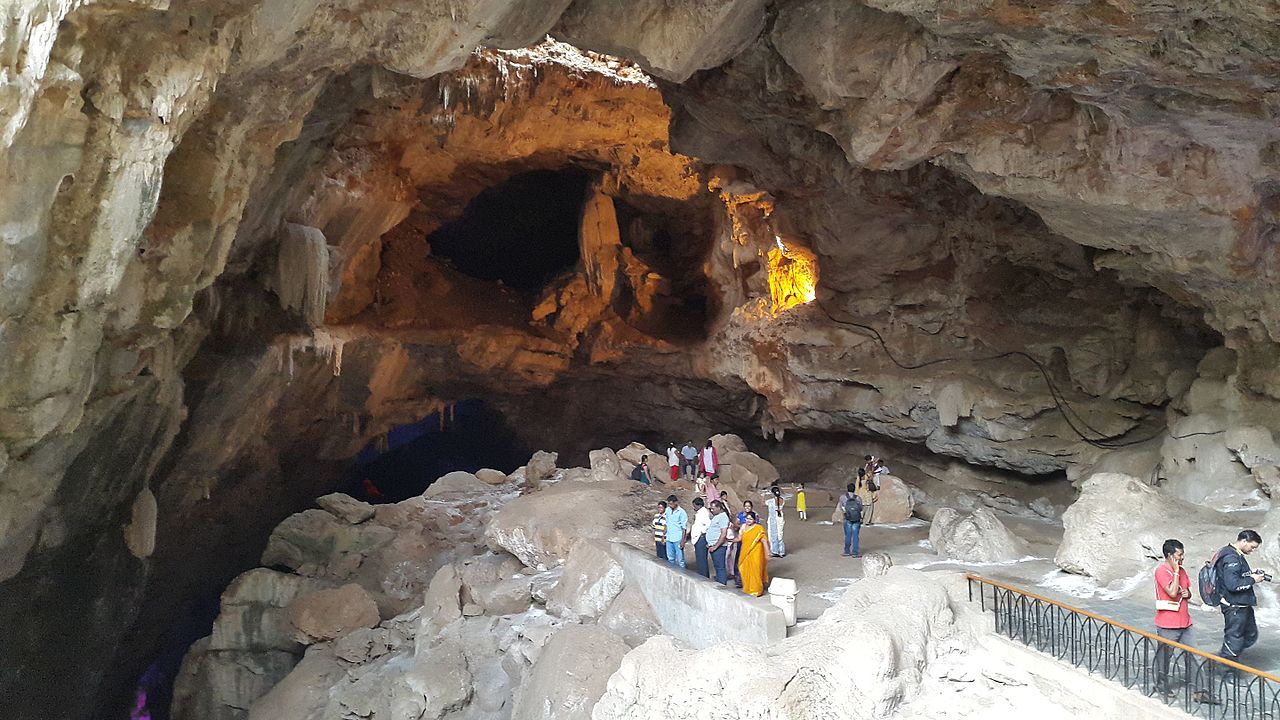
The Borra Caves are a karstic system, a landscape sculpted by the dissolution of soluble rock. They are located in the Ananthagiri hills of the Eastern Ghats at an elevation of about 705 meters. The caves formed over millions of years as the Gosthani River flowed through a massive deposit of limestone, a type of calcium carbonate rock. Rainwater, made slightly acidic by absorbing atmospheric carbon dioxide to form carbonic acid, percolated through the ground, dissolving the limestone and slowly carving the caverns. This process created a vast network extending 80 meters deep, making them among the deepest caves in India.
The entrance alone measures 100 meters horizontally and 75 meters vertically. Inside, the chemical process continues. As mineral-rich water drips from the ceiling, it leaves behind calcite deposits. These grow downwards to form stalactites, some reaching lengths of 3.5 meters. Where the drips land on the cave floor, they build up into stalagmites, which can be over a meter tall. Sometimes, a stalactite and stalagmite meet to form a single column. The largest of these pillars is 6 meters high and 0.75 meters wide. The cave's internal temperature remains a stable 16°C. The geological setting is the Archaen-age Khondalite suite of rocks, which also contains mica deposits prospected for rubies.
Human history in the depths
British geologist William King of the Geological Survey of India formally documented the caves in 1807. However, human history here is much older. Excavations have unearthed stone tools from the Middle Paleolithic culture, dating back 30,000 to 50,000 years, indicating the caves were a shelter for early humans.
For local tribal communities, the caves hold deep religious importance. This is primarily due to specific speleothems that resemble figures from Hindu mythology. A large, rounded stalagmite is worshipped as a Shivalinga. Nearby, another formation is interpreted as the divine cow Kamadhenu. According to legend, the Gosthani River originates from the "udder" of this stone cow. These naturally formed mineral shapes have made the caves a place of pilgrimage. The cave ecosystem also supports a variety of life, including large colonies of the fulvous fruit bat (Rousettus leschenaultii), the golden gecko, and thick, orange microbial mats that may help with mineral precipitation.