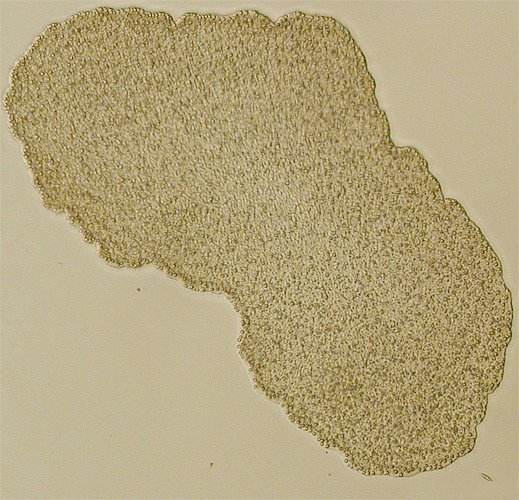
The simplest animal on Earth
In the warm, shallow waters of the Red Sea, you can find what is arguably the simplest animal on the planet. It is a tiny, blob-like organism called Trichoplax adhaerens, a member of the phylum Placozoa. Discovered in the 1880s in a saltwater aquarium, this creature resembles a microscopic pancake, usually less than a millimeter across. Its body has no symmetry, no organs, no muscles, and no nervous system. The entire animal consists of just a few thousand cells organized into three simple layers.
Detailed microscopic study reveals only six distinct types of cells. There is an upper layer of flattened "cover cells," a lower layer of cylinder and gland cells used for movement and digestion, and a middle layer of star-like fiber cells. It moves using the cilia on its underside and feeds by crawling over algae and microbes, secreting digestive enzymes and absorbing the nutrients. Reproduction is typically asexual, with the animal simply splitting in two. Its official name even translates to "sticky hairy plate," a nod to its simple structure and tendency to cling to surfaces.
A surprisingly complex blueprint
The extreme simplicity of Trichoplax hides a deep secret within its cells. Its nuclear genome, sequenced in 2008, contains approximately 98 million base pairs and includes over 11,500 protein-coding genes. While the total number of base pairs is much smaller than a human's, the number of genes is substantial—over half the human count of around 20,000.
Remarkably, nearly 87% of the genes in Trichoplax are similar to known genes in other animals, including humans. Its genome contains the genetic toolkit for processes it does not seem to perform. For example, Trichoplax has numerous genes for cell adhesion and cell-to-cell signaling, which in more complex animals are important for building and maintaining organs and tissues. It even possesses many genes that, in humans, are involved in the formation of a nervous system, which Trichoplax completely lacks. The arrangement of genes on its six pairs of chromosomes also shows a conserved structure when compared to human chromosomes. This surprising genetic depth in such a simple organism suggests that the blueprint for complex animal life existed long before the animals themselves did. Phylogenetic analysis places Placozoa as one of the earliest branches on the animal family tree, diverging after sponges but before jellyfish and more complex animals.