The Turquoise Mines of Hathor
High on a desert plateau in the southwest Sinai, at an altitude of 850 meters, are the ruins of an ancient Egyptian temple and turquoise mines. This is Serabit el-Khadim. For over 800 years during Egypt's Middle and New Kingdoms, pharaohs sent expeditions here to extract the prized blue-green gemstone. Dominating the site is a temple dedicated to the goddess Hathor, known by the epithet "Lady of Turquoise". The temple, first established around 1971-1926 BCE by Senusret I, was a place for miners to leave offerings, hoping for a successful expedition and a safe return.
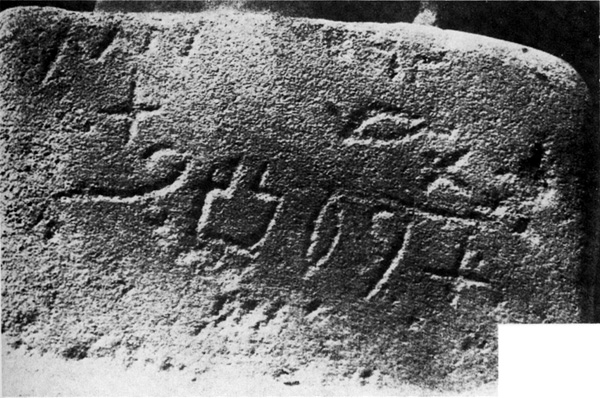
Working in these remote mines were Egyptians and Semitic-speaking people from the Levant, often referred to as Canaanites. Amidst the formal hieroglyphic stelae left by Egyptian officials, archaeologists have found a very different kind of writing: around 30-40 crudely carved inscriptions. These markings, found on rocks and small statues near the mines and the temple, record a revolutionary moment in human communication. The inscriptions are dated by most scholars to between the 19th and 16th centuries BCE.
An Alphabet for the People
The Canaanite workers were surrounded by complex Egyptian hieroglyphs, a system with hundreds of signs that took years of training to master. They needed a simpler way to write their own language. Their solution was to borrow pictures from the Egyptians but use them in a completely new way. This invention is based on the acrophonic principle: a picture is chosen to represent the first sound of the word it depicts in their own Semitic language.
For example, they took the Egyptian hieroglyph for an ox-head and used it to represent the first sound of their word for ox, 'alp. This became the letter 'aleph'. The symbol for a house, bayt in their language, became the 'b' sound, our letter B. The wavy line hieroglyph for water, or mayim, became the 'm' sound, the ancestor of M. This was the world's first known alphabet, a script based on single sounds rather than whole words or syllables.
The British Egyptologist Alan Gardiner made the breakthrough in deciphering the script in 1916. He identified a recurring sequence of signs and translated it as l-bʿlt, meaning "to the Lady"—a dedication to the Semitic goddess Ba'alat, whom the miners likely equated with the Egyptian Hathor. The initial discovery of the inscriptions was made by Hilda and Flinders Petrie during their expedition in the winter of 1904-1905.