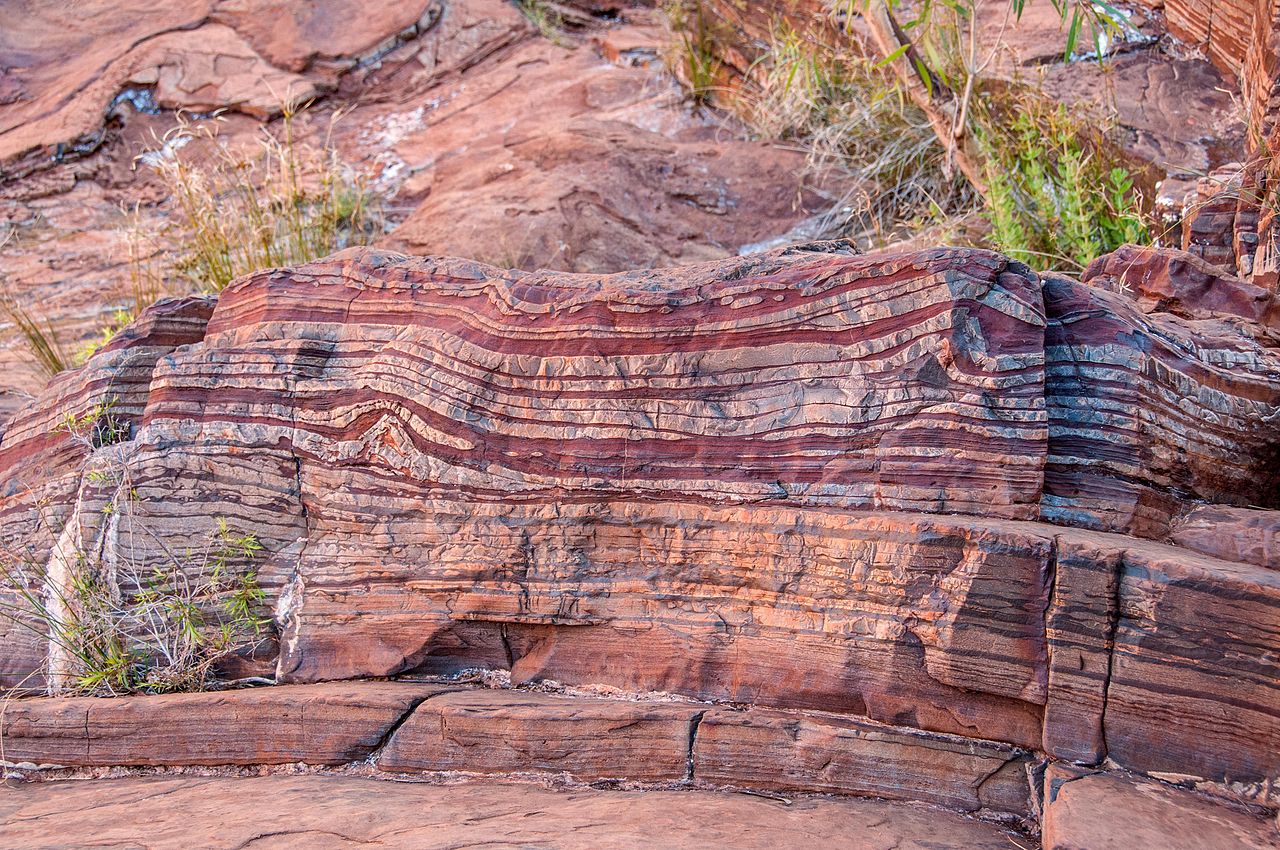
A Planetary Poisoning
These striped rocks are a crime scene written on a geological scale. The evidence records a mass extinction, the rusting of an entire planet, and the rise of a new atmospheric order. For the first billion years of Earth's history, the oceans were full of dissolved iron. Then, around 3.4 billion years ago, a new form of life evolved: cyanobacteria. These microbes developed a novel way to make energy from sunlight called oxygenic photosynthesis. Its waste product, oxygen, was toxic to the anaerobic life that dominated the planet.
This led to the Great Oxidation Event, a period starting around 2.4 billion years ago when oxygen produced by cyanobacteria began to accumulate in the oceans and atmosphere. The free oxygen immediately reacted with the abundant dissolved iron, which precipitated out of the seawater as insoluble iron oxides. These particles of what was effectively rust settled on the ocean floor, forming vast layers of iron-rich sediment. This process, which locked away immense quantities of iron, happened on a global scale but the formations in Western Australia's Hamersley Range are among the largest and best-preserved.
Earth's Rhythmic Breath
The distinct layering in Banded Iron Formations (BIFs) records cyclical activity. The dark, red-to-black bands are iron oxides, minerals like hematite (Fe2O3) and magnetite (Fe3O4). The lighter, silver-gray bands are chert, a microcrystalline form of silica (SiO2). This rhythmic alternation is thought to reflect seasonal blooms of cyanobacteria.
During periods of high activity, the microbes released large amounts of oxygen, creating a thick layer of precipitated iron oxides. When the bloom subsided, a layer of silica would settle on top. The thickness of these layers, called mesobands, ranges from a few millimeters to a few centimeters. Within these, even finer microbands less than a millimeter thick can be seen. Over hundreds of millions of years, these deposits built up into formations that can be several hundred meters thick and stretch for hundreds of kilometers. The formations in the Pilbara region account for more than 60% of the world's iron reserves.