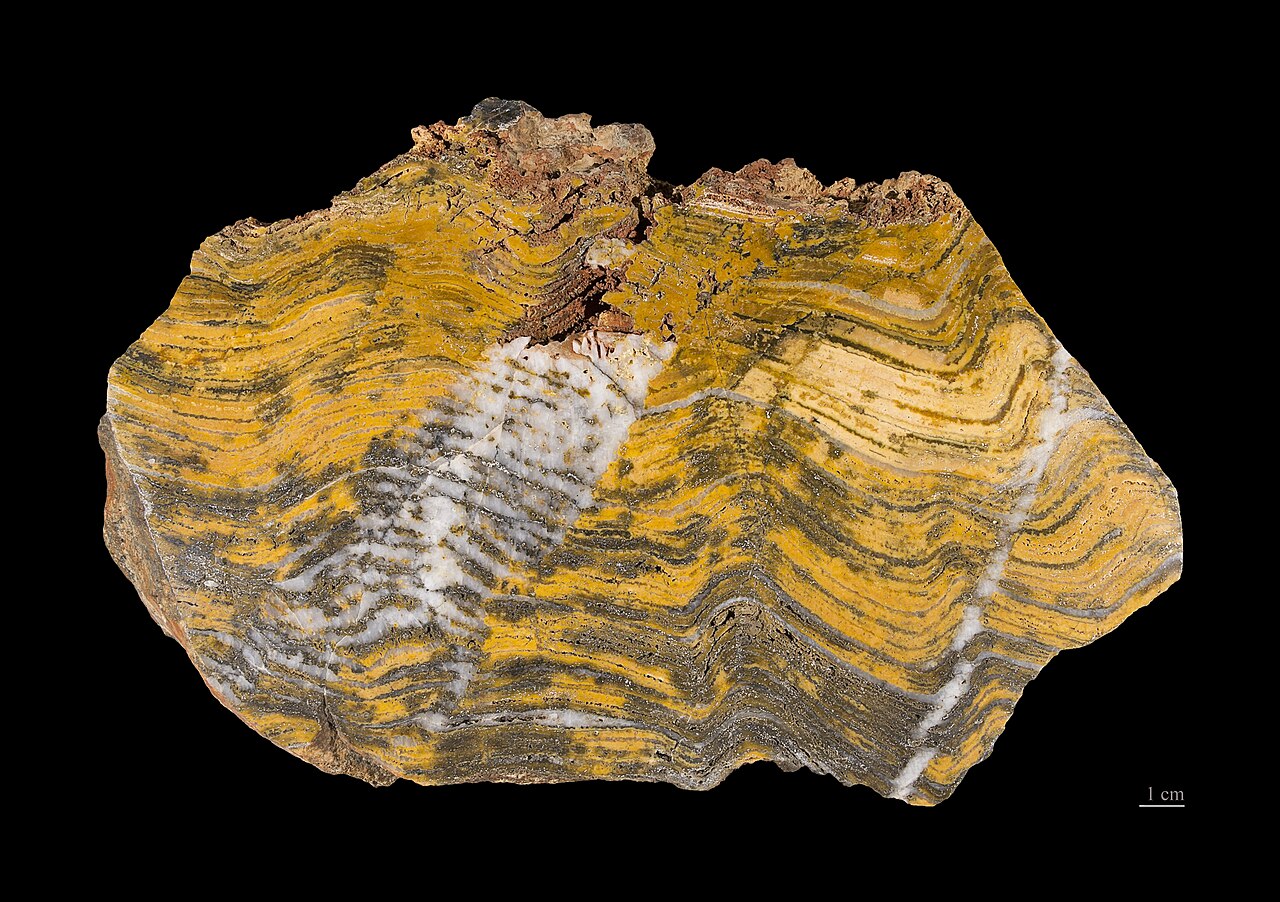
Layered rock formations built by cyanobacteria 3.5 billion years ago, the oldest widely accepted evidence of life on Earth. These microbial mats pumped out oxygen that would make complex life possible. Living stromatolites still grow in a few places today.
Didier Descouens, CC BY-SA 4.0, via Wikimedia Commons
A Planet-Altering Fossil Record
In the remote Pilbara region of Western Australia lies some of the oldest, most stable crust on the planet. Within this ancient landscape are rock formations containing stromatolites that date back nearly 3.5 billion years. These are not fossils of individual animals or plants, but rather the layered, mineralized structures built by immense colonies of microorganisms, primarily cyanobacteria. The fossils are found in geological units like the Dresser Formation, dated to 3.48 billion years old, and the slightly younger Strelley Pool Formation, dated to 3.43 billion years.
The formation process was slow and repetitive. Cyanobacteria formed sticky microbial mats in shallow, sunlit water. These adhesive layers trapped particles of sediment carried by the water. To avoid being buried and to continue accessing sunlight for photosynthesis, the microbes would grow upwards through the newly trapped sediment, starting a new layer. Over thousands of years, this cycle of sediment trapping and upward growth created the distinct, laminated domes and cones now preserved in stone. Some of these fossilized structures are small, with shapes described as "egg-carton" formations, while others form broad domes up to a meter high. Their complex shapes are evidence of a biological origin, as purely non-biological processes are unlikely to create such diverse structures.
The Oxygen Architects
The cyanobacteria that built the Pilbara stromatolites changed Earth's environment. Through photosynthesis, these microbes took in carbon dioxide and released oxygen as a waste product. During the Archean Eon, when these organisms thrived, Earth's atmosphere and oceans contained almost no free oxygen. For hundreds of millions of years, the oxygen produced by these microbial mats reacted with dissolved iron in the oceans, causing it to precipitate as iron oxides. This process formed the massive Banded Iron Formations, the source of much of the iron ore mined in the Pilbara today.
Once the dissolved iron in the oceans was largely used up, oxygen began to accumulate in the atmosphere, leading to what is known as the Great Oxidation Event around 2.4 billion years ago. This dramatic shift was toxic to the anaerobic life that had dominated the planet, but it was the step that led to the evolution of more complex, oxygen-breathing organisms. For over two billion years, stromatolites were a dominant form of life on Earth, their collective metabolism slowly engineering a planet capable of supporting animals, and eventually, us.
These ancient fossils have a direct relevance to astrobiology. Scientists from NASA and the European Space Agency study the Pilbara stromatolites as an analog for what to look for on Mars. The rocks of the Pilbara Craton are of a similar age to much of the Martian surface, and understanding how these biosignatures were preserved on Earth helps refine the search for signs of ancient life on other worlds.
💡Fun Facts
The name "stromatolite" comes from the Greek words for ‘layered rock’.
For about 85% of Earth's history, life was exclusively microbial, and stromatolites were a dominant life form for over two billion years.
Living stromatolites still exist in a few places, most famously in the hypersaline water of Hamelin Pool, Shark Bay, Western Australia.
Some of the iron ore mined in the Pilbara is a direct result of the oxygen produced by the ancient microbes that formed the stromatolites.
The fossil sites are in remote, unfenced wilderness areas and are technically accessible 24/7, but travel is only safe during daylight hours.
Admission
Free. However, some key sites are designated State Geoheritage Reserves and require permission to access for research or collection.
Accessibility
The sites are extremely remote and require a 4WD vehicle, significant off-road driving experience, and careful preparation for harsh desert conditions. There are no visitor facilities. The best time to visit is during the cooler winter months (May-September).
The Pilbara StromatolitesWestern Australia, Australia