A planet-wide chemical reaction
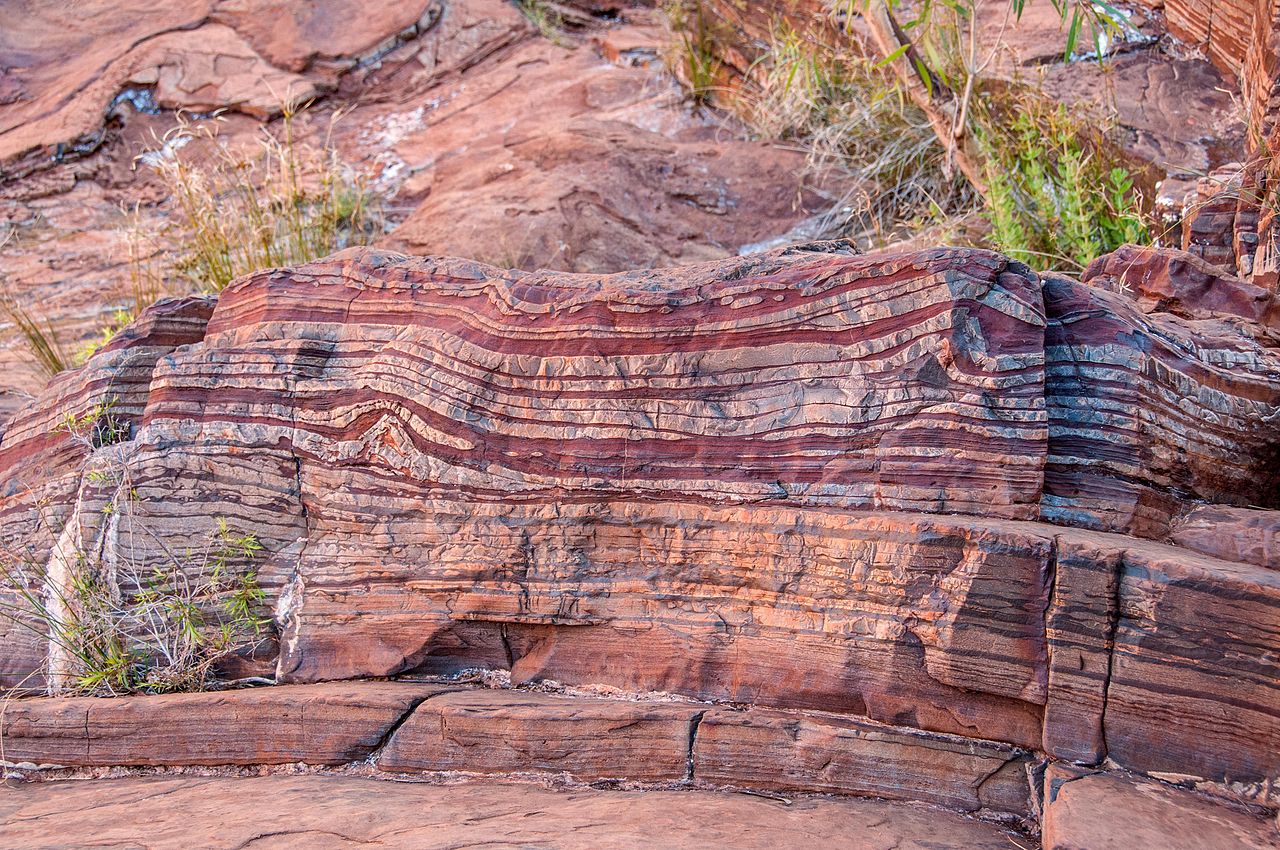
The dramatic striped cliffs of the Hamersley Range are a record of a deep planetary transformation. These rocks, known as Banded Iron Formations (BIFs), document the period when Earth’s oceans began to rust. For over a billion years, early oceans were full of dissolved iron and almost completely devoid of free oxygen. Life was exclusively anaerobic. Around 2.7 to 2.5 billion years ago, photosynthetic cyanobacteria evolved and began to release oxygen as a waste product.
This new, highly reactive gas immediately combined with the abundant dissolved ferrous iron (Fe²⁺) in the seawater. The reaction formed insoluble iron oxides, primarily magnetite (Fe₃O₄) and hematite (Fe₂O₃), which precipitated and settled on the seafloor. This process created the distinct layering visible today. The dark, iron-rich bands represent periods of oxygen production and iron oxide deposition, while the lighter-colored layers are iron-poor chert, a form of silica. These alternating bands, some just millimeters thick, are thought to reflect cyclic or seasonal variations in microbial activity and oxygen output. The extensive BIFs in this region, such as the Brockman and Marra Mamba Iron Formations, can be several hundred meters thick.
The Great Oxidation Event
These local formations are the most compelling physical evidence for a global atmospheric shift called the Great Oxidation Event (GOE). This event, which unfolded between roughly 2.4 and 2.1 billion years ago, is the interval when oxygen produced by microbes finally overwhelmed the planet's chemical "sinks," like dissolved iron. For hundreds of millions of years, the oceans absorbed the new oxygen, locking it away in these vast iron formations. Estimates suggest the total amount of oxygen captured in the world's BIFs is as much as twenty times the volume present in our modern atmosphere.
Once the dissolved iron in the oceans was largely used up, oxygen began to escape into the atmosphere for the first time. This permanently altered the planet's chemistry, allowing for the evolution of aerobic respiration and, eventually, complex multicellular life. Before the GOE, atmospheric oxygen was less than 0.001% of its current level; afterward, it rose significantly, though it would take another billion years to reach modern concentrations. The deposition of most BIFs ceased around 1.8 billion years ago, signaling that the deep oceans had also become oxygenated. Today, these ancient chemical precipitates form the economic backbone of the Pilbara region, accounting for over 60% of global iron reserves and making it one of the most significant iron ore mining regions on Earth.