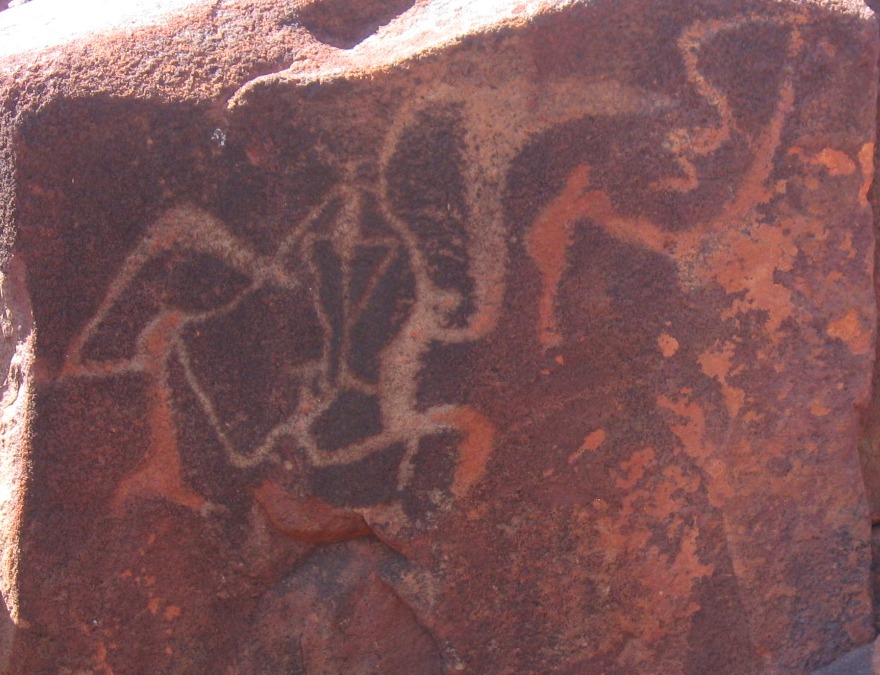
The world's largest collection of rock art with over a million petroglyphs. Some depict extinct megafauna, dating the art to over 40,000 years and making it humanity's oldest art site.
Tradimus, CC0
A library etched in stone
On the Burrup Peninsula in Western Australia, known as Murujuga to its traditional custodians, lies the densest concentration of rock engravings on Earth. Estimates place the number of individual petroglyphs at over one million, with some potentially dating back 50,000 years. The geology of the peninsula provides an ideal medium for this ancient art. The landscape is covered in hills of hard igneous rocks like gabbro and granophyre. Over millennia, these rocks develop a dark, iron and manganese-rich outer layer called a rock varnish or patina. The artists created the petroglyphs by pecking, pounding, or scratching through this dark skin to expose the lighter-colored, weathered rock underneath.
This vast outdoor site is the work of the region's Aboriginal peoples, and the land is important to five local groups: the Ngarluma, the Mardudhunera, the Wong-Goo-Tt-Oo, the Yaburara, and the Yindjibarndi. The Murujuga National Park, covering over 5,000 hectares, was declared in 2013 and is jointly managed by the Murujuga Aboriginal Corporation and the Western Australian government.
A record of extinction and climate change
The petroglyphs of Murujuga are a continuous record of environmental and cultural history spanning the last ice age. The oldest engravings depict land animals, including now-extinct megafauna like the fat-tailed kangaroo. There are also many depictions of the thylacine (Tasmanian tiger), which vanished from mainland Australia thousands of years ago. The collection includes some of the earliest known engravings of the human face.
As the Pleistocene epoch ended and sea levels rose, the peninsula was transformed into an archipelago. The subject matter of the rock art shifted to reflect this change. Newer layers of art show marine species such as turtles, fish, and dugongs, documenting the changing environment and the adaptation of the people who lived there. This long, unbroken sequence records the history of life and ecological transformation recorded directly on the landscape.
The art is now threatened by its proximity to one of Australia's largest industrial hubs. Emissions from nearby gas and fertilizer plants produce airborne pollutants like nitrogen oxides. Scientists have raised concerns that these emissions create acidic conditions that accelerate the weathering of the rock surfaces, potentially erasing the petroglyphs. This has led to ongoing monitoring and debate as Murujuga is considered for UNESCO World Heritage status.
💡Fun Facts
The art is a living tradition; Aboriginal custodians continue to create engravings for cultural and ceremonial purposes.
The local gabbro rock rings with a metallic sound when struck, a property that may have been significant to the ancient artists.
The collection contains some of the earliest known depictions of the human face, with some estimates dating them to 30,000 years old.
The art documents the disappearance of the thylacine from the mainland and the arrival of the dingo.
The main public viewing area at Ngajarli (Deep Gorge) is accessible year-round. Guided tours are also available.
Admission
Free to enter the national park for self-guided visits. Fees apply for guided cultural tours.
Accessibility
The Ngajarli viewing trail is a 700-meter universal access boardwalk suitable for wheelchairs and strollers. The surrounding terrain is rocky and uneven.