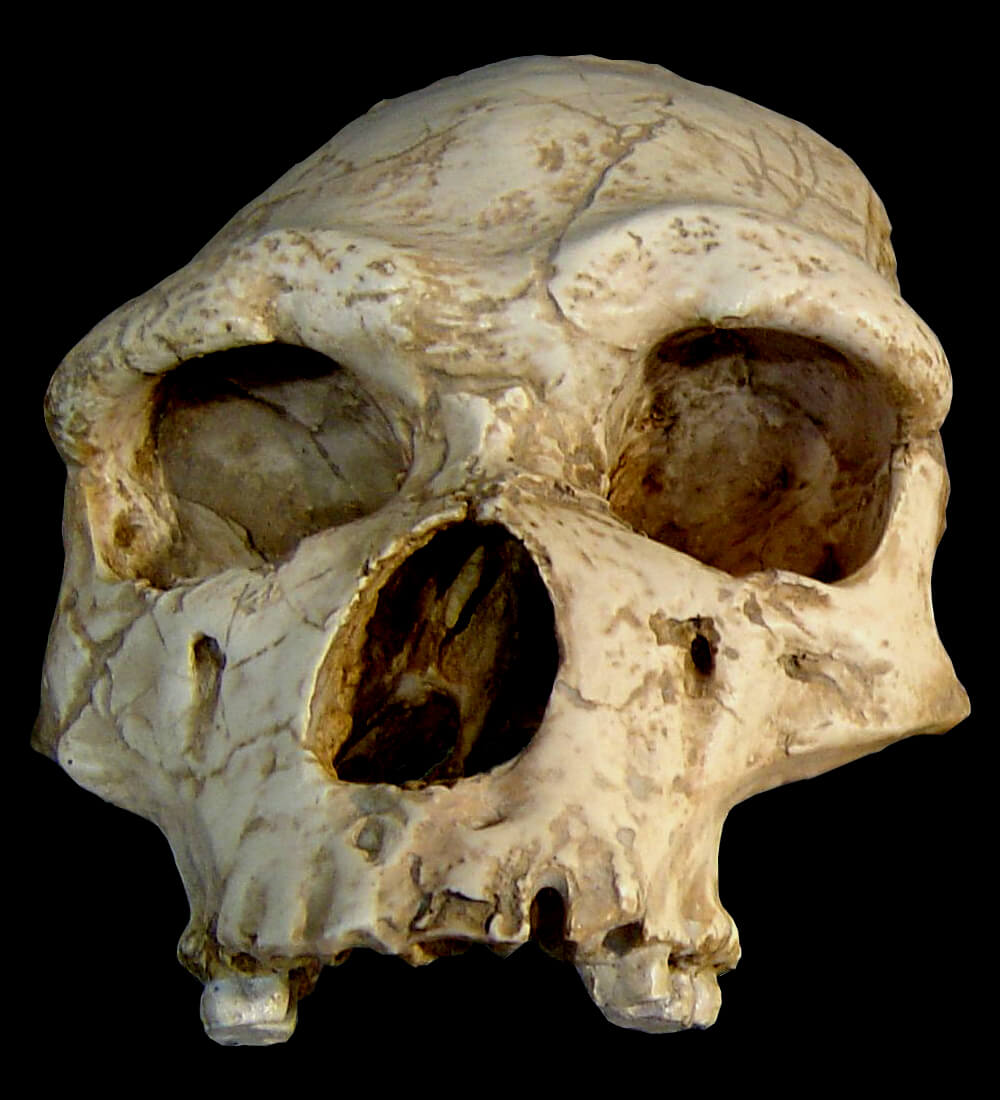
The face from the cave floor
In the Caune de l’Arago, a large limestone cave overlooking the Tautavel plain, archaeologists made a remarkable find. On July 22, 1971, a team led by Henry and Marie-Antoinette de Lumley uncovered a crushed but nearly complete human face, designated Arago 21. Dating to approximately 450,000 years ago, it is one of the oldest and most complete hominin faces ever found in Europe. The individual, nicknamed Tautavel Man, is classified as Homo heidelbergensis, an extinct species considered to be an ancestor of Neanderthals.
The fossil consists of the face, a frontal bone, and a right parietal bone (Arago 47) discovered in 1979 that fits perfectly with the main skull fragment. Analysis of the skull sutures indicates the individual was a young adult, around 20 years old, and its robust features suggest it was a male. Arago 21 presents a mosaic of features: a thick, prominent brow ridge and a receding forehead are considered archaic traits. Yet, the overall structure of the face led to reconstructions that appear surprisingly contemporary. His brain capacity was about 1,166 cubic centimeters, smaller than the average for modern humans (around 1,400 cm³) but within the lower range.