A half-million years of history
The Caune de l'Arago, or Tautavel Cave, sits on a cliffside 80 meters above the Verdouble river valley. For hundreds of thousands of years, this vast limestone cavity acted as a natural trap, accumulating nearly 15 meters of sediment from wind and water. These layers hold a detailed record of climate, animal life, and human activity spanning from roughly 700,000 to 100,000 years ago. Excavations led by Henry and Marie-Antoinette de Lumley began in 1964, eventually uncovering around 600,000 individual items, from stone tools to animal bones.
The most significant finds relate to an early human species called Homo heidelbergensis. More than 150 fossil fragments of these hominins have been found within the cave. The different layers show the cave was used for various purposes over millennia, including long-term camps, temporary hunting stops, and butchery workshops. For example, Layer G, dated to 450,000 years ago, represents a long-term base camp for hunting large herbivores.
Meet Tautavel Man
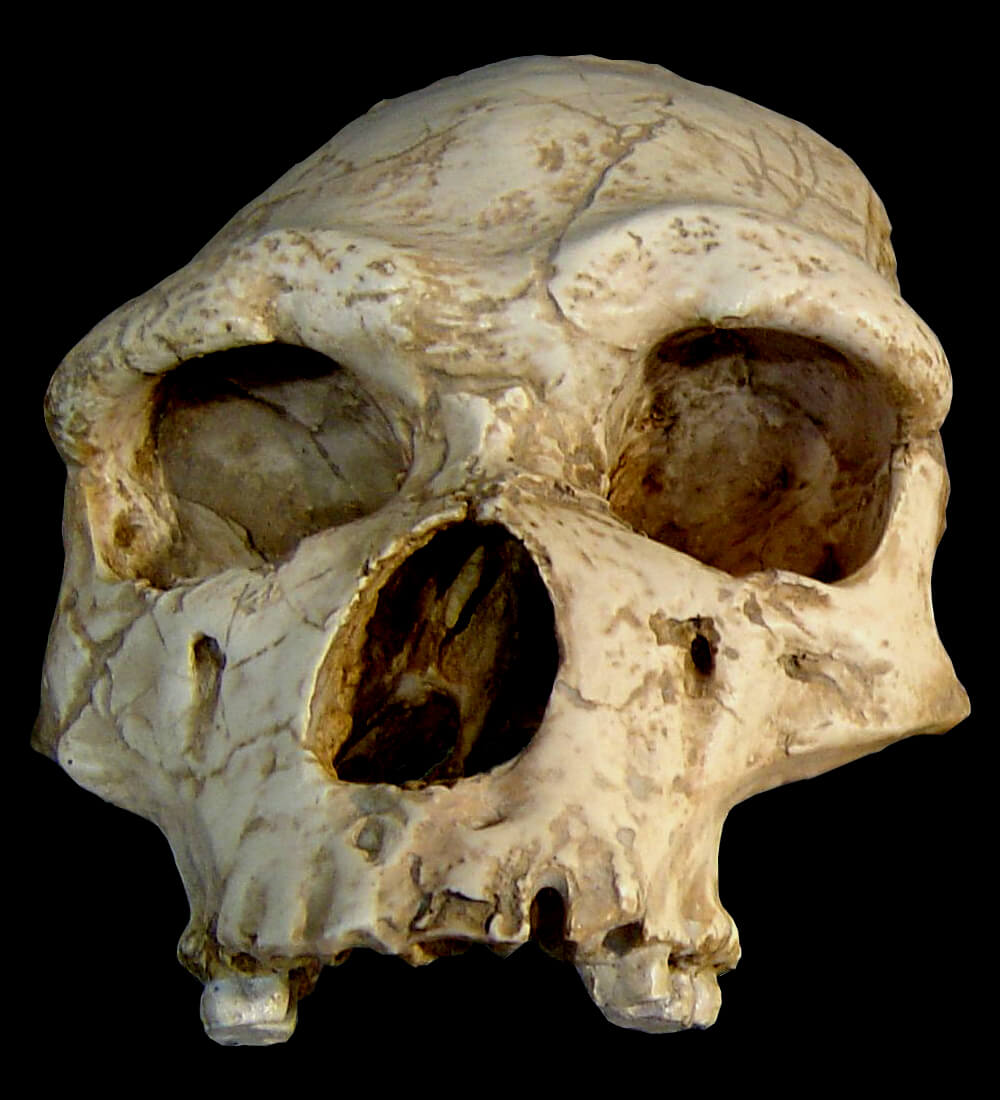
The most famous fossil from the cave is Arago 21, nicknamed "Tautavel Man." Discovered in 1971, it consists of a well-preserved face, a frontal bone, and a sphenoid bone. Later, a parietal bone (Arago 47) was found that belonged to the same individual. Analysis of the skull sutures suggests the person was a young adult, about 20 years old, when he died around 450,000 years ago.
The skull of Tautavel Man has features characteristic of Homo heidelbergensis, a species considered a likely ancestor of Neanderthals. These include a receding forehead, a strong brow ridge, and a large, forward-projecting face. The brain capacity is estimated to have been about 1,166 cubic centimeters. Standing around 1.65 meters (5 feet 5 inches) tall, Tautavel Man was robustly built. The remains from Arago Cave provide a detailed picture of this early European population.
A right-handed world
Evidence from Tautavel and other contemporary sites indicates that Homo heidelbergensis was predominantly right-handed. This conclusion comes from analyzing wear patterns on their teeth and the structure of their tools. When processing hides or cutting meat, these early humans would hold an object between their front teeth while slicing it with a stone tool. Occasional slips would leave tiny, angled scratches on the tooth enamel. The direction of these striations reveals which hand held the tool.
This handedness is a sign of brain lateralization—the separation of the brain's hemispheres into different functions. It is a distinctly human trait linked to the development of complex skills and language. The presence of right-handedness 450,000 years ago suggests that the neurological foundations for these abilities were already in place in our ancient ancestors.
The surrounding landscape
The animal bones found in Tautavel Cave show the Pleistocene environment. The climate fluctuated between cold steppeland and temperate forests. The animal remains reflect these changes. During colder phases, the landscape supported herds of reindeer, musk oxen, steppe bison, and an extinct horse species, Equus mosbachensis. Warmer periods brought red deer, fallow deer, and ancient rhinos.
The hominins of Arago were skilled hunters who targeted different species depending on the season and climate. Archaeological layers show a focus on reindeer in some periods and on musk ox or deer in others. They were not alone in the landscape, competing for resources with carnivores like lions and cave bears, whose remains are also found in the cave.