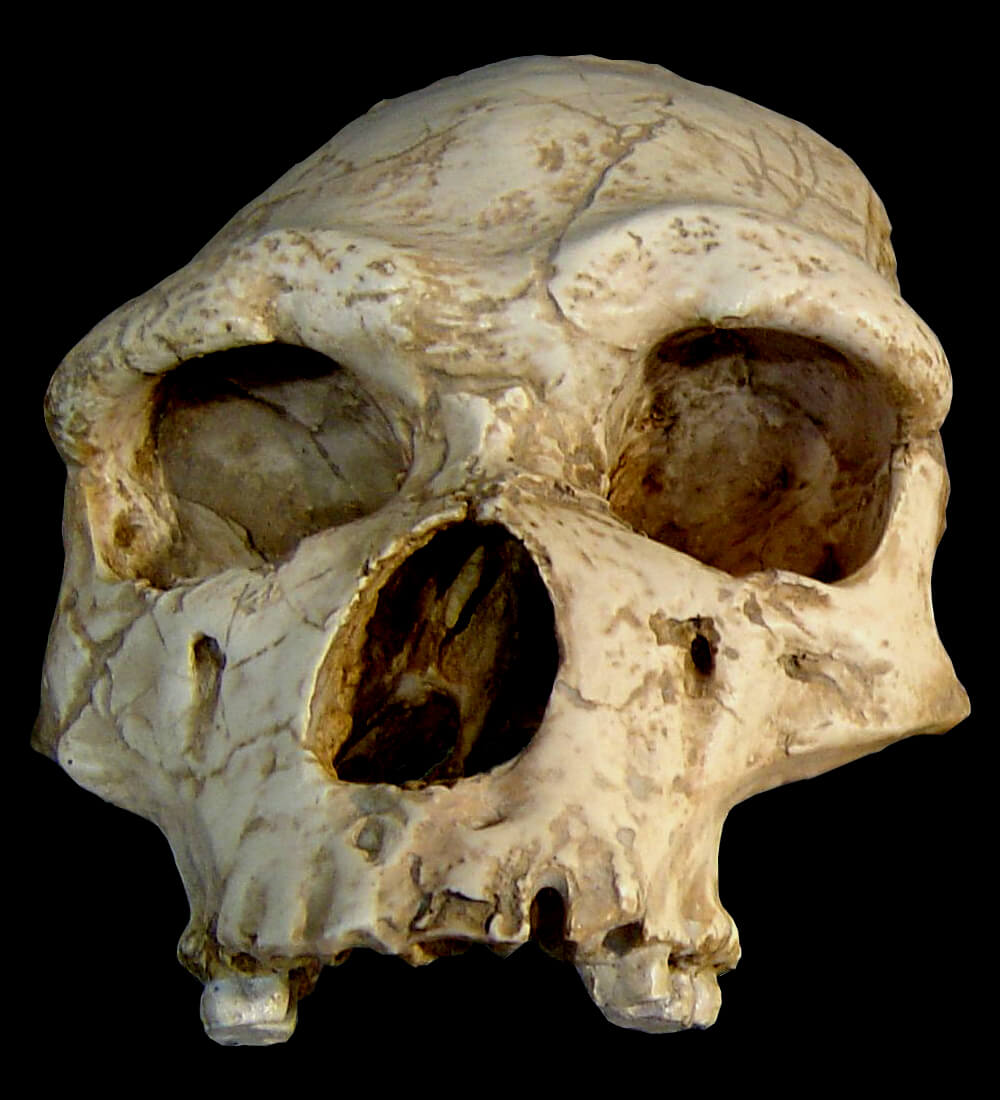
A 450,000-year-old human face so complete it shows wear patterns on teeth revealing right-handedness in our ancestors.
The original uploader was Luna04 at French Wikipedia. Later versions were uploaded by 120 at fr.wikipedia., CC BY-SA 3.0, via Wikimedia Commons
The Face of Tautavel Man
In July 1971, a team of archaeologists led by Henry and Marie-Antoinette de Lumley discovered a crushed but remarkably complete human face in Arago Cave. Cataloged as Arago 21, the fossil consists of a face, a frontal bone, and a sphenoid bone. Uranium-series dating of the stalagmitic floor on which the skull rested places its age at approximately 450,000 years.
The skull belongs to the species Homo heidelbergensis, an ancestor to the Neanderthals. Analysis of the skull's features, including prominent brow ridges and a receding forehead, suggests it belonged to a young male, likely no more than 20 years old. With an estimated cranial capacity of 1,166 cubic centimeters, his brain was smaller than that of modern humans but typical for his species. Nicknamed "Tautavel Man," this fossil is one of the oldest and most complete human faces ever found in Europe.
A Prehistoric Butcher Shop
The evidence from Arago 21's teeth shows ancient behavior. The front teeth show a pattern of fine scratches, all angled in the same direction. Paleoanthropologists believe these marks were made by a stone tool. The individual likely gripped a piece of meat with his front teeth and his left hand, while cutting slices with a flint tool held in his right hand. When the tool slipped, it grazed the tooth enamel, leaving a scratch. The consistent angle of these scratches indicates right-handedness.
Arago Cave was not a permanent home, but a temporary camp for hunting parties. Its position high on a hillside provided an excellent vantage point for spotting herds of animals in the valley below. Inside the cave, excavations have unearthed the remains of butchered animals, including horses, bison, reindeer, and rhinos. Alongside these bones were hundreds of thousands of stone tools, mostly simple choppers and flakes from the Acheulean and Tayacian industries, made from local quartz and flint. Over 150 different human fossil fragments have been found in the cave, representing at least 30 individuals, including both adults and children.
💡Fun Facts
The Arago Cave has yielded over 600,000 prehistoric objects since excavations began in the 1960s.
The skull known as Arago 21 was later joined by a parietal bone (Arago 47), found three meters away in 1979, which fit perfectly with the original fossil.
In 2015, a volunteer student discovered a single human tooth (Arago 149) in a deeper layer of the cave, dating to around 560,000 years old, 110,000 years older than Tautavel Man.
Wear patterns on the front teeth of Tautavel Man suggest they were often used as a "third hand" for gripping materials during tool use.