A prince's grave
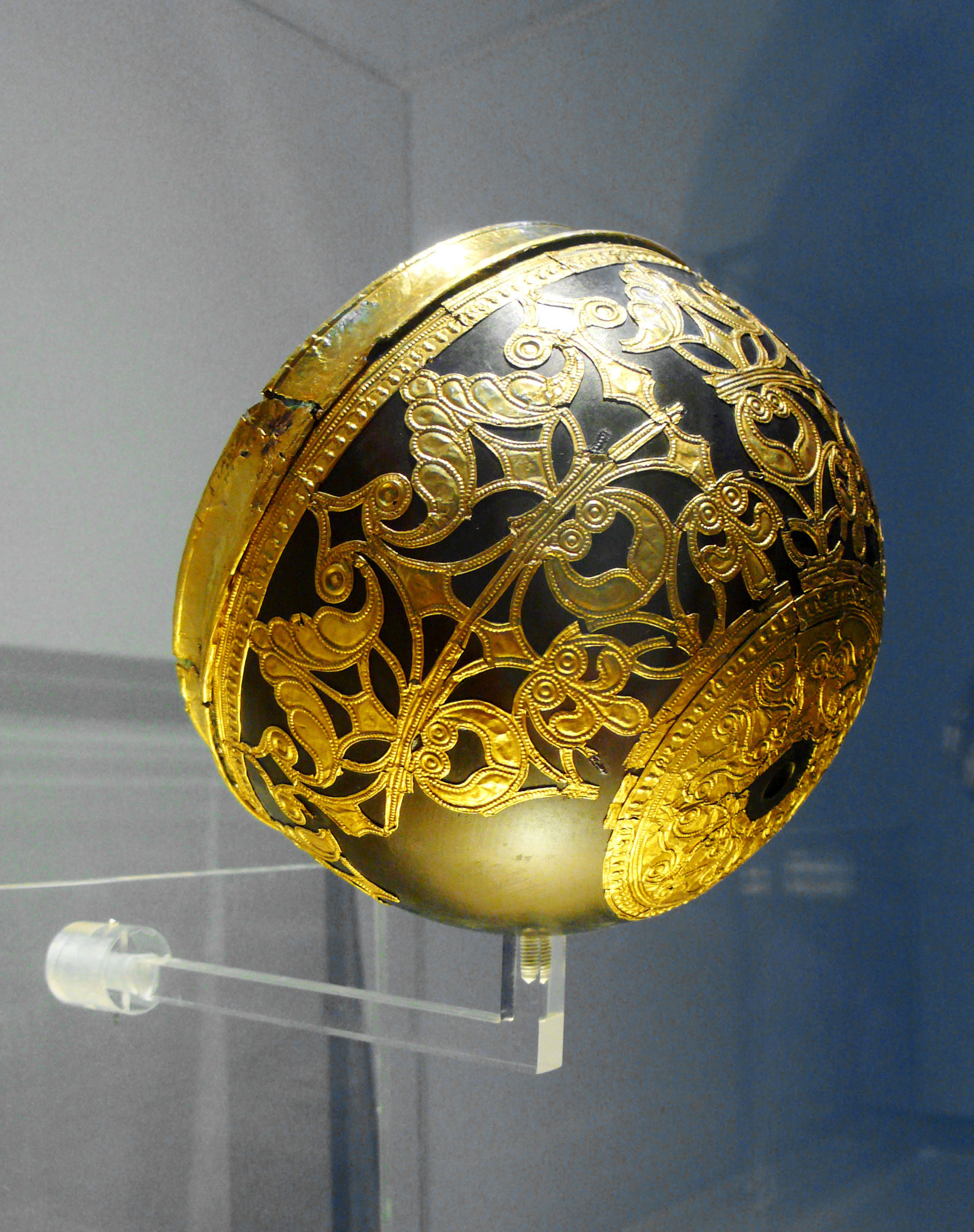
In 1849, a burial mound near the German village of Schwarzenbach revealed a complete set of ceremonial drinking vessels. The find was part of a "princely grave" (Fürstengrab) dating to the 5th century BCE. This period corresponds to the early La Tène culture, an Iron Age civilization that flourished across Europe. The grave contained an amphora for mixing wine, a beaked pitcher, a golden bowl, and the remains of two drinking horns. Only the decorative gold and bronze fittings from the organic horns survived. One set of fittings has a complex design, which creates a subtle but deliberate optical effect.
The decoration follows the Waldalgesheim, or Vegetal, style. This artistic movement is defined by its use of classical plant motifs, like lotus blossoms and palmettes, which are deconstructed and reassembled into fluid, abstract patterns. The Schwarzenbach horn's gold trim has a lower band of repeating lotus flowers. Above this, a more complex pattern of palmettes and sinuous tendrils creates a shifting visual field. The artists used a technique of outlining some shapes in gold while leaving others as negative space, forcing the viewer's eye to organize the patterns. This clever use of positive and negative space is central to the horn's perceptual puzzle.
The science of seeing faces
The visual effect on the Schwarzenbach horn comes from bistable perception. This phenomenon occurs when the brain is presented with an ambiguous image that can be interpreted in two or more mutually exclusive ways. The famous Necker cube or Rubin's vase are classic examples. All visual information is inherently ambiguous, and the brain makes decisions to resolve it into a stable perception. Celtic art from the La Tène period frequently uses this ambiguity, creating hybrid forms where boundaries between human, animal, and plant are intentionally blurred.
As you rotate the drinking horn, the abstract vegetal patterns resolve into human-like faces. The palmette leaves become stylized hair or headdresses, and circular coral inlays, now lost, would have drawn the eye to form faces. The image is never static; a slight turn causes the faces to dissolve back into foliage. This intentional ambiguity appears often in Celtic art, which often plays with abstraction and emergent figures. The artists manipulated the viewer's perception, encoding multiple images within a single, complex metal design. It shows how the human visual system actively constructs reality from uncertain sensory input.