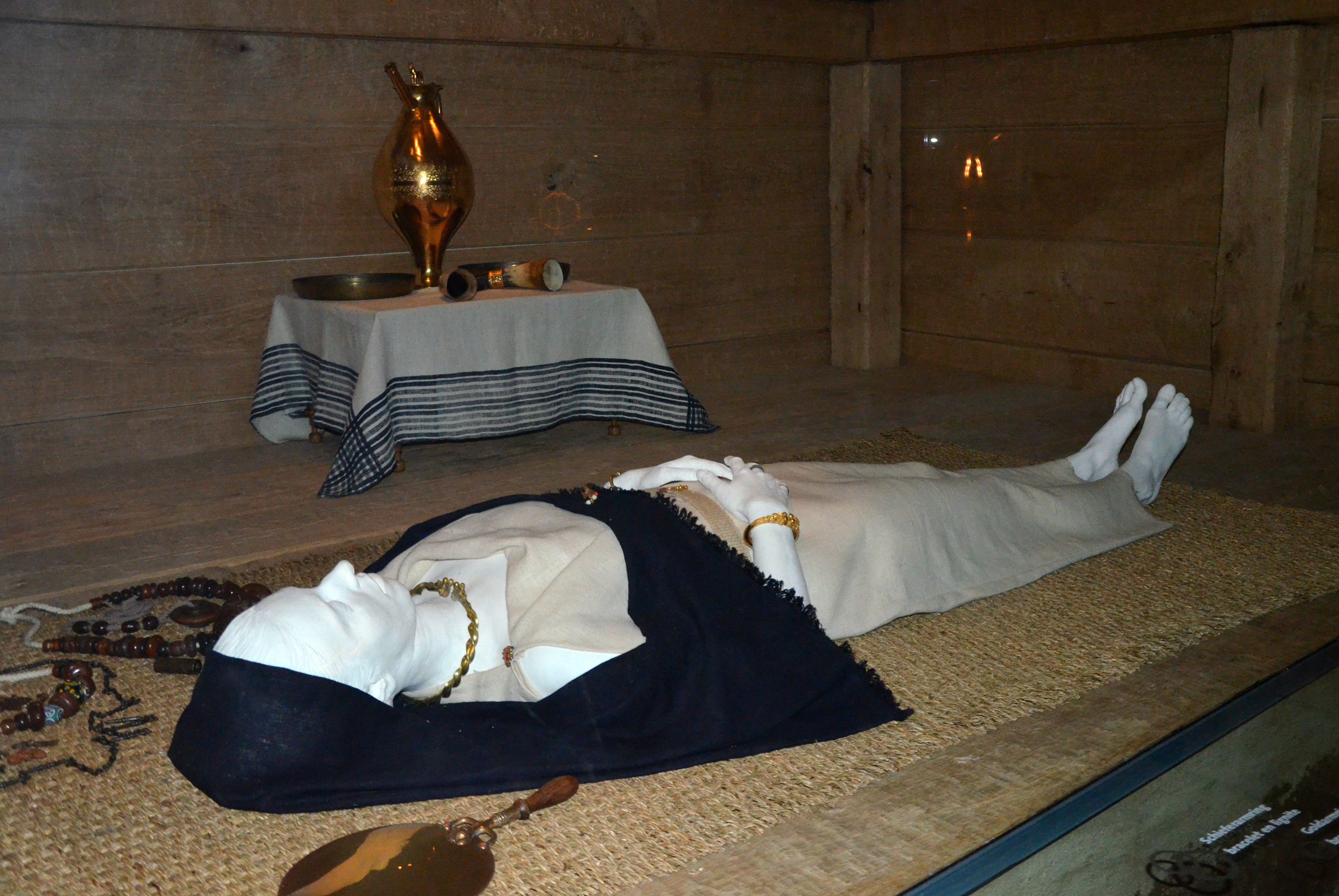
A 2,400-year-old woman buried with 200 objects including gold jewelry and a bronze mirror. Pollen in her grave shows she was buried in spring with fresh flowers. Personal details preserved.
Carole Raddato from FRANKFURT, Germany, CC BY-SA 2.0
An accidental discovery
In 1954, workers quarrying for gravel near the village of Reinheim, Germany, struck a bronze object with a shovel. The local entrepreneur, Johannes Schiel, reported the find to conservation authorities, initiating a professional excavation. Archaeologists led by Alfons Kolling soon uncovered an undisturbed tomb from the early La Tène period, dated to around 370 BCE.
The burial chamber, constructed of oaken beams, measured approximately 3.5 by 3 meters. Inside lay the remains of a high-status woman, a Celtic "princess" or priestess. Due to the acidic soil, no skeleton survived, but the precise arrangement of her jewelry allowed for a detailed reconstruction of her burial position. The chamber was originally covered by a large earthen mound, or tumulus, about 20 meters in diameter and 4.6 meters high. Later investigations revealed this was the smallest of three such mounds in the immediate area, once known collectively by locals as the "Katzenbuckel" or "cat's arched back".
The grave goods showed this was an elite burial. The woman wore a solid gold torc around her neck, a gold bangle on her right arm, and several gold rings on her fingers. She also had bracelets made of glass and lignite, a type of brown coal. Her clothing was fastened with ornate fibulae, some decorated with coral inlays. The tomb also contained a bronze drinking service, including a spouted flagon and two bowls, and fittings for two drinking horns. A large collection of 124 amber beads and numerous glass beads were also found, possibly from a decomposed wooden box placed near her head.
A burial in springtime
The most important scientific data from the grave comes from palynology—the study of pollen grains. Analysis of sediment from the burial chamber revealed a high concentration of pollen from plants that flower in the spring. This finding is direct evidence that the woman was buried with fresh flowers and that the funeral took place during the spring months. This "pollen clock" provides a specific detail about the season of an ancient ceremony.
The best-known object from the tomb is an elaborate bronze hand mirror. The mirror's polished plate, originally 18 cm in diameter, was attached to a handle shaped like a human figure with upraised arms. This design, along with complex engravings of human heads and mythological creatures, suggests the mirror had a ritualistic purpose, perhaps related to divination or viewing the Celtic otherworld. The handle was also decorated with inlays of red coral, a prized imported material.
The collection of artifacts shows a person of great wealth and status within her community. The combination of locally crafted masterpieces, like the flagon and mirror, with imported materials such as amber from the Baltic and coral from the Mediterranean, places Reinheim within a wide network of Iron Age trade and cultural exchange.
💡Fun Facts
The burial was found by accident during industrial sand and gravel quarrying in 1954.
The bronze mirror's handle is shaped like a female caryatid figure and features hollow rivets with coral inlays.
No bones survived, but two teeth were found, providing the only biological material from the woman herself.
The original artifacts are displayed at the Museum of Prehistory and Protohistory in Saarbrücken, while a full reconstruction is at the discovery site.
The European Archaeological Park Bliesbruck-Reinheim's museum areas are open from March 15th to October 31st. Monday to Friday: 10:00 AM - 5:00 PM; Weekends and public holidays: 10:00 AM - 6:00 PM. The outdoor park grounds are accessible year-round.
Admission
Adults: €5.00; Reduced price (seniors, students): €3.50; Children under 16: Free.
Accessibility
The park has accessible parking and the outdoor areas are described as easy to walk and navigate. Staff are trained to assist visitors.