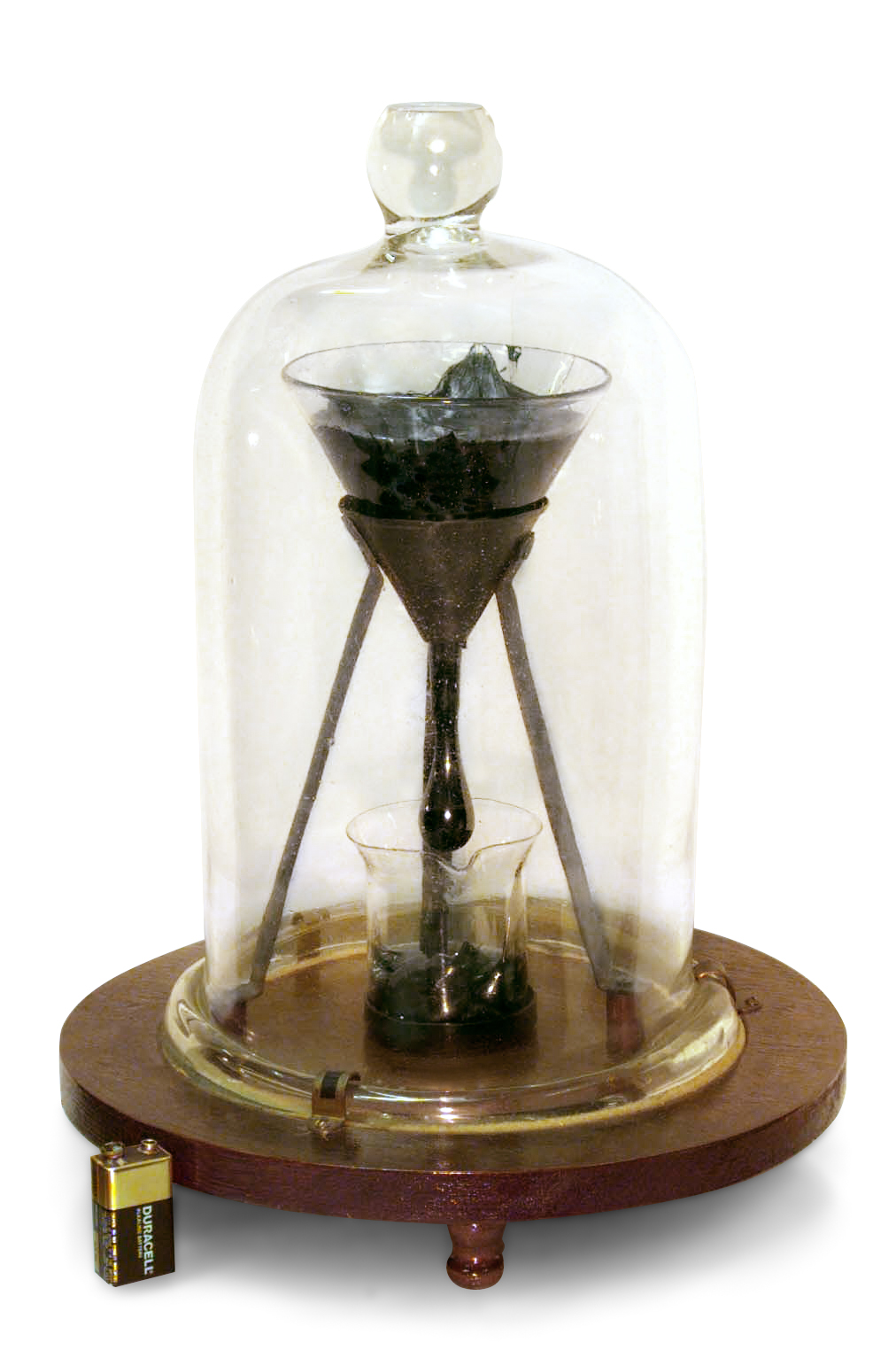
Bacteria trapped in the world's longest-running experiment (a pitch drop) remain viable after decades in tar. They demonstrate that life can persist in asphalt, informing the search for life in Titan's methane lakes.
University_of_Queensland_Pitch_drop_experiment.jpg: John Mainstone derivative work: Amada44, CC BY-SA 3.0, via Wikimedia Commons
The longest wait in science
Inside the Parnell Building at the University of Queensland, a glass dome covers a simple-looking funnel of black pitch. This is the world's longest continuously running laboratory experiment, a title certified by Guinness World Records. In 1927, Professor Thomas Parnell set it up to show his students that pitch, or bitumen, which shatters like a solid when struck, is actually an extremely viscous fluid. He heated a sample, poured it into a sealed funnel, and let it settle for three years. In 1930, he cut the stem, and the wait began.
The first drop took eight years to fall. Since then, only eight more have followed, with the ninth drop falling in April 2014. The pitch flows at a rate determined by ambient temperature, which means the process can speed up or slow down with the seasons. Its viscosity is estimated to be about 230 billion times that of water. Despite webcams and decades of observation, no one has ever witnessed a drop fall with their own eyes. The eighth drop in 2000 was missed due to a camera malfunction, and the experiment's second custodian, John Mainstone, who cared for it for 52 years, missed the seventh drop in 1988 because he had stepped out for a drink.
Unexpected inhabitants
For decades, the experiment was a curiosity of physics. Then, it became a subject for microbiology. After the eighth drop fell in 2000, a sample of the decades-old pitch was collected for analysis. Scientists discovered something unexpected within the hydrocarbon-filled, seemingly sterile material: life. DNA sequencing revealed the presence of a community of microbes, including bacteria and archaea.
These organisms were ancient relics; they were viable. They had survived in a dormant or slow-metabolizing state, trapped within the pitch for decades. The discovery shows that life can persist in asphalt, a substance with very little water. This has important implications for astrobiology. Natural asphalt lakes on Earth, like Pitch Lake in Trinidad, also teem with microbial life, with up to 10 million microbes per gram. These organisms thrive in low-water, hydrocarbon-filled environments, breathing metals instead of oxygen.
The survival of these microbes on Earth points to new possibilities for life elsewhere in the solar system. Saturn's largest moon, Titan, is a world with rivers, lakes, and seas of liquid methane and ethane. The conditions in Titan's hydrocarbon lakes could be analogous to the pitch on Earth. If microbes can endure for nearly a century in a funnel of tar in Brisbane, it strengthens the hypothesis that life, or at least its chemical precursors, might exist in the cold, hydrocarbon seas of Titan.
💡Fun Facts
In 2005, Thomas Parnell (posthumously) and John Mainstone were awarded an Ig Nobel Prize in Physics for the experiment.
The pitch is estimated to be about 100 billion times more viscous than water.
No person has ever seen a drop fall live; the ninth drop in 2014 was recorded on camera, but the moment of separation happened unseen.
The experiment was once stored in a cupboard and nearly thrown out before being rediscovered and put on display by its second custodian.