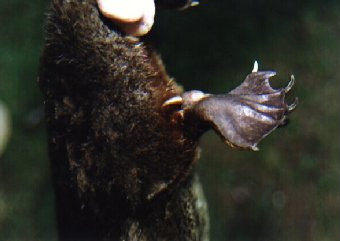
A Spur with a Purpose
The platypus (Ornithorhynchus anatinus), a semi-aquatic mammal endemic to eastern Australia, is one of the few mammals to produce venom. This capability is exclusive to males, who possess a sharp, hollow spur on each hind ankle. These keratinous spurs, typically 15-18 millimeters long, are connected via a duct to a venom-producing crural gland in the upper thigh. While females are born with rudimentary spur buds, these structures drop off within their first year.
The venom system's primary role is not for hunting prey but for combat during the mating season. Venom production increases dramatically during this period, which corresponds with a rise in androgen hormones and testicular size. When threatened or competing with rivals, a male platypus will wrap its hind legs around a target, erect the spurs, and jab them inwards with considerable force. While the venom is potent enough to kill a dog, it is not lethal to humans. For humans, an envenomation causes immediate and excruciating pain, often described as worse than being hit by shrapnel, which can persist for weeks or even months and is notoriously resistant to morphine.
An Evolutionary Cocktail
Platypus venom is a complex chemical mixture containing at least nineteen different peptides, with transcriptomic studies identifying as many as 88 putative venom genes. The main toxic components include defensin-like peptides (DLPs), C-type natriuretic peptides (CNPs), and nerve growth factor. These proteins disrupt pain regulation, lower blood pressure, and can cause severe swelling and hyperalgesia (a heightened sensitivity to pain).
The genetic origins of this venom show convergent evolution. The defensin-like peptides in platypus venom evolved from beta-defensin genes, a gene family also used as a template for venom toxins in some snakes and lizards. This means the platypus and certain reptiles independently evolved similar venom molecules from the same ancestral genes. One component of the venom, a hormone called glucagon-like peptide-1 (GLP-1), is being investigated to treat Type 2 diabetes. The platypus version of GLP-1 is far more stable and resistant to degradation than the human equivalent, making it a promising model for developing longer-lasting diabetes medications.