The Sonic Architecture of Gut
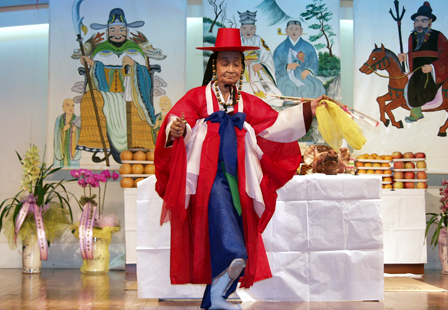
The Korean shamanic ritual, or gut (굿), is a complex performance of music, dance, and spiritual communion led by a shaman, known as a mudang. The soundscape is not arbitrary; it is a structured acoustic environment designed to facilitate communication between the physical and spiritual worlds. The primary instruments are percussive, dominated by the janggu (an hourglass-shaped drum) and the kkwaenggwari, a small, high-pitched brass gong.
The kkwaenggwari, typically 19 to 22 centimeters in diameter, produces a sharp, piercing tone that leads the ensemble and signals changes in rhythm. Its sound has many overtones, a quality that allows it to cut through the sonic texture of the entire ensemble. The janggu provides a rhythmic foundation, with two distinct heads producing low and high-pitched sounds. Together with a larger gong (jing) and a barrel drum (buk), these instruments create complex rhythmic patterns called jangdan. Common patterns in shamanic music include the gutgeori, a 12/8 beat cycle that is often cheerful and exciting, and the salpuri, also based on a 12/8 cycle, which is used during exorcism songs. The tempo often accelerates throughout the ritual, building to a rapid, energetic climax.
Neurological Resonance
The rhythmic foundation of the gut has measurable effects on human brain activity. The core mechanism is brainwave entrainment, where the brain's own electrical cycles synchronize with an external rhythmic stimulus. Shamanic drumming worldwide often utilizes a tempo of 3 to 7 beats per second (180-420 beats per minute). This frequency range directly corresponds to the brain's theta wave activity, which operates between 4 and 7 Hertz.
Theta waves are associated with deep relaxation and meditation, and the boundary of the subconscious mind. Studies using electroencephalography (EEG) on individuals listening to shamanic drumming show a marked increase in theta wave power. Some research indicates that sustained drumming at a rate of 4.5 beats per second for 13-15 minutes is sufficient to induce a trance-like state characterized by dominant theta wave patterns. This state disengages the brain's awareness of external stimuli and heightens activity in networks related to internally directed thought and memory. Neuroimaging studies of shamanic practitioners show significant changes in brain network activity and increased gamma power, which is correlated with heightened sensory perception and insight. Beyond brainwaves, physiological changes occur; one study on Korean shamans noted that dopamine levels can increase by up to 390% during possession states within a ritual.