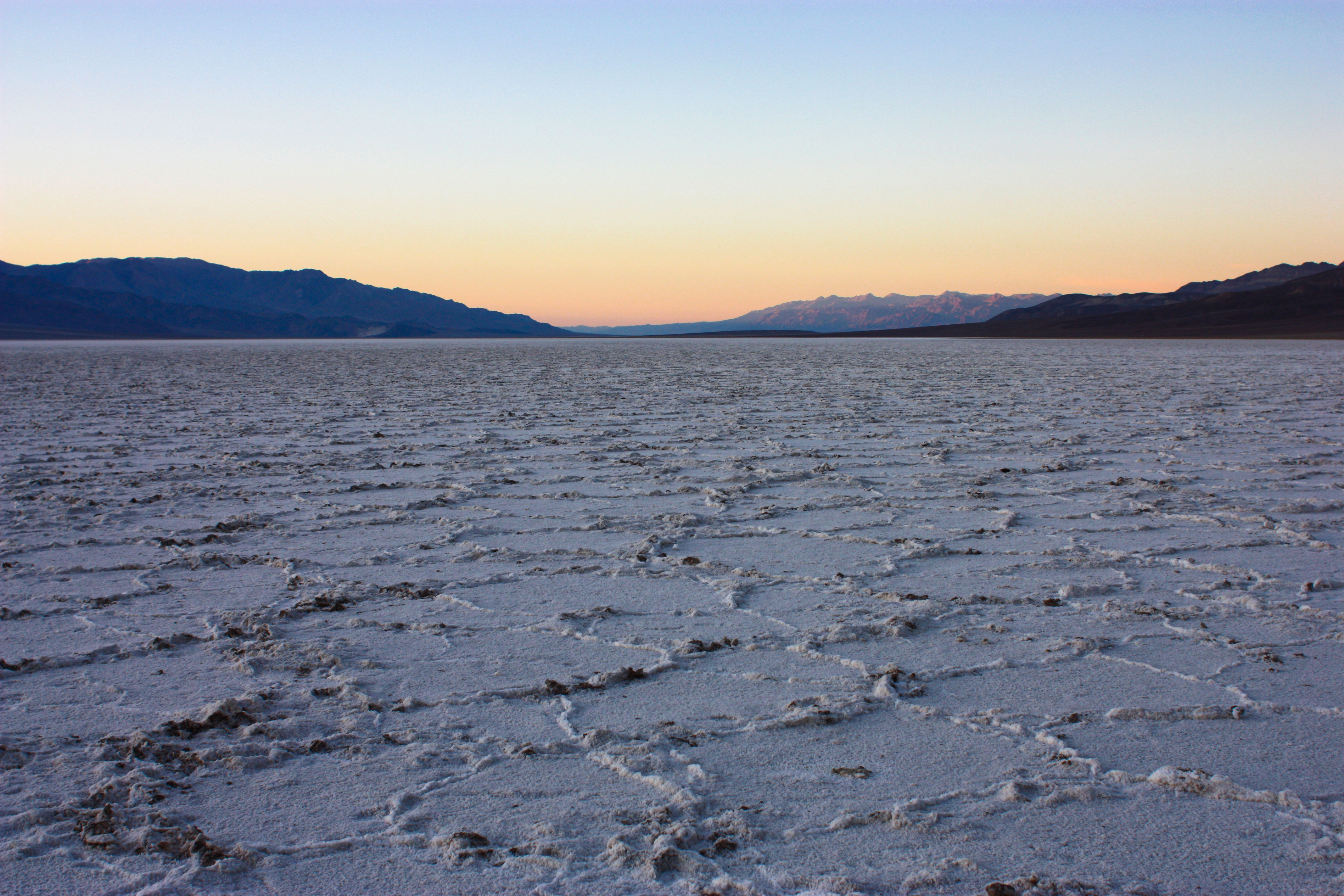
The floor of North America
Badwater Basin is the lowest point of elevation in North America, sitting at 282 feet (86 meters) below sea level. This extreme depth is the result of tectonic forces; Death Valley is a graben, a block of land that has dropped down between two parallel faults. The valley floor itself is sinking over time, and beneath the salt crust lies more than 11,000 feet of accumulated sediment and salts.
The vast, flat expanse, covering nearly 200 square miles, is a salt pan made primarily of sodium chloride (table salt). Other minerals, including calcite, gypsum, and borax, are mixed into the crust. This mineral-rich layer, which can be three to five feet thick in places, is the remnant of ancient lakes that evaporated long ago. Today, water from a 9,000-square-mile drainage system flows into the basin after infrequent but intense rainfall. With no outlet to the sea, the water collects and evaporates, leaving behind another thin layer of concentrated salts. The constant cycle of flooding, evaporation, and crystallization forms the famous hexagonal, honeycomb-like patterns on the basin's surface.
An ancient lake and its tenacious survivors
The present-day salt pan occupies the floor of what was once a massive body of water, Lake Manly. During the Pleistocene epoch, a wetter climate and meltwater from mountain glaciers filled Death Valley with a lake that was up to 600 feet deep and nearly 100 miles long. This ancient lake existed intermittently, with its last major highstand ending around 120,000 years ago.
Though the great lake is gone, life persists in the hypersaline environment. A small, salty, spring-fed pool near the edge of the basin gave the area its name when a surveyor's mule refused to drink from it. The pool, while too salty for mules, hosts a unique ecosystem. Residents include the Badwater snail (Angustassiminea infima), a species endemic only to this specific location. Aquatic insects and salt-tolerant pickleweed also survive here. Researchers have also discovered a unique magnetotactic bacterium, designated BW-1, in the basin's brackish water. The microbe creates internal nanocrystals of both magnetite and the iron sulfide mineral greigite, a rare ability that has attracted scientific interest for potential nanotechnology applications.