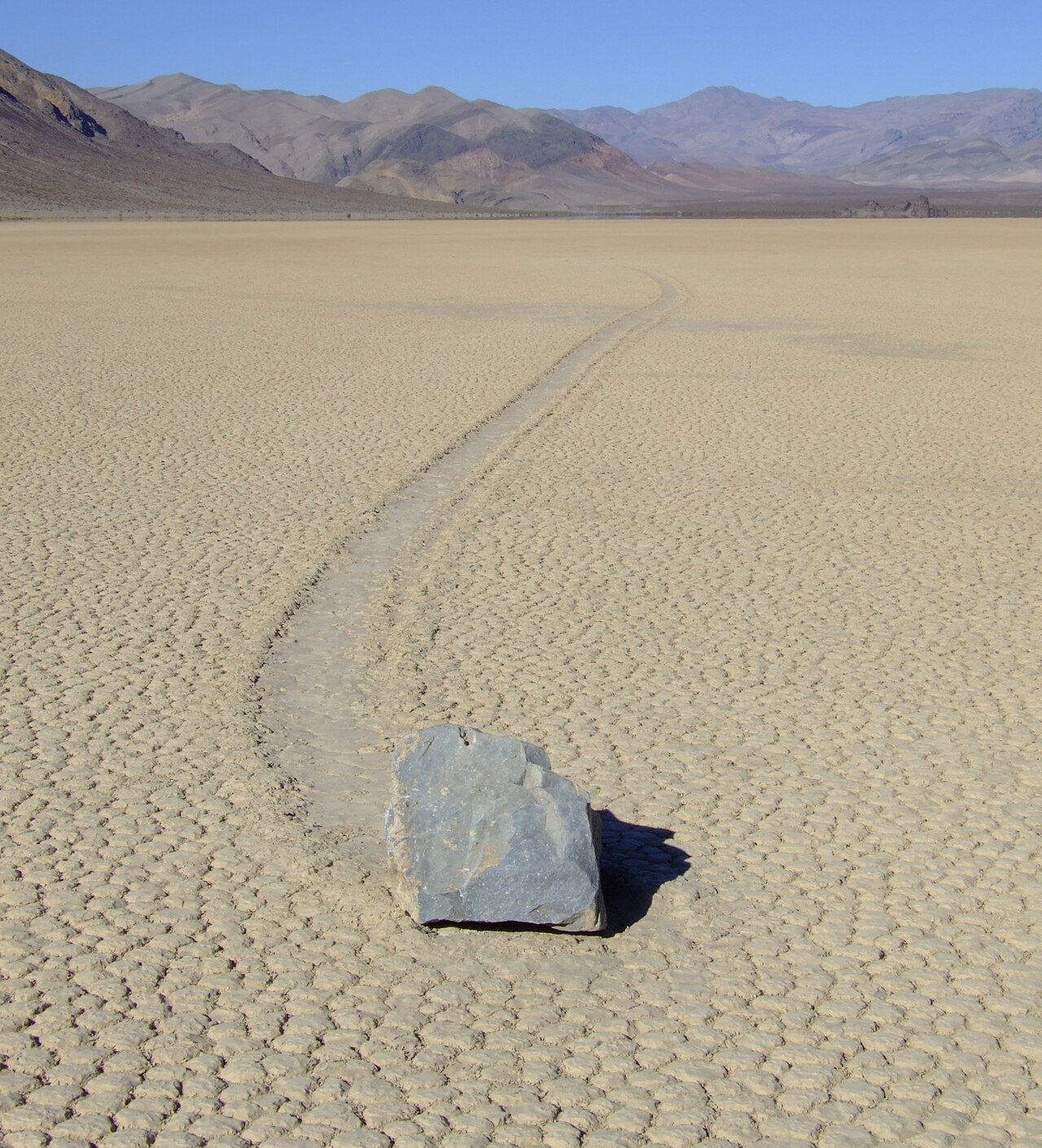
A century-old geologic puzzle
On a remote, dry lakebed in Death Valley National Park known as Racetrack Playa, hundreds of rocks leave long, parallel trails etched into the cracked mud. Some of these "sailing stones," weighing up to 320 kilograms (700 pounds), appear to have moved hundreds of meters across the remarkably flat surface. For decades, this phenomenon baffled scientists. The first investigations began in the 1940s, leading to many theories, including hurricane-force winds, magnetic fields, or even pranksters.
The playa itself is a remnant of an ancient lake that evaporated around 10,000 years ago, leaving a fine clay surface that is almost perfectly flat. The northern end is only about 4 centimeters higher than the southern end, over a distance of nearly 5 kilometers. The stones, composed of dolomite and syenite, fall from the surrounding mountains onto the playa. Once on the lakebed, their movement begins. Some stones with rough bottoms leave straight tracks, while smooth-bottomed ones tend to wander. These trails, typically a few centimeters wide and less than 2.5 cm deep, can persist for three or four years before weathering away.
The mechanism revealed
The mystery was finally solved in the winter of 2013-2014. Researchers Richard Norris and James Norris had initiated the "Slithering Stones Research Initiative," embedding 15 rocks with motion-activated GPS units and setting up a high-resolution weather station. They expected to wait years for any results, as movement is infrequent. By a stroke of luck, they were present when the right conditions occurred.
A rare winter rain created a shallow pond, no more than seven centimeters deep, across the playa. As temperatures dropped at night, this water froze into thin sheets of "windowpane" ice, just 3 to 6 millimeters thick. During the day, the sun began to melt the ice, causing it to break into large, floating panels. Light winds, moving at just 3-5 meters per second (about 10 miles per hour), were enough to push these expansive ice sheets across the slick, muddy surface. The rocks, trapped in the ice, were pushed along at a slow, almost imperceptible speed of 2 to 6 meters per minute.
On December 20, 2013, the team observed more than 60 rocks moving simultaneously, some traveling over 60 meters. One of their GPS-instrumented rocks moved a total of 224 meters over several events that winter. The entire process is subtle; the ice melts and the water evaporates, leaving only the rock and its mysterious track behind.