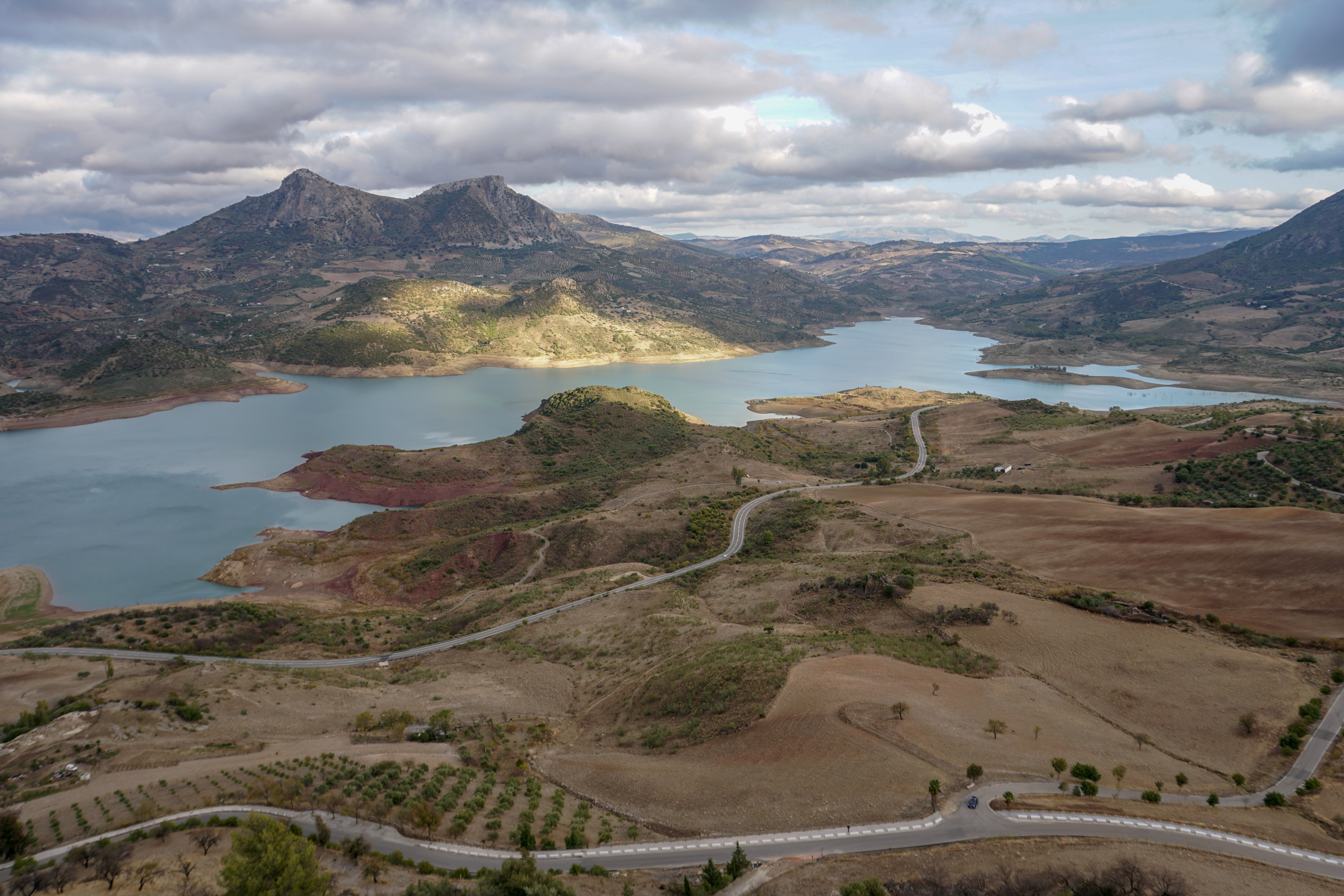
A Lakebed Ledger
The Zahara-El Gastor reservoir, an artificial lake created by a dam on the Guadalete River, appears as a placid body of turquoise water. Its primary purpose since construction finished in 1992 has been to store water for the irrigation of surrounding agricultural lands. The dam and its reservoir, with a total capacity of 223 cubic hectometers, are situated within the Sierra de Grazalema Natural Park, a UNESCO Biosphere Reserve. This location is important. The park's limestone karst landscapes and the area's Mediterranean climate—characterized by infrequent but heavy rainfall—mean that water runoff carries a significant load of suspended particles.
Once this runoff enters the calm waters of the reservoir, the flow slows dramatically, and the suspended materials settle to the bottom. This process turns the reservoir into a massive sediment trap. Year after year, new layers of silt, clay, pollen, and organic matter accumulate on the lakebed. Scientists can extract core samples from these deep layers of mud. Each distinct layer, or lamina, corresponds to a specific period, often with seasonal resolution. By analyzing the physical, chemical, and biological contents of these layers, researchers can reconstruct a detailed history of the surrounding environment that extends back to the reservoir's creation.
Reading the Layers
The sediment cores from Zahara-El Gastor provide a direct record of regional environmental change. The thickness and composition of the layers reveal patterns of erosion, which can be linked to specific events. For example, an unusually thick layer of coarse sediment might indicate a period of intense rainfall and flooding. Conversely, finer, darker layers rich in organic matter can point to periods of drought when less water flowed into the reservoir and algae thrived.
Analysis of pollen grains trapped in the sediment is a historical log of vegetation. An increase in Olea europaea (olive) pollen, for instance, would chronicle the expansion of olive groves in the region, common in Andalusian agriculture. Similarly, the presence of heavy metals or specific chemical compounds can be tied to historical shifts in industrial or agricultural practices in the catchment area. While detailed public studies on the specific paleo-limnological findings at Zahara are not abundant, the principles are well-established in similar reservoirs worldwide, where sediment cores have revealed everything from the impact of introducing new farming machinery to periods of large-scale deforestation.