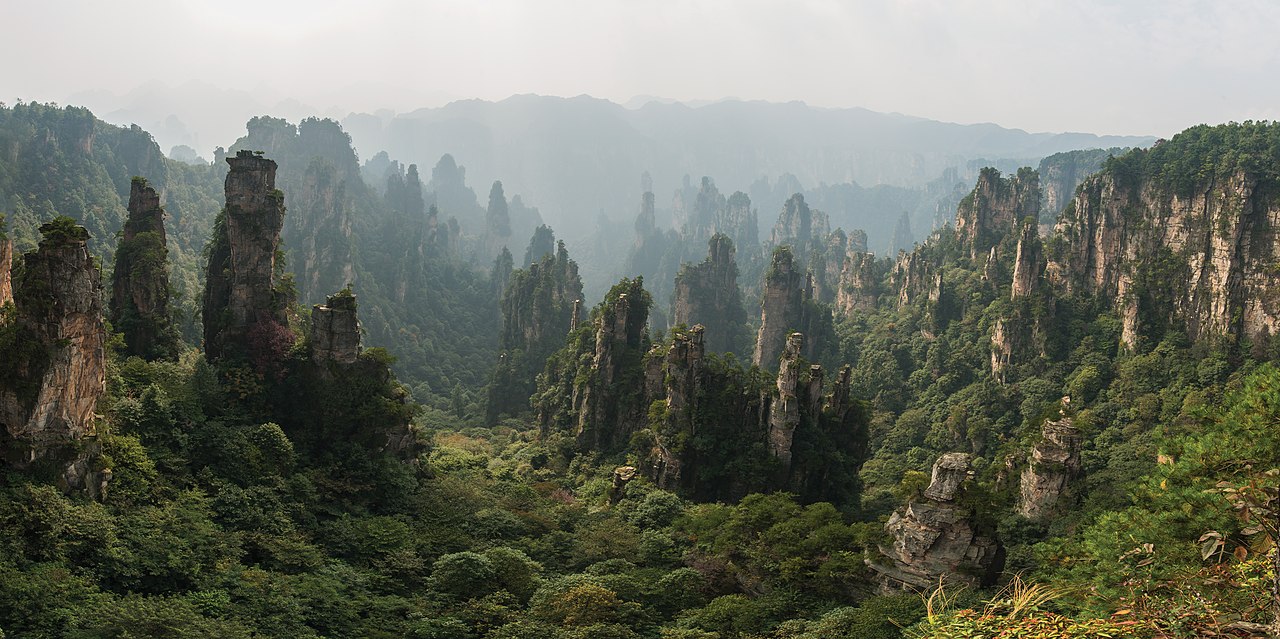
Listening to stone giants
The Wulingyuan Scenic and Historic Interest Area in China's Hunan Province contains a forest of over 3,000 quartzite sandstone pillars. Many of these silent giants rise more than 200 meters (660 feet) from the valley floor, creating a landscape that looks unusual. This unique geology is the result of millions of years of physical weathering, not the chemical dissolution typical of karst landscapes. The main erosion mechanism is the expansion of ice in vertical joints during the winter, followed by the removal of weathered material by streams and the persistent force of plant roots.
To understand the stability of these structures and ensure visitor safety, geologists and engineers have embarked on a unique monitoring project. They have installed sensitive instruments, including strain gauges, deep inside the pillars. These devices measure infinitesimal changes in the rock, detecting subtle swelling, shrinking, or shifting. The data provides a constant stream of information on the internal stresses affecting the stone, helping to predict potential collapses before they happen. The monitoring aims to create an early-warning system for the pillars most at risk of failure.
Ancient weaknesses, modern stress
The story of the pillars' instability begins long before they were carved into their present forms. The sandstone itself was deposited in a shallow sea during the Devonian period, roughly 400 million years ago. Subsequent tectonic movements, beginning around 200 million years ago, lifted and fractured the rock, creating a grid-like pattern of vertical joints. These ancient fractures, some dating back 300 million years, are the inherent weaknesses that weathering agents exploit today.
The strain gauges reveal how modern-day stresses, gravity, temperature fluctuations, and water saturation are concentrated along these prehistoric fault lines. Each measurement shows the pillars responding to their environment, slowly progressing toward eventual collapse. The research at Wulingyuan applies of geological science to public safety, using modern technology to listen to the deep-time story told by the rocks themselves. By understanding the forces at play along these 300-million-year-old fractures, scientists can better forecast the future of this remarkable landscape.