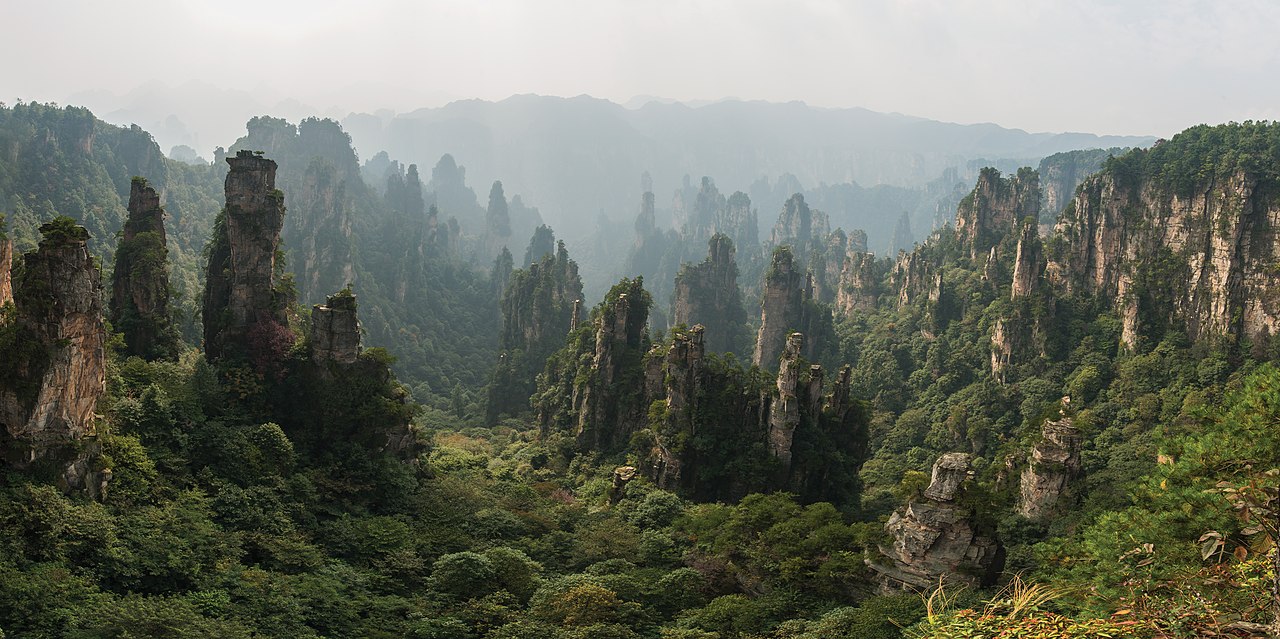
From ancient sea to fractured stone
The story of Tianzi Mountain's pillars begins around 380 million years ago, during the Devonian period, when this region of China was a shallow sea. Rivers deposited enormous amounts of sand and other detritus into this littoral environment, which, over millions of years, compacted into a thick layer of quartz sandstone, in some places 500 meters thick. This rock, which is 75-95% quartz, forms the parent material of the more than 3,100 pillars seen today.
A series of tectonic events then lifted this former seabed far above sea level. The Yanshan Movement, between 180 and 80 million years ago, was particularly significant. The immense stress of this uplift raised the plateau; it also created a grid-like system of vertical cracks, or joints, throughout the sandstone. These pre-existing fractures created a network of weaknesses, led to for the next phase of sculpting. The landscape we see is the result of neotectonic uplift that began over 2.6 million years ago and continues today, slowly raising the entire region.
Carved by water and ice
The transformation from a solid plateau to a forest of pillars shows the power of erosion acting on the fractured sandstone. For millions of years, water has been the primary carving tool. In the humid subtropical climate, abundant rainfall exploited the vertical joints, gradually widening them into deep ravines and gorges. In winter, this process intensifies. Water seeps into the cracks, freezes, and expands—a process known as frost wedging—prying the rock apart and making it vulnerable to being washed away.
This combination of physical and chemical weathering, along with erosion from streams and the action of plant roots, has relentlessly eaten away at the weaker points in the rock grid. The more resistant blocks of sandstone were left standing, isolated from their neighbors. This process has created pillars that are often over 200 meters (660 feet) tall. The highest peak in the Tianzi Mountain area is Kunlun Peak, at an elevation of 1,262.5 meters (4,142 feet). The entire unique landscape is now recognized as a distinct "Zhangjiajie Landform."