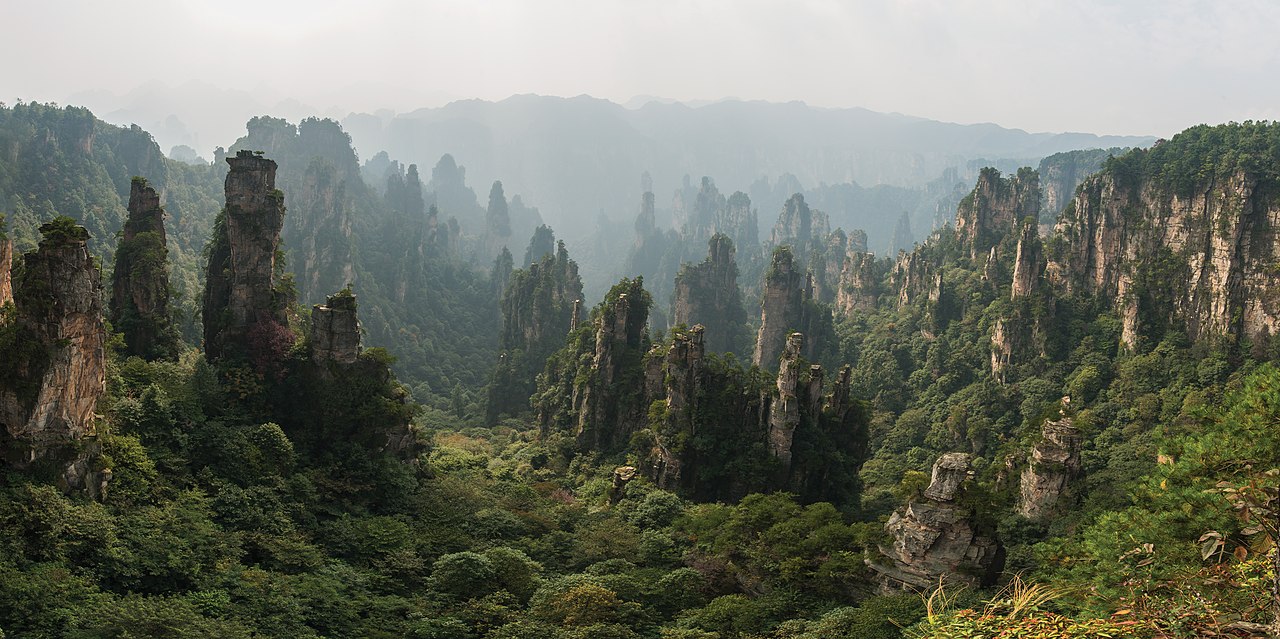
A forest carved by water
The Zhangjiajie National Forest Park contains a landscape of over 3,000 quartzite sandstone pillars, many rising over 200 meters (660 ft) from the valley floor. This geological formation, recognized as the Zhangjiajie Landform, originates from Devonian period rock, formed around 380-400 million years ago when the region was a shallow sea. Tectonic activity later uplifted this seabed, creating a high plateau composed of a 500-meter-thick layer of sandstone that is 75-95% quartz.
The formation of the pillars results from physical and chemical weathering acting on vertical fractures, or joints, in the sandstone. These joints were created by the same tectonic stresses that lifted the plateau. The region's humid, subtropical climate provides ample water, which is the main agent of erosion. Water infiltrates the vertical joints, where it slowly dissolves the calcite and iron-based cements that bind the hard quartz grains together. This chemical weathering is more effective within the fractures than on the exposed rock faces, causing the joints to widen over millions of years, isolating the rock into individual towers. Physical weathering, including freeze-thaw cycles in winter and the action of plant roots, assists in breaking the rock apart.
A unique ecosystem
The pillar forest is the primary feature of the Wulingyuan Scenic and Historic Interest Area, a UNESCO World Heritage site designated in 1992 that covers more than 26,000 hectares. The tallest of the pillars, the Southern Sky Column, stands at an elevation of 1,080 meters (3,543 ft) and was officially renamed "Avatar Hallelujah Mountain" in 2010. The unique topography supports a diverse ecosystem, with some pillar tops hosting isolated patches of forest. The park is over 97% forested and was a refuge for many ancient species during the Quaternary Glacial Era.
This environment provides a habitat for a number of vulnerable species, including the clouded leopard, Asiatic black bear, and the Chinese giant salamander (Andrias davidianus). The Chinese giant salamander, the world's largest amphibian, can reach lengths of 1.8 meters and is considered a "living fossil," with a lineage dating back 170 million years. This critically endangered species thrives in the cool, clean mountain streams of the park.