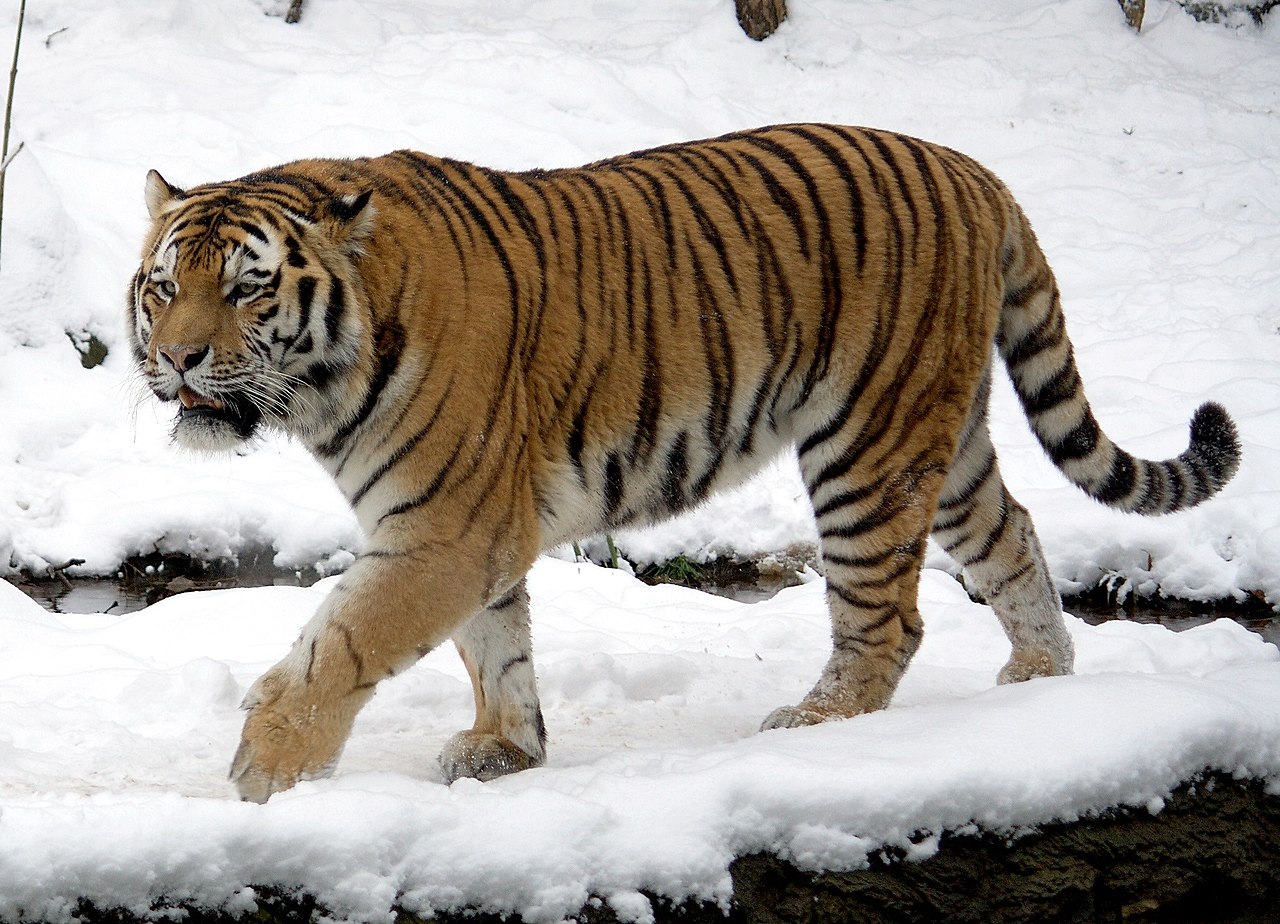
The Apex Predator of the Taiga
The Amur tiger, Panthera tigris altaica, is the largest feline on Earth. Males typically weigh between 160 and 190 kg, but can reach over 250 kg and measure more than two meters in length. This predator is uniquely adapted to the severe winters of the Russian Far East. Ahead of winter, it develops a subcutaneous fat layer on its belly that can be 5 to 6 cm thick, providing insulation against temperatures that can drop to -40°C. Its coat becomes paler and thicker than that of any other tiger, with extra fur on its paws that protects them from the cold and allows for silent movement through snow. These large paws act like snowshoes, distributing the animal's weight as it navigates deep snow.
The tiger's primary habitat is the mixed coniferous and deciduous forests of the Sikhote-Alin mountain range. More than 90% of the entire Amur tiger population lives in this single region. Due to the low density of prey in this harsh environment, Amur tigers require immense territories. A single male's home range can exceed 1,000 square kilometers, overlapping with the smaller territories of several females. A recent census estimated the total population in Russia at approximately 750 individuals, a significant recovery from a low of fewer than 50 tigers in the 1940s.
A Precarious Existence
The life of an Amur tiger is governed by the hunt. They are solitary and most active at night, relying on exceptional hearing and sight that is five times better than a human's in the dark. Their diet consists mainly of large hoofed animals. Wild boar and red deer are the preferred prey, and a single tiger needs to consume 50 to 70 such animals per year to survive. When a large kill is made, a tiger may eat up to 40 kg of meat at once. They also hunt smaller prey like roe deer, badgers, and raccoon dogs, and have been documented preying on brown and black bears.
Conservation efforts have been critical to the Amur tiger's survival. In 1947, Russia became the first country to grant the tiger full protection. Today, a network of protected areas, including the Sikhote-Alin Zapovednik and Land of the Leopard National Park, provides an important refuge. The park, located in the southwest of Primorsky Krai, is a habitat that supports Amur tigers alongside the critically endangered Amur leopard. Despite these successes, poaching is a threat, driven by the illegal trade in tiger pelts and body parts.