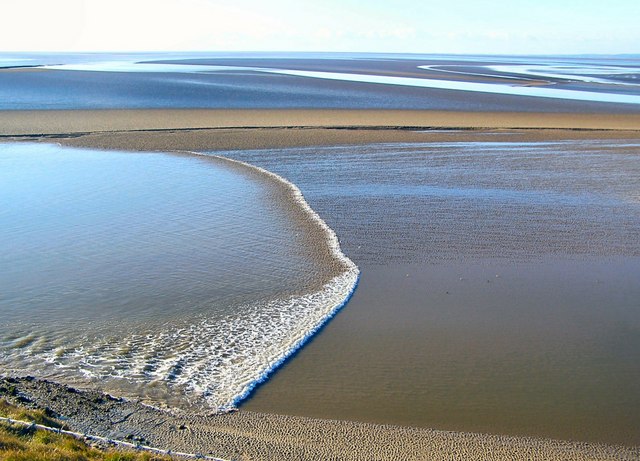
A river that flows backwards
A tidal bore is a rare natural event where an incoming high tide funnels into a river mouth, creating a wave—or series of waves—that travels upstream against the river's current. The Sittaung River bore is a dramatic example of this phenomenon, generated by the powerful tides of the Andaman Sea entering the wide, shallow Gulf of Martaban. For a bore to form, specific conditions are necessary: a large tidal range, typically over 6 meters, and a funnel-shaped estuary that narrows and shallows upstream.
The Gulf of Martaban's shape concentrates the tidal energy, forcing a huge volume of water into the Sittaung's channel. This causes the leading edge of the flood tide to steepen into a breaking wave. The Sittaung's bore, an undular bore, advances as a distinct wall of water, sometimes followed by a train of smaller waves. This reversal of the river's flow is not a gentle process; it's a powerful surge capable of altering the landscape. The bore's passage is often audible long before it is visible, accompanied by a low rumble.
A landscape in motion
The Sittaung River is defined by its immense sediment load, carrying an estimated 50 million tons of sand and silt annually. The tidal bore drives this sediment transport. The intense turbulence generated by the wave scours the riverbed and erodes its banks, keeping fine particles, with a mean diameter of just 0.02–0.04 mm, in constant suspension. This gives the river its characteristic muddy appearance and drives extreme rates of erosion and deposition.
The estuary's morphology is in a constant state of flux, with riverbanks eroding at rates up to 1.6 kilometers per year in the most active locations. Channels migrate, sandbars appear and disappear, and meanders are cut off. This dynamic environment is a direct consequence of the energy injected into the river system by the tide. The bore's intensity has reportedly diminished in recent decades. Increased sedimentation in the estuary, partly from mining and deforestation upstream, has altered the river's bathymetry, or underwater topography, affecting the wave's propagation. This makes the Sittaung a living laboratory for studying the interaction between tidal forces and river geomorphology.