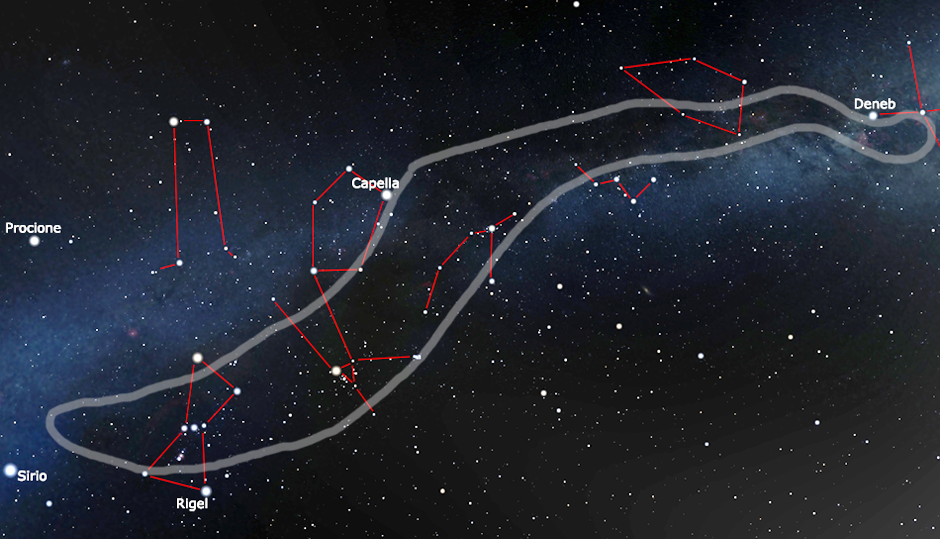
A 9,000-light-year wave of stellar nurseries discovered in 2020, snaking through our galactic neighborhood like a cosmic sine wave. Astronomers didn't know our nearby star-forming regions were connected in this undulating chain.
Roberto Mura, CC BY-SA 4.0, via Wikimedia Commons
A Wave Hiding in Plain Sight
In January 2020, astronomers announced the discovery of the largest known gaseous structure in the Milky Way. Named the Radcliffe Wave, this enormous, undulating filament of interconnected stellar nurseries stretches approximately 9,000 light-years long and 400 light-years wide. It contains gas with the mass of about 3 million suns. The discovery was made by a team from the Radcliffe Institute for Advanced Study at Harvard University, using 3D mapping techniques and data from the European Space Agency's Gaia satellite.
Before this, many of the star-forming regions within the wave, such as the famous Orion Nebula and the Taurus and Perseus molecular clouds, were thought to be part of a ring-like structure called the Gould Belt. The new, more precise data revealed these are not a ring around the Sun, but are instead nodes along one coherent, massive filament. This fundamentally altered the long-held model of our local galactic neighborhood. From a top-down perspective of the galaxy, the Radcliffe Wave is remarkably straight, but when viewed from Earth's position within the galactic disk, it shows a distinct wave-like shape. The structure oscillates, cresting 500 light-years above and dipping 500 light-years below the central plane of the galaxy.
Our Sun's Cosmic Surf
The Radcliffe Wave is surprisingly close. At its nearest point, the structure is only about 500 light-years from our Solar System. Its existence went unnoticed for so long simply because the technology to create high-resolution 3D maps of the interstellar medium did not exist. The Gaia mission, which is precisely charting the positions and motions of over a billion stars, was essential for revealing the wave's true shape and scale.
Analysis of the Sun's trajectory through the galaxy shows that it interacts with this structure. Our solar system passed through a dense part of the Radcliffe Wave—specifically the Orion region—about 13 to 14 million years ago. Scientists are investigating whether this encounter, which would have exposed Earth to a "series of supernovae," corresponds with the Middle Miocene climate transition, a period of global cooling on Earth. Projections indicate the Sun will cross the wave's path again in another 13 million years. Further research published in February 2024 confirmed that the wave looks like a wave but also moves like one, with its star clusters oscillating up and down like fans in a stadium. The cause of the wave itself is still unknown, with theories pointing to a massive event like the collision of a dwarf galaxy with the Milky Way.
💡Fun Facts
The wave contains enough gas to form at least 3 million stars the size of our Sun.
The 150-year-old "Gould's Belt" theory, which proposed a ring of nearby star-forming regions, has been largely replaced by the discovery of this single, linear wave.
Our Solar System passed through the wave about 13 million years ago and is expected to cross it again in another 13 million years.
Data from the Gaia space telescope was essential to this discovery, allowing astronomers to create the first accurate 3D map of our galactic neighborhood.
The night sky is always open. Components like the Orion Nebula are best viewed in winter from the Northern Hemisphere.
Admission
Free
Accessibility
A dark sky site away from city lights provides the best viewing conditions. While parts are visible to the naked eye, a telescope reveals stunning detail.