A Genetic System for Diversity
The split-gill mushroom, Schizophyllum commune, holds the record for the most complex mating system known in any organism. Instead of two sexes, it has more than 28,000 distinct mating types. This is not a system of males and females, but a genetic mechanism that prevents self-breeding and promotes genetic diversity. The thousands of variations are found in the fungus's genome, at two separate locations on different chromosomes called the A and B loci. To mate successfully, two individuals must have different alleles at both the A locus and the B locus.
The A locus has over 300 different versions (alleles), while the B locus has over 90. The total number of mating types is the product of these variations, resulting in over 28,000 possible combinations. This system ensures that any individual fungus is compatible with nearly 99.98% of the global population, making it extremely likely that any chance encounter will be with a suitable mate. This genetic strategy strongly encourages outbreeding with non-relatives, which maximizes the genetic variation within the species. Research into this unique system dates back to the work of John Raper and his colleagues at Harvard University from the 1950s to the 1970s.
A Resilient Global Decomposer
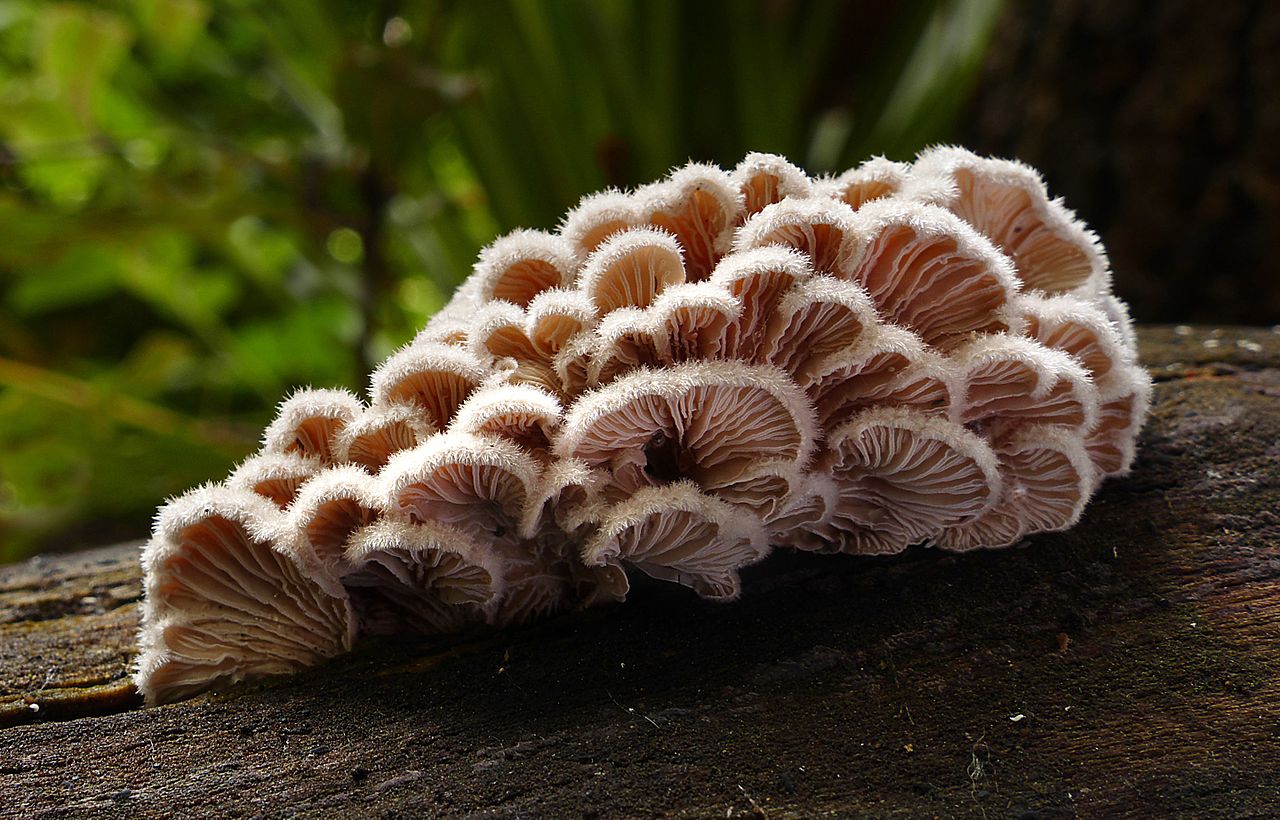
Schizophyllum commune is one of the most widespread fungi on the planet, found on decaying wood on every continent except Antarctica. Genetic studies have confirmed that despite its global distribution, it is a single species. The fungus appears as small, fan-shaped brackets, typically 1 to 4 centimeters across, with a hairy, whitish-grey surface. Its common name comes from its most distinctive feature: gill-like structures on its underside that are split down the middle.
These are not true gills but folds in the fertile surface. This split structure is an adaptation to fluctuating moisture levels. During dry periods, the fungus shrivels, and the splits close over the spore-producing surfaces to protect them. When rain returns, the fungus rehydrates, the splits open, and it resumes releasing its white spores. This cycle of dehydration and revival can happen many times, allowing the fruiting bodies to persist and reproduce for long periods. As a saprobic fungus, it helps forest ecosystems by causing white rot, breaking down the tough lignin in wood and leaving the softer, white cellulose. The complete genome of S. commune was sequenced in 2010.