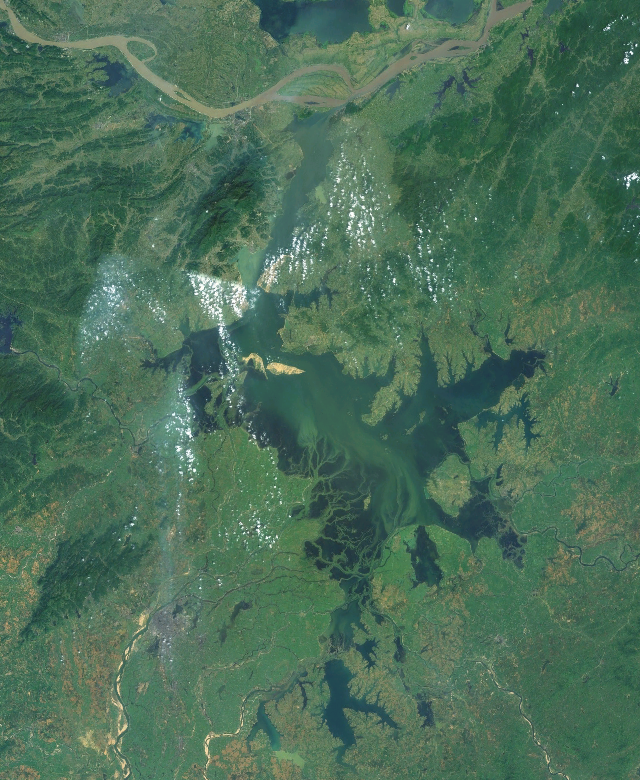
A Lake on an Annual Cycle
Poyang Lake, China's largest freshwater body, undergoes one of the most dramatic seasonal transformations of any lake on the planet. Located in Jiangxi province, its fate depends on the powerful Yangtze River, into which it drains. During the summer wet season, from roughly April to September, monsoon rains swell the Yangtze and the five rivers that feed the lake—the Gan, Fu, Xinjiang, Rao, and Xiu. This influx of water, combined with backflow from the flooding Yangtze, causes the lake to expand rapidly. At its peak, its surface area can exceed 3,500 square kilometers.
Come winter, the process reverses. As the monsoon rains subside, the Yangtze's water level drops, and the lake drains into the river. The transformation is startling. The vast expanse of water shrinks to a fraction of its summer size, sometimes to less than 200 square kilometers. This leaves behind extensive mudflats and seasonal marshes, effectively turning a massive lake into a winding river channel connected to scattered wetlands. This annual pulse, where "high water is a lake, low water is a river," is a cycle that has shaped the region for millennia.
An Altered Rhythm and an Ecological Hub
While this fluctuation is natural, its intensity and timing have shifted, creating the "paradox." Since the construction of the Three Gorges Dam on the Yangtze River in 2003, the lake's seasonal cycle has been altered. The dam holds back water in the autumn, which can intensify and advance the start of Poyang's dry season, leading to record-low water levels. In some recent years, the dry season has started 100 days earlier than the historical average. This amplified shrinking affects the unique ecosystem that depends on the lake's pulse.
The exposed winter mudflats provide an important feeding ground for hundreds of thousands of migratory birds on the East Asian-Australasian Flyway. This includes over 95% of the global population of the Siberian crane (Grus leucogeranus), which winters here. The lake is home to the critically endangered Yangtze finless porpoise (Neophocaena asiaeorientalis asiaeorientalis). The earlier, more extreme low water levels threaten these species by reducing their available habitat and food sources. The year-round fishing ban, implemented in 2021 for a 10-year period, is one measure aimed at protecting the lake's biodiversity amidst these hydrological changes.