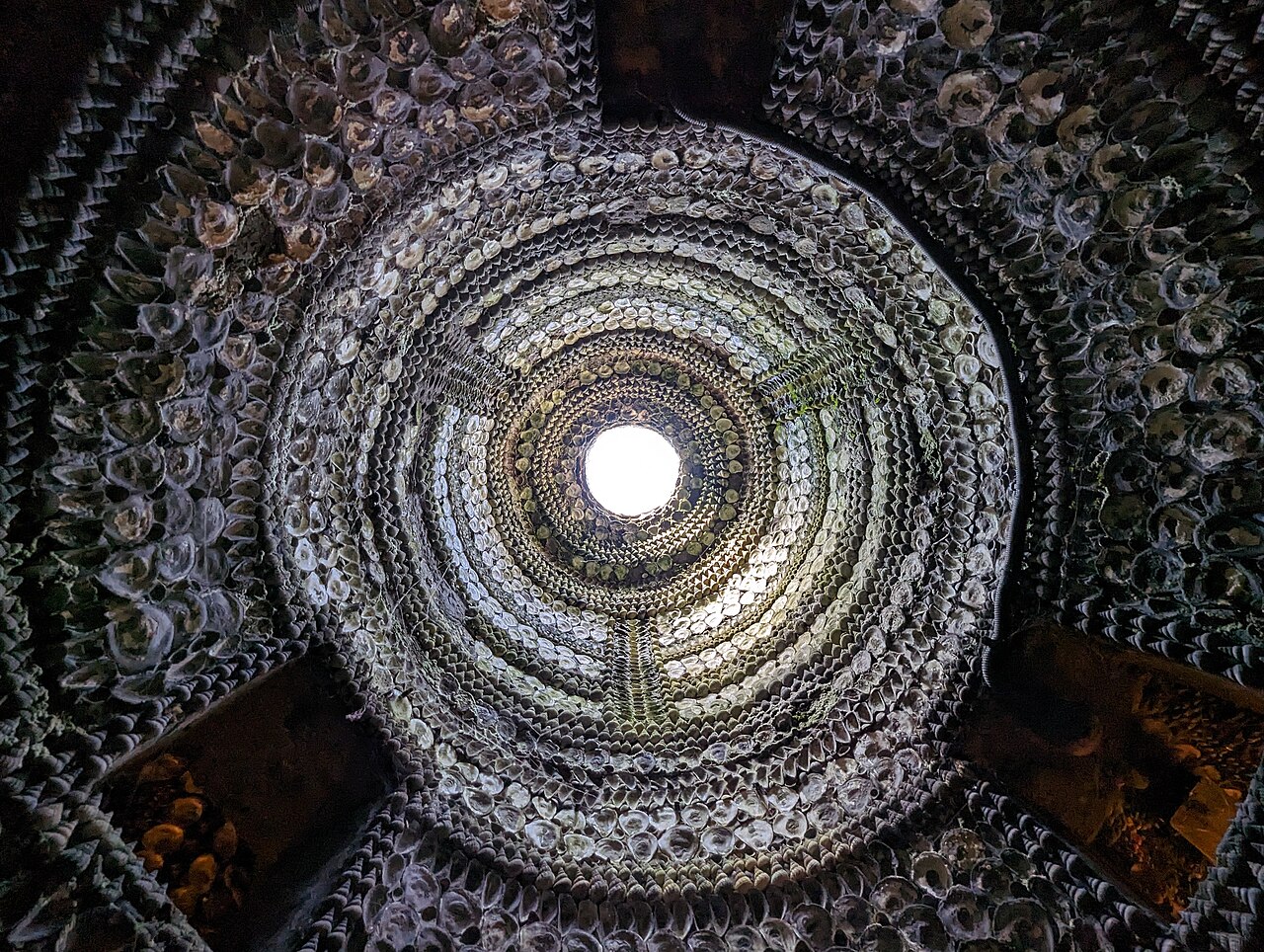
An archaeological anomaly in chalk
Beneath a residential street in the seaside town of Margate lies a complete archaeological mystery. In 1835, a local schoolmaster, James Newlove, reportedly lowered his son into a hole discovered while digging a duck pond. What he found was a subterranean passage and chamber completely covered in shell mosaics. The structure had no prior record on any maps or in historical documents. Newlove purchased the land and opened the grotto to the public in 1837.
The underground structure consists of a winding, chalk-hewn passageway about 70 feet (21 meters) long and 8 feet (2.4 meters) high. This serpentine path leads to a central circular area called the Rotunda, and finally into a rectangular room measuring approximately 15 by 20 feet, known as the Altar Chamber. Nearly every surface across these 2,000 square feet (190 square meters) is adorned with mosaics made from an estimated 4.6 million seashells. The designs are complex and feature geometric patterns as well as sun and star motifs. The purpose of its construction and the identity of its creators remain unknown.
The shells and the science
The mosaics are composed primarily of local British mollusc shells, including mussels, oysters, cockles, limpets, scallops, and whelks. The background infill, however, is made from the flat winkle, a species rare in the Kent area but abundant on shores west of Southampton. In the Altar Chamber, a few exotic Queen Conch shells, native to the Caribbean, have been identified.
Scientific attempts to date the Grade I listed structure have been inconclusive. Radiocarbon dating is considered unworkable due to contamination from the gas lamps used for lighting for nearly a century, which left a layer of soot on the shells. Analysis of the mortar used to affix the shells has also yielded ambiguous results; multiple samples revealed different compositions, including lime mortar and a "Roman cement type" substance, likely indicating various undocumented repairs over time. Theories about the grotto's origin range from a secret temple for the Knights Templar to an ornate 18th-century folly. One researcher has suggested that sunlight projected through the grotto's dome aligns with certain points in the Altar Chamber, potentially forming a solar calendar. Without definitive proof, the grotto is an unsolved archaeological puzzle.