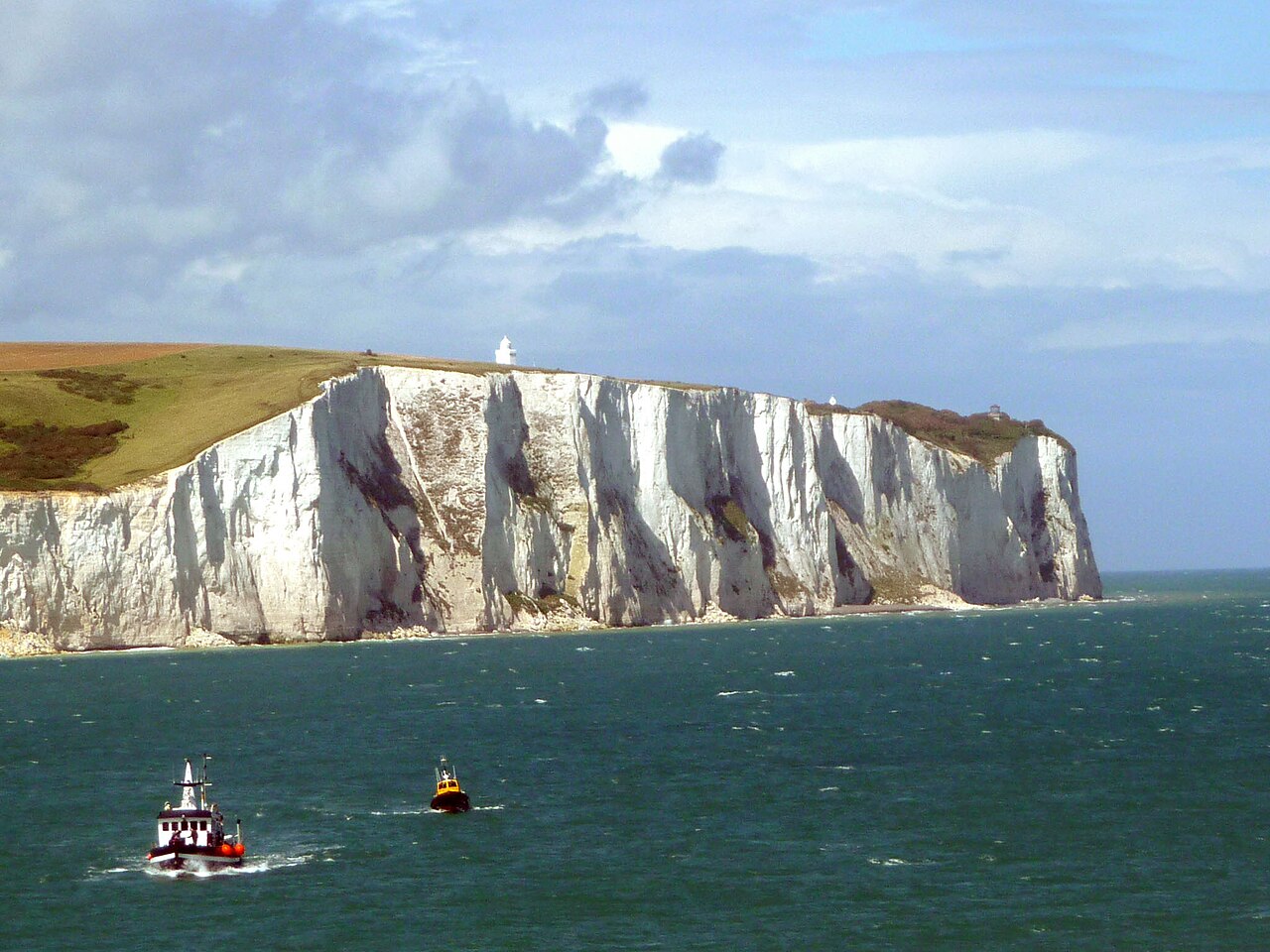
The white cliffs are made of trillions of microscopic algae shells. Electron microscopy reveals coccolithophores that lived 100 million years ago when dinosaurs walked nearby shores.
Immanuel Giel, CC BY-SA 3.0, via Wikimedia Commons
The Microscopic Architects
The White Cliffs of Dover are not solid stone in the typical sense; they are a massive biological deposit. Their entire 110-meter (350-foot) height is composed almost entirely of chalk, a soft, white form of limestone. This chalk is made from the skeletal remains of single-celled planktonic algae called coccolithophores. These organisms, which still exist today, surround themselves with circular plates of calcium carbonate known as coccoliths.
During the Late Cretaceous period, between 100 and 66 million years ago, much of Europe was submerged under a warm, shallow sea. The global climate was much warmer, and there were no polar ice caps. In these conditions, coccolithophores thrived in the sunlit surface waters. As they died, their microscopic calcite plates—trillions of them—sank to the bottom, forming a thick, white ooze. This sediment accumulated at an incredibly slow rate, estimated at perhaps half a millimeter per year. Over tens of millions of years, the immense weight of overlying deposits compacted this ooze into the dense chalk beds seen today.
A Cretaceous Seabed Preserved
The pure white color of the cliffs is due to the high concentration of calcium carbonate from the coccoliths, with some chalk beds being 90-98% pure calcite. The distinct horizontal black or dark grey lines that streak across the cliff face are bands of flint. Flint is a microcrystalline form of quartz. Its silica originated from the skeletons of other marine organisms, such as sponges and diatoms, that also lived in the Cretaceous sea. This silica dissolved in the sediment's porewater and later precipitated within cavities, particularly the burrows of crustaceans and other animals on the seafloor, forming the distinct nodules and layers we see.
The chalk contains microscopic algae and other remains. It preserves a record of a wider marine ecosystem. Fossils of larger animals are regularly discovered as the cliffs erode. These include sea urchins (echinoids like Micraster), brachiopods, bivalves, and ammonites. Even the teeth of sharks that swam in this ancient sea are found embedded in the rock. The entire formation records life and conditions in the shallow sea that once covered southern England.
💡Fun Facts
The name of the "Cretaceous Period" is derived from *creta*, the Latin word for chalk.
The full chalk layer in southern England, known as the Chalk Group, can reach a thickness of over 400 meters in some regions.
The cliffs are visible from Cap Gris-Nez in France, approximately 32 km (20 miles) away, evidence of a time when a land bridge connected Britain to mainland Europe.
Coccolithophore blooms today can be so extensive that they are visible from space, turning vast patches of the ocean a milky, turquoise color.
The cliff-top walking paths are open year-round. The National Trust visitor centre is typically open daily, but check the website for seasonal hours. The car park is open 7am to 7pm.
Admission
Free to walk the cliff paths. Parking fees apply for non-National Trust members.
Accessibility
A wheelchair-friendly, all-weather path leads from the visitor centre to a main viewpoint. Many other paths are unpaved, grassy, and can be uneven or steep.