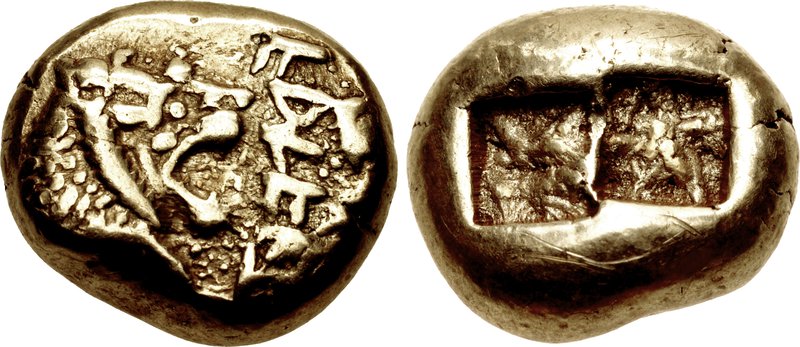
The world's first standardized coinage (700 BCE) was made from electrum, a natural gold-silver alloy. Metallurgical analysis shows controlled ratios proving quality assurance, and punch marks indicate state certification - inventing trusted currency.
Unknown / Photography by CNG coins, CC BY-SA 3.0
A new kind of money
In the 7th century BCE, the Kingdom of Lydia, with its capital at Sardis, introduced a transformative technology: standardized coins. Before this, commerce relied on barter or weighing pieces of precious metal for each transaction. The Lydians began producing small, bean-shaped lumps of a gold and silver alloy called electrum, stamped with a mark of authority. The innovation created a medium of exchange with a state-guaranteed value, streamlining trade and finance.
The electrum occurred naturally in the region, particularly in the Pactolus River, and was a source of the kingdom's wealth. The earliest coins had simple punches on one side, but these evolved to feature designs, most common was the head of a roaring lion, a symbol of Lydian royalty. Some of these coins even bear inscriptions in the Lydian alphabet, such as "WALWET," which may refer to King Alyattes (c. 610–560 BCE). These coins came in standardized weights based on the Lydo-Milesian standard. The largest denomination was the stater, weighing about 14.1 grams, but the most common was the trite, or one-third stater, weighing around 4.7 grams. Fractions existed down to a tiny 1/96th of a stater, which weighed only 0.15 grams.
Metallurgical quality control
Scientific analysis of the Lydian coins reveals a sophisticated understanding of metallurgy. While the local electrum from the Pactolus River contained 70 to 90 percent gold, analysis of the coins shows a different composition. The minted coins consistently contain about 54% gold, 44% silver, and a small amount of copper, likely to increase hardness. The analysis shows the Lydian state was not simply mining and stamping natural electrum. Instead, they were deliberately adding refined silver to the alloy.
This process created a standardized metal content for every coin of a given type. It was a form of quality assurance, ensuring that each coin had a predictable intrinsic value. By controlling the metallic ratio, the Lydian authorities established trust in their currency. A merchant accepting a Lydian trite knew it contained a specific amount of gold and silver, guaranteed by the king's stamp. This debasement of the natural alloy also generated a profit for the state. Excavations at Sardis have uncovered an industrial-scale refinery for separating gold and silver, confirming the Lydians' advanced metallurgical capabilities.
This system of electrum coinage lasted for about 80 years. It was eventually replaced around 550 BCE by the last Lydian king, Croesus, who is credited with introducing the world's first bimetallic currency of pure gold and pure silver coins. This reform further removed the uncertainty of the gold-to-silver ratio inherent in electrum and set the standard for coinage for centuries to come.
💡Fun Facts
Ancient Greeks sometimes referred to electrum as "white gold."
The Lydian king Croesus, who ended the electrum era by introducing pure gold and silver coins, is the origin of the phrase "as rich as Croesus."
A Lydian trite, the most common denomination, was likely worth about one month's subsistence pay for a soldier.
The reverse side of the earliest coins features one or two deep square punch marks, created by the hammer used to strike the coin blank into the engraved anvil die.
The Sardis archaeological site is generally open daily. Summer hours (April 1 - October 1) are typically 8:30 AM to 7:00 PM. Winter hours (October 1 - April 1) are 8:30 AM to 5:30 PM. It is advisable to check the official Turkish Museums website for the most current information.
Admission
There is an admission fee to enter the site. The price is subject to change, so checking the official website is recommended.
Accessibility
The site covers a large area with unpaved paths and uneven terrain typical of an archaeological excavation. It may present challenges for visitors with mobility issues. The main visitor areas, including the gymnasium complex and synagogue, are more accessible.